Tingsha Bells / Cymbals for Sound Healing and Meditatio
Article written August 24, 2023 By hmmart
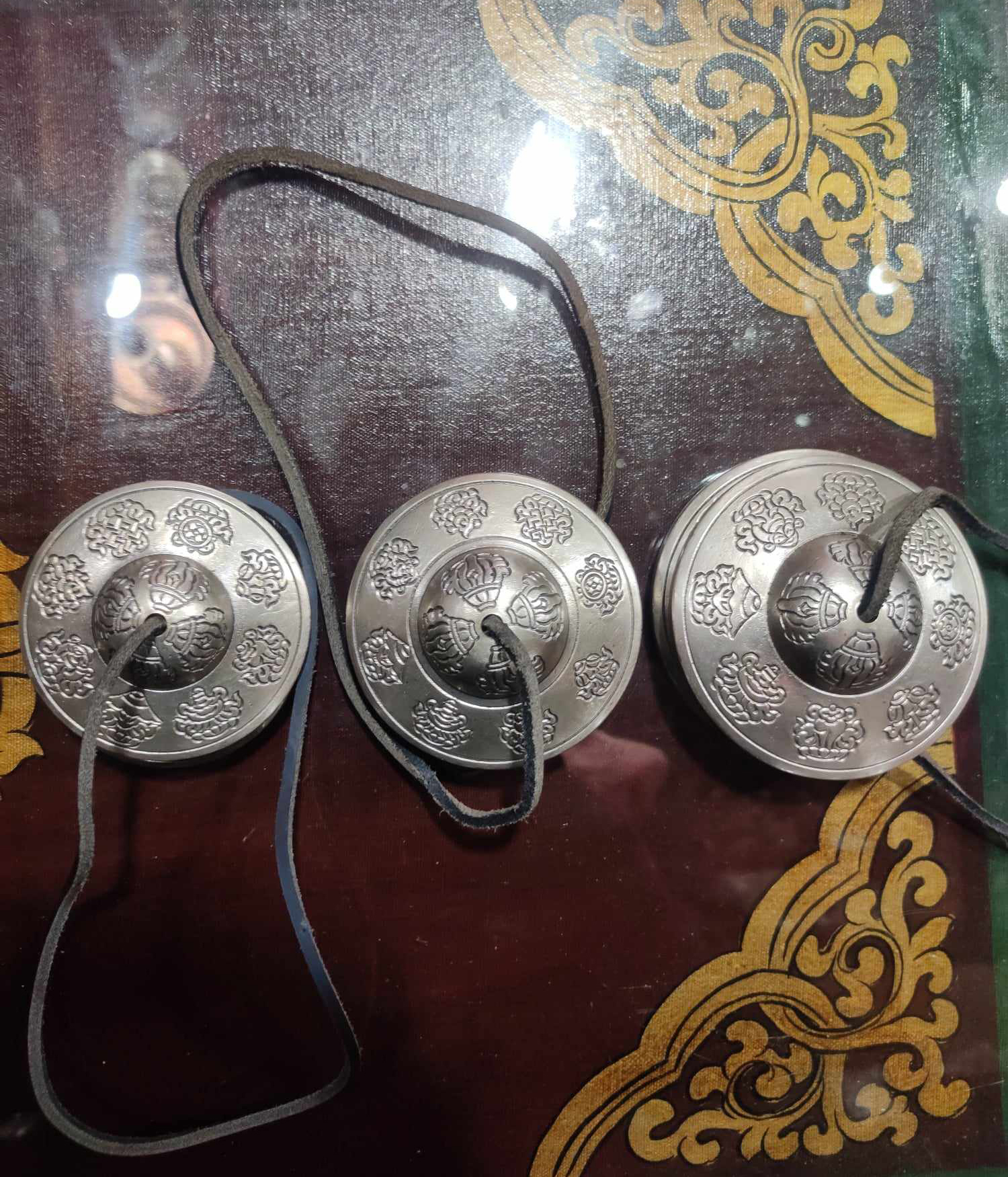
Tingsha Tibetan Hand Cymbals: Tingsha bells, also known as Tingsha cymbals or Tibetan hand cymbals, are small metal instruments used for various purposes, including sound healing, meditation, and spiritual practices. These sacred objects originate from Tibetan and Himalayan traditions and are valued not only for their melodious sound but also for their ability to create an environment conducive to relaxation, meditation, and healing.
Physical Characteristics: Tingsha bells consist of two metal cymbals that are connected by a leather or fabric strap. The cymbals are often made of a high-quality blend of metals, including bronze, copper, and other alloys. They are typically engraved or adorned with intricate designs, symbols, and mantras, adding to their aesthetic and spiritual significance.
Sound Healing and Meditation: The melodious sound produced by Tingsha bells is believed to have therapeutic and spiritual qualities. When struck together, the cymbals create a clear, resonant tone that resonates and lingers in the environment. This sound has the power to cleanse, purify, and harmonize the energy of a space, making it an ideal tool for sound healing sessions and meditation practices.
Sound Vibration and Energy Cleansing: In sound healing, the vibrations emitted by Tingsha bells are thought to influence the energy centers (chakras) and subtle bodies of individuals. The resonant vibrations help release tension, balance energy flows, and clear stagnant or negative energies. Practitioners often move the ringing Tingsha bells around a person’s body or throughout a space to cleanse and align the energy field.
Meditative Practice and Mindfulness: The sound of Tingsha bells serves as a focal point for meditation and mindfulness. When struck gently, the sustained sound invites practitioners to focus their attention and awareness on the present moment. This can facilitate a deeper state of relaxation and inner stillness, aiding meditation practitioners in achieving a tranquil state of mind.
Ceremonial and Ritual Use: Tingsha bells are also used in various ceremonial and ritual contexts. Their clear sound is believed to help connect with divine energies and invoke the presence of enlightened beings. They are commonly used to mark the beginning and end of meditation sessions, prayers, and other spiritual practices.
How to Use Tingsha Tibetan Hand Cymbals:
- Hold the Tingsha bells by their leather/fabric strap or gently grasp the cymbals themselves.
- Strike the cymbals together at their edges, allowing them to make contact and produce a resonant sound.
- Let the sound of the bells resonate in the space, allowing the vibrations to permeate and cleanse the environment.
- You can also gently move the ringing bells around a person’s body or throughout a room during a sound healing session.
- When using Tingsha bells in meditation, focus your attention on the sound, allowing it to lead you into a state of mindfulness.
In summary, Tingsha bells are revered instruments with deep spiritual and healing significance in Tibetan and Himalayan traditions. Through their resonant sound, they facilitate sound healing, meditation, and energy cleansing practices, helping individuals connect with their inner selves and create a sacred atmosphere of harmony and peace.

Niguma Thangka Scroll Painting
Article written August 23, 2023 By hmmart
Niguma – The Lady of Illusion
Niguma was a great yogini and female Tantric master who lived during the 11th century. She was a Dakini who defied social conventions by being one of the few influential female lineage holders of ancient India to have proliferated an important Tantric lineage. Niguma was closely related to Guru Naropa; it is believed that Niguma received teachings on the Six Yogas from Naropa. The corpus of her teachings have become the foundation of the Shangpa Kagyu Buddhist tradition. The Shangpa Kagyu is hailed as one of the “Eight Great Chariots of the Practice Lineages” which means that it is one of the most important Buddhist traditions brought from India to Tibet. The legacy of the great yogini Niguma as a meditator, teacher, mystic, and founder of a lineage endures to this day.
Gesture and Attributes
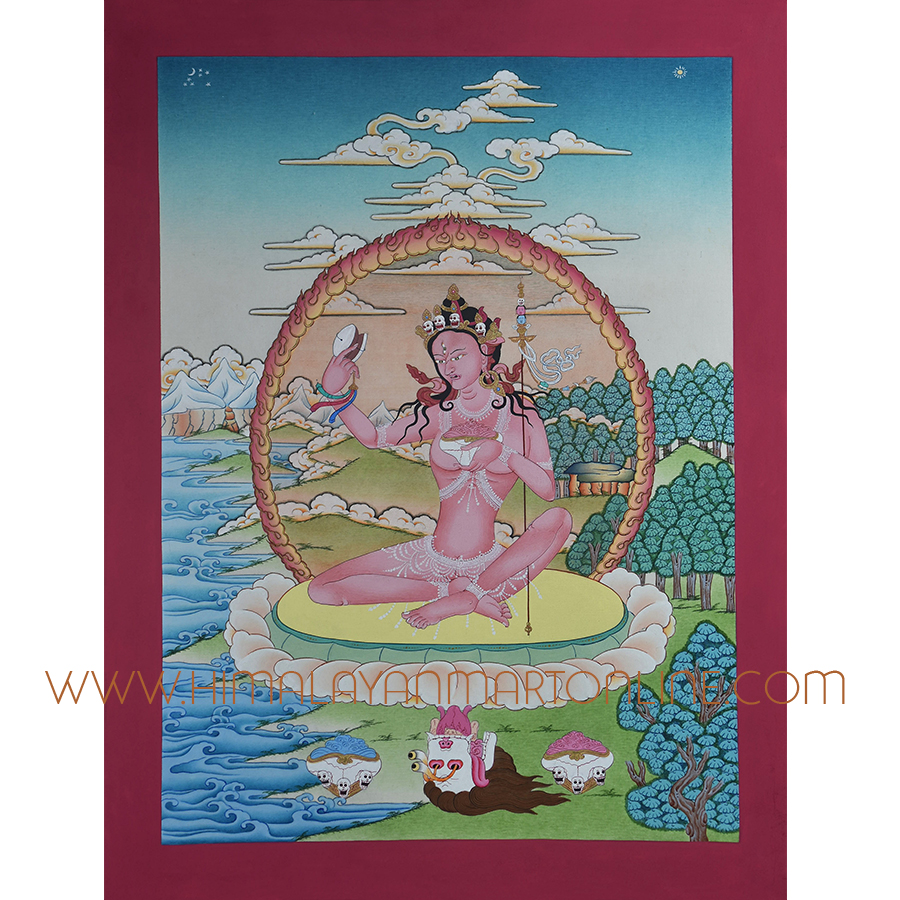
Niguma is depicted as a black Dakini in semi wrathful form with three eyes including the one in the center of her forehead. She wears crown made from skulls, necklaces, armlets and anklets. Her right hand holds a Damaru and her left hand holds a Kapala filled with blood. She also holds a Khatvanga similar to that of Vajrayogini.
About this Niguma Thangka Scroll Painting
This is a Tibetan Style Thangka Scroll Painting which is entirely hand painted by the experienced artisan using same ancient techniques. This Niguma Thangka Scroll Painting is hand painted on cotton canvas with 24 karat gold detailing; by the artisans of Patan in Nepal who have been in the business from generations.
Robes (Dress) for Statues of Buddha & other Deities
Article written August 20, 2023 By hmmart
Robes Dress Buddha Statues – Ku Nhamja – Robes (Dress) for Statues
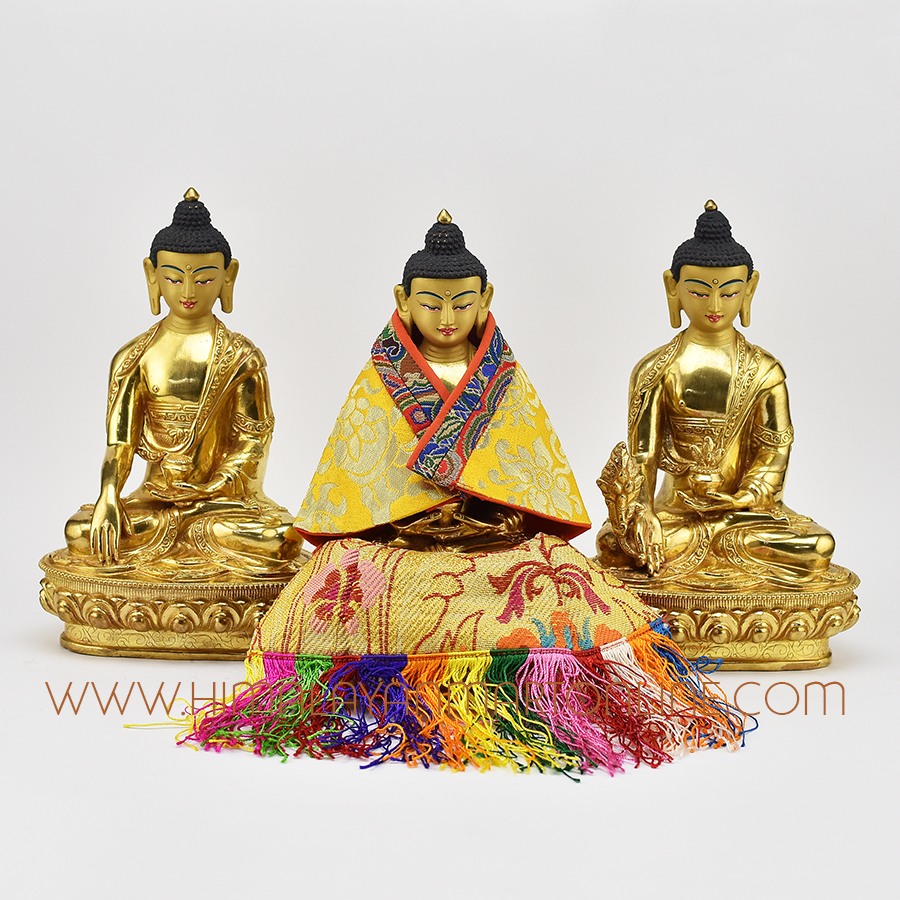
In Tibetan Buddhism, dressing statues of the Buddha and other revered deities is an essential part of religious practice, and it holds special significance within this particular Buddhist tradition. The practice of dressing statues in Tibetan Buddhism is known as “enrobing” or “empowering” the statues, and it is influenced by the rich cultural and religious heritage of Tibet.
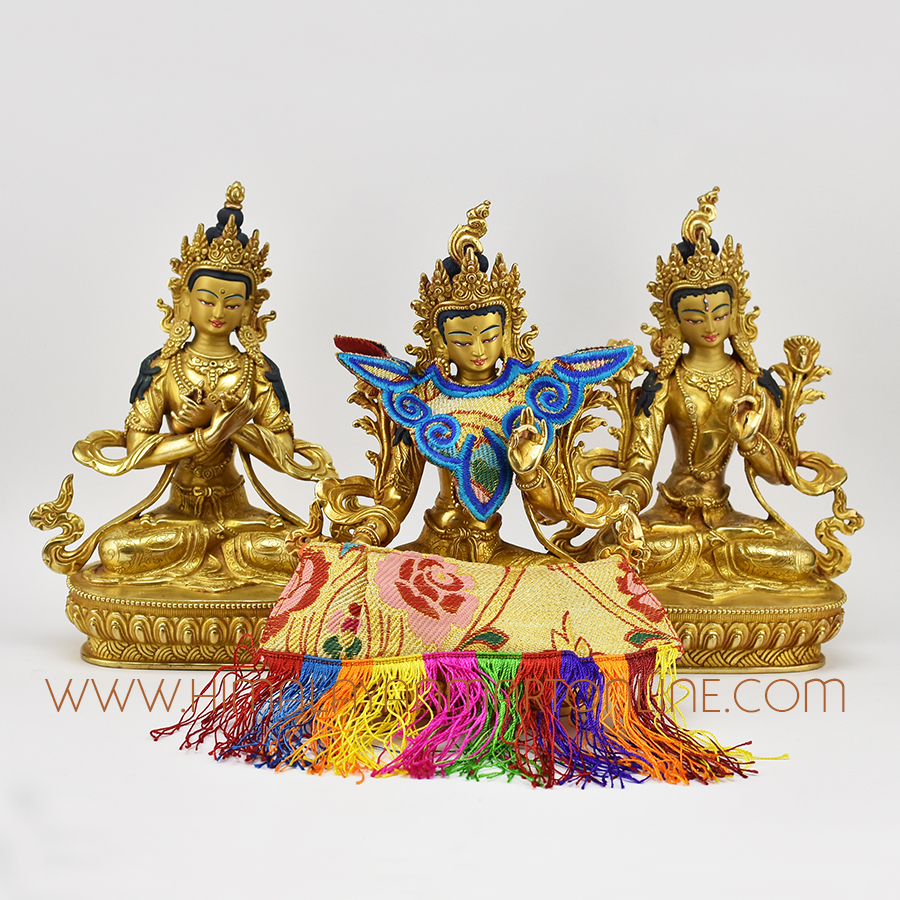
Dressing statues (Robes Dress Buddha Statues other deities) is important in Tibetan Buddhism because of following reasons:
- Symbolism and Empowerment: In Tibetan Buddhism, dressing the statues is seen as a way to imbue them with spiritual power and blessings. The process involves a consecration ritual performed by qualified lamas or monks, during which sacred mantras and prayers are recited. This is believed to infuse the statue with the presence and energy of the enlightened beings it represents, making it a living symbol of their qualities and teachings.
- Offerings and Devotion: Dressing the statues is considered a profound offering and an act of devotion. It is an opportunity for practitioners to express their reverence and gratitude to the Buddhas, Bodhisattvas, or other deities for their guidance and compassion.
- Aiding Visualization and Meditation: In Tibetan Buddhist practices, visualizations of deities play a significant role. The physical presence of a dressed statue can aid practitioners in their meditations and visualizations of the enlightened beings. It serves as a focal point for generating a deeper connection and understanding of the deity’s qualities.
- Cultural Heritage: Tibet has a rich cultural heritage, and the enrobing of statues is deeply rooted in its artistic traditions. The clothing and accessories used to dress the statues often reflect the distinctive Tibetan art styles and craftsmanship.
- Merit and Spiritual Benefits: As in other Buddhist traditions, dressing statues in Tibetan Buddhism is believed to generate merit and positive karma. The act of offering beautiful and symbolic garments is thought to create auspicious conditions for one’s spiritual growth and well-being.
- Ritual and Ceremonial Importance: Enrobing statues is part of various religious ceremonies and festivals in Tibetan Buddhism. These rituals play a vital role in fostering a sense of community among practitioners and reinforcing their shared faith and devotion.
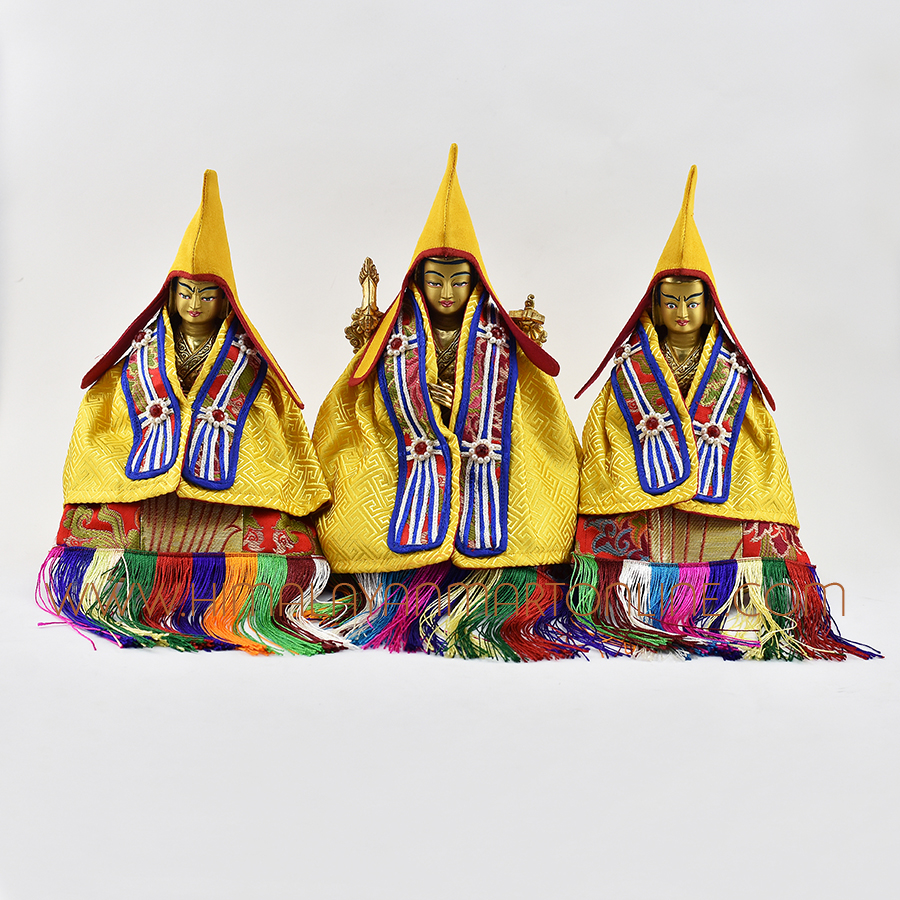
It’s important to emphasize that the significance and practices related to dressing statues can vary within different Tibetan Buddhist schools and lineages. Additionally, the cultural context and historical influences in Tibet have shaped the specific rituals and customs surrounding this practice in unique ways.
Blessing of Buddha Statue
Article written August 2, 2023 By hmmart
The “Blessing of Buddha Statue” refers to a common practice in Buddhism where devotees offer prayers and pay their respects to a Buddha statue or an image of the Buddha. The act of offering blessings to the statue is seen as a means of expressing gratitude, seeking protection, and accumulating positive karma. Blessing of Buddha Statues varies across different Buddhist traditions and cultures, but the essence of the blessing remains consistent – to imbue the statue with sacred qualities and to create a connection between the devotee and the enlightened beings the statue represents.
In Buddhism, the Buddha is not considered a deity to be worshiped, but rather a teacher who attained enlightenment and taught the path to liberation from suffering. Buddha statues serve as a reminder of the Buddha’s teachings and the ideal of enlightenment.
When a Buddhist offers blessings to a Buddha statue, it is an act of devotion and reverence. The practitioner may bow, make offerings such as flowers, candles, or incense, recite prayers or mantras, or simply sit quietly in meditation as a way to connect with the Buddha’s wisdom and compassion.
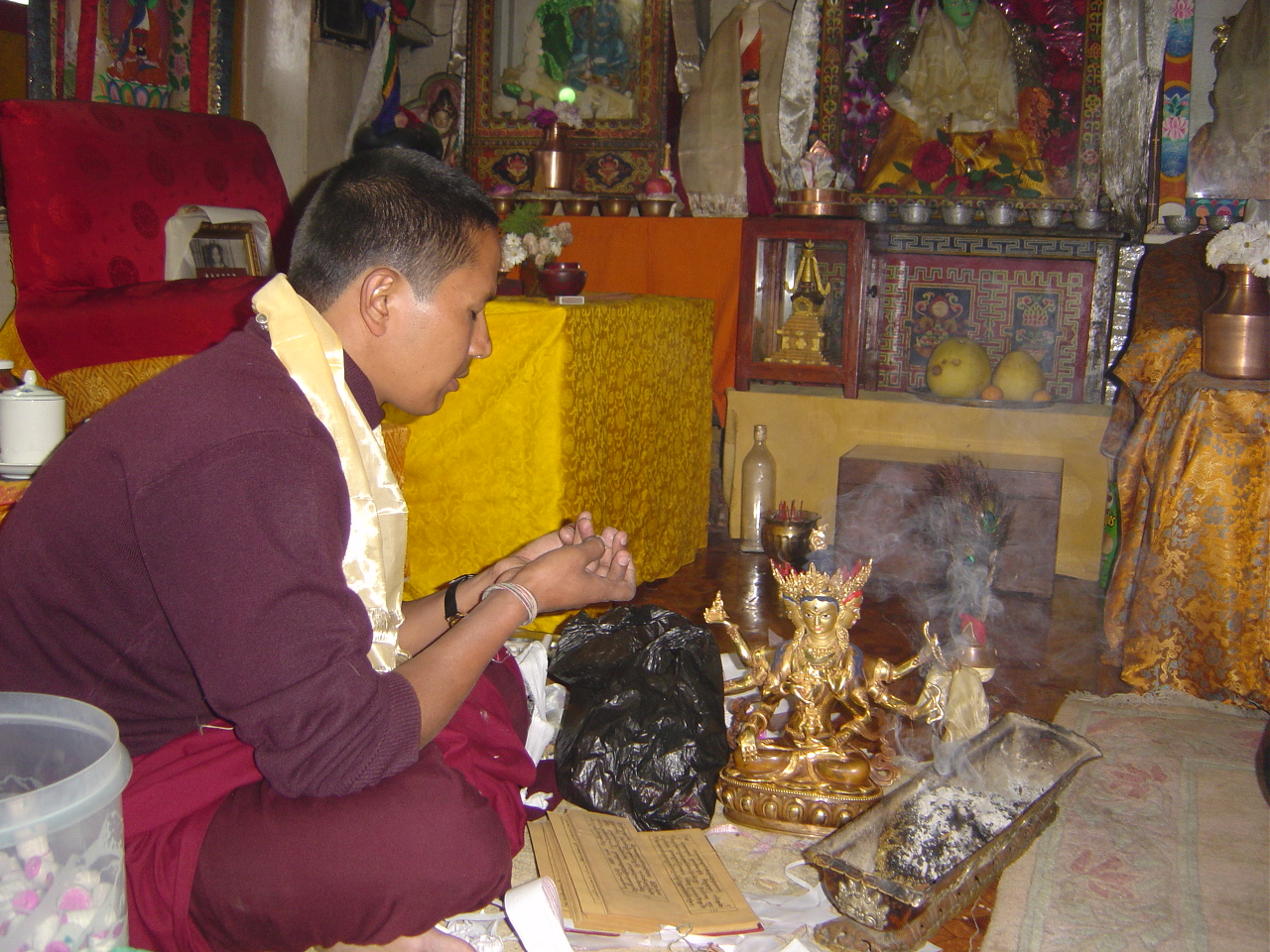
The act of offering blessings is not about seeking blessings from the Buddha himself but about cultivating positive qualities within oneself and fostering a sense of peace and harmony in the mind. It is also believed that such acts of devotion and mindfulness can help the practitioner progress on the path towards enlightenment.
Different Buddhist traditions and cultures may have variations in how they perform the “Blessing of Buddha Statues,” but the underlying intention remains the same – to honor the Buddha’s teachings and find inspiration in the qualities he embodies.
Thousand Armed Avalokiteshvara / Chenrezig – Bodhisattva of Boundless Compassion
Article written November 27, 2022 By hmmart
Thousand Armed Avalokiteshvara: Avalokiteshvara (Guan Yin in Chinese; Chenrezig in Tibetan; Kannon in Japanese) is the Bodhisattva of Compassion. Among the Bodhisattvas, it is Avalokeshvara who has the largest number of forms and is perhaps the most venerated and most popular Buddhist deity. His sex, originally masculine, is sometimes considered feminine in China and Japan, although this discrimination is unsupported by any canonical text and was often considered in China and Japan as the ‘mother of the human race’ and, in this respect, worshiped in the form of a woman.
Among the 108 forms of Lokiteshvara, Avalokeshvara is one who refuses to accept Nirvana since he considers such acceptance selfish in view of the ignorance of the great majority of the people who have not yet attained that stage. His sacrifice symbolizes infinite compassion (Karuna), sharing of mankind’s misery, willingness to help those in distress. Avalokeshvara holds in his hand the indestructible jewel. He is savior and protector from danger. So, his invocation (Mantra) “OM MANI PADME HUM” is found inscribed on rocks, loose stones, prayer wheels, etc.
Avalokiteshvara is known from very early in the development of the Mahayana doctrines and, until Buddhism disappeared from India, enjoyed great favor there. His cult passed from India to South-East Asia and Java, where it met with great success, and also in Nepal, Tibet (where he arrived with Buddhism and where King Srong – Tsong Gampo, 519-650, was considered to be his incarnation), and in China, from where he went on to Korea and Japan. All these countries imagined him in different forms according to their own temperaments and spirituality.
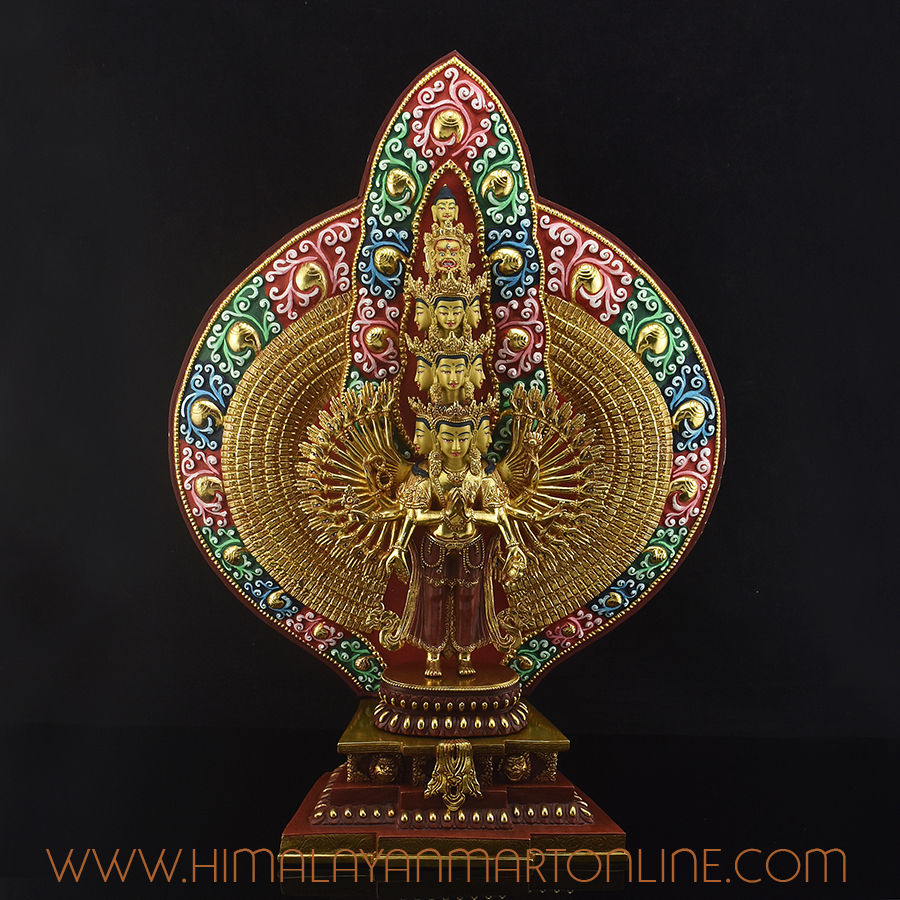
Gestures and Attributes of Thousand Armed Avalokiteshvara
It is said that Chenrezig once grew exhausted and discouraged from the overwhelming task of rescuing sentient beings. While struggling to comprehend the needs of so many, his head and body exploded into a thousand pieces. Buddha Amitabha came to Chenrezig’s aid and helped prepare the Bodhisattva for his monumental task. Amitabha endowed Chenrezig with eleven heads, with which to hear the cries of the suffering, and also with a thousand arms, with which to aid the suffering multitudes.
Chenrezig’s eleven faces are arranged in three tiers, topped by the wrathful face of Vajrapani, and, at the very top, the face of Buddha Amitabha. The skin of a deer is draped over Chenrezig’s left shoulder and heart, symbolizing his compassionate nature. His first two principal hands are pressed together at his heart in deference to his teacher, Amitabha; and his other principal hands hold a crystal rosary, a lotus blossom, an undrawn bow and arrow, an eight-spoked Dharma wheel, and a golden water pot. Each of Chenrezig’s one thousand hands has an eye in the center of its palm, symbolizing the union of the five method perfections (five fingers) with the sixth perfection of wisdom (eye).
Vajra and Bell
Article written January 16, 2022 By hmmart
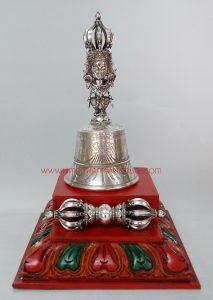
The Vajra and Bell are very important ritual implements in Tibetan Buddhism. The Vajra known as Dorje in Tibetan term and the Bell known as Drilbu in Tibetan term are mostly used as pair by every Buddhist monk almost in daily basis as ritual objects in tantric rituals and practice. Most of the Buddhist monks carry these two implements with them where ever they go because they need these items in their ritual performance. Though the Vajra (Tibetan: Dorje) symbolizes masculine inviolability and the Bell (Tibetan: Drilbu) symbolizes feminine wisdom are two different objects but mostly these are used as pair in the practice. These implements are attributes of many Buddhist deities and are held by deities like; Vajrapani, Chakrasamvara, Kalachakra, Vajradhara Buddha, Vajrasattva, Guru Padmasambhava, etc. as a part of their appearance which shows the importance of these two ritual items.
Vajra (Tibetan: Dorje)
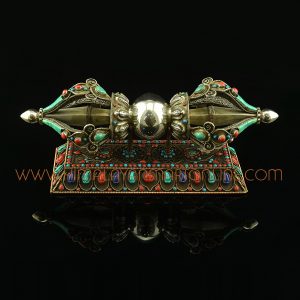
The Vajra (Dorje) is one of the main ritual implements in Buddhism. The Vajra is an important ritual sacred tool in Vajrayana Buddhism. This Vajra can also found in Hinduism and Tantric practice where it symbolizes the male principle in religious practice. The Vajra – Indestructible Thunderbolt is believed as the destroyer of all kinds of ignorance. In Hindu mythology; The Vajra is symbol of Indra the Vedic god of war and king of Devas accordingly to Hindu mythology.
There are four types of Vajras; a. The nine prongs (pointed) Vajra which is known is Commitment Vajra, in nine prongs (pointed) Vajra; there are eight prongs plus the central hub, b. The five prongs (pointed) Vajra which is known as the Full Knowledge Vajra, c. The three prongs (pointed) Vajra which is used for exorcising inimical forces, and d. The open prongs (pointed) Vajra which is called the Wrathful Vajra.
Out of these four types of Vajras; the Nine pointed and the Five pointed Vajras are found used most commonly.
In Buddhism
The Vajra (Dorje) is a ritual implement which has very important role in Tibetan Buddhism. The use of Vajra in Buddhism is in all aspect of their religious, mythology, symbolism and philosophy. Many deities in Buddhism like; Vajrasattva, Vajradhara, Vajrapani, Chakrasamvara, Kalachakra, Guru Padmasambhava etc., hold Vajra as their attributes. The Vajra along with its counterpart Bell (Drilbu) is used by Buddhist monks in almost all their ritual performance.
In Hinduism
The Vajra also has its specific role in Hinduism. According to Hindu mythology; Indra the Vedic god of war and king of Devas; holds it as his weapon. It is a powerful weapon which has the combined feathers of all sword, mace and spear in it. As per Hindu mythology; it is believed that the Vajra is made out of thigh bones of sage Dadhichi who gave up his life willingly for a noble cause so that his spine could be used to build weapon and Indra used this weapon to kill Vritrasura who had conquered heaven and terrorized the gods. Due to this supreme sacrifice, sage Dadhichi became a legend. In another incident; Vitra, the serpent of drought had swallowed the cosmic water. Indra using his Vajra weapon split Vitra’s stomach to release the water inside the Vitra’s stomach.
In Tantric Buddhism
The Vajra is used widely in the rituals of the Tantra where it symbolizes male principle where as its counterpart Bell (Drilbu) symbolizes female principle representing compassion. The use of their interaction leads to enlightenment. According to Buddhist mythology; the Vajra destroys all kinds of ignorance, and is indestructible against any evil force. Various deities like; Vajrasattva, Vajradhara, Chakrasamvara, Kalachakra, Vajrapani, Guru Padmasambhava, etc., in Buddhism are depicted holding the Vajra individually or with its counterpart Bell together. Vajrasattva, Vajradhara and some other deities hold the Vajra in their right hand along with the Bell on their left hand and Vajrapani, Guru Padmasambhava and some other deities hold the Vajra on their right hand without its counterpart the Bell.
Bell (Tibetan: Drilbu)
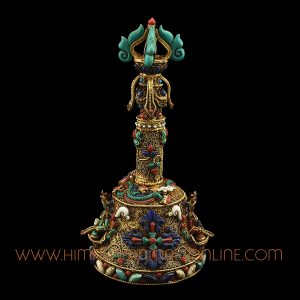
Like Vajra (Dorje) the Bell (Drilbu) is also an important religious implement in Tibetan Buddhism. Like its counterpart Vajra; it plays important role in religious practice. While the Vajra symbolizes the male principle; the Bell symbolizes the female principle. The Bell can be seen held by many deities in Buddhism like; Vajrasattva, Vajradhara, Chakrasamvara, Kalachakra, etc. The Vajra is held by deities in right hand whereas the Bell is held in left hand. In ritual practice; the Vajra symbolizes the male principle and is held on right hand and the Bell symbolizes the female principle and is held in left hand in the practice.
The symbolism of the Vajra Bell Ritual Implement
Vajras are made of different prongs (points) some with five, some with nine, some with three and some with open prongs. These prongs or (points) symbolize the five wisdoms that are attained through beyond ordinary limits of five kleshas which are greed, anger, delusion, pride and envy. The hub between these signifies emptiness.
Vajra; it is a Sanskrit word and in Tibetan it is called Dorje; which is related to the word for diamond. The Buddhism has very important role of Vajra; which has been shown as attributes of different deities and it us used in ritual ceremonies. According to Hindu mythology; it is used as thunderbolt weapon carried by the Vedic god Indra. The Vajra has been used as important implement in Buddhist and Hindu religion however it the Vajra as an artifact appears throughout the cultures around the world like; the Zeus carries it as thunderbolt weapon as per ancient Greek mythology. As per the Greek mythology; Zeus the Sky god received it from Cyclopes; one eyed giant creature.
In all the religion; the Vajra has been used as a weapon which destroys both internal and external enemies. Like a diamond it symbolizes the indestructible and all penetrating mind of enlightenment.
It is believed that the bell sound calls to mind to purify all kinds of sins. The sound of the Bell is considered by Tibetan Buddhists as beautiful music. The bell is used as musical instrument together with other sacred instruments like Damaru, Tingsha, etc., in ritual ceremony as musical offerings to the Buddhas and other gods. This music is presented as one of eight offerings to the deity that is invoked during the ritual.
How are they used
The Vajra and Bell are often seen held in the hands of deities, and in ritual practice they are held in the hands of the monks during rituals performance, the Vajra in the right hand, the Bell in the left hand. They are moved as pair in prescribed manners in ritual performance. When the arms are crossed holding Vajra and Bell; it symbolizes that the two are united-representing enlightenment. The Vajra is used as weapon which destroys all the negativity and sins and purify minds. The Vajra is used in other religion as well such as; it is used as weapon by the Vedic god Indra as per Hindu mythology and by Zeus as per Greek mythology. The sound of the Bell is believed to purify the minds and is considered by Tibetan Buddhists as the most beautiful music. This music is presented as one of eight offerings to the deity that is invoked during the ritual.
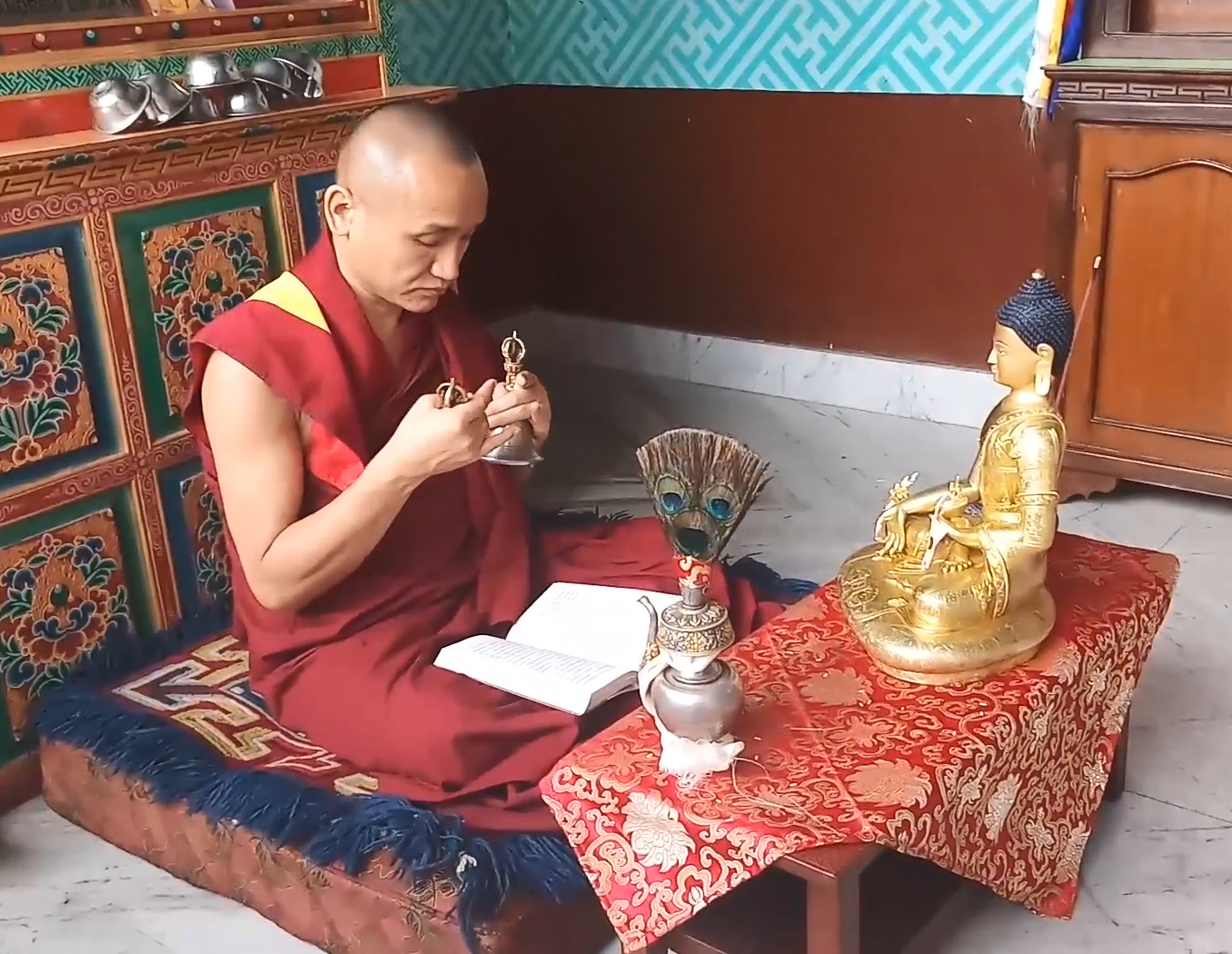
Vajra and Bell are important ritual objects not only in Buddhism but in other religion as well such as Hindu, Greek, etc. In Buddhist religion; many deities carry Vajra and Bell as their prime attributes. The Vajra is found used in Hindu and other religion such as Greek religion from ancient time. The Vajra is considered as male principle in Buddhist religion which states masculine and bold and believed to destroy all the negativity whereas the Bell is considered as the female principle which has soft and southing sound and believed to purify the negativity in minds. The Vajra and Bell are important ritual objects which are widely used in ritual ceremony in Buddhist religion by the monks. There are many ritual objects like; Damaru, Offering Bowls, Bhumpa – The Ritual Vase, Kapala, etc. which all have significant role in Buddhist tradition.
Neshi / Dhupur – Rice Pot
Article written June 19, 2021 By hmmart
Neshi / Dhupur – Ritual Pot
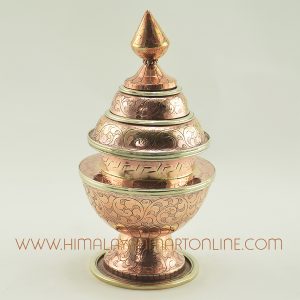
Neshi Dhupur: Neshi is also a Buddhist Ritual Object and is used to store offerings specially rice to the deities in a ritual ceremony. The Neshi is an important ritual object in the Buddhist community and Buddhist religion. The Neshi is store pot like object which is used to keep offerings in a ritual ceremony. Neshi may be found in copper, silver, brass or mixture of different metals.
Nheshi / Dhupur – Rice Pot
Article written June 19, 2021 By hmmart
Nheshi / Dhupur – Ritual Pot
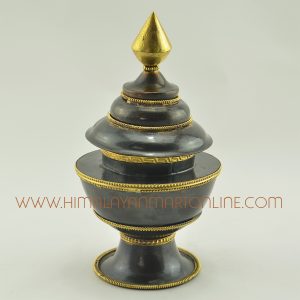
Nheshi Dhupur: Nheshi is also a Buddhist Ritual Object and is used to store offerings specially rice to the deities in a ritual ceremony. The Nheshi is an important ritual object in the Buddhist community and Buddhist religion. The Nheshi is store pot like object which is used to keep offerings in a ritual ceremony. Nheshi may be found in copper, silver, brass or mixture of different metals.
Nesi / Dhupur – Rice Pot
Article written June 19, 2021 By hmmart
Nesi / Dhupur – Ritual Pot
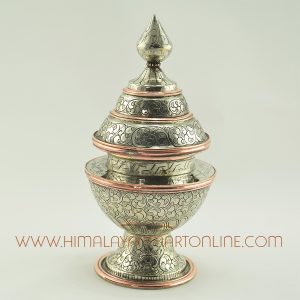
Nesi Dhupur: Nesi is also a Buddhist Ritual Object and is used to store offerings specially rice to the deities in a ritual ceremony. The Nesi is an important ritual object in the Buddhist community and Buddhist religion. The Nesi is store pot like object which is used to keep offerings in a ritual ceremony. Nesi may be found in copper, silver, brass or mixture of different metals.
Jambala Water Offering
Article written March 7, 2021 By hmmart
Jambala Water Offering(Chutor) Set
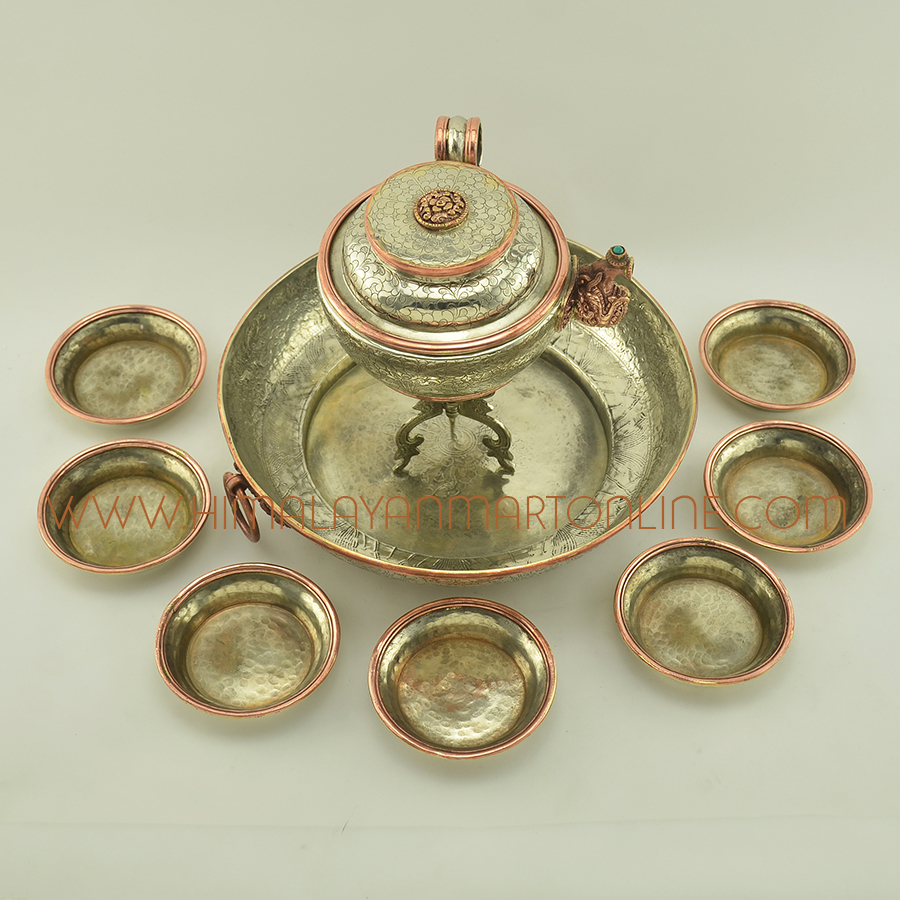
Jambala Water Offering Set: Jambala Water Offering (Chutor) Set which is also known as Water Torma Set is a whole set of pots which includes a water pot or kettle, a large plate type bowl where the offered water is stored after over filling from the Kettle, a tripod to place Kettle and 7 pieces of saucers or small plates. The Jambala Water Offering (Chutor) Set is used to perform water offering to the God of Wealth Dzambhala (Dzambhala).