
Dzambala Water Offering
Article written March 7, 2021 By hmmart
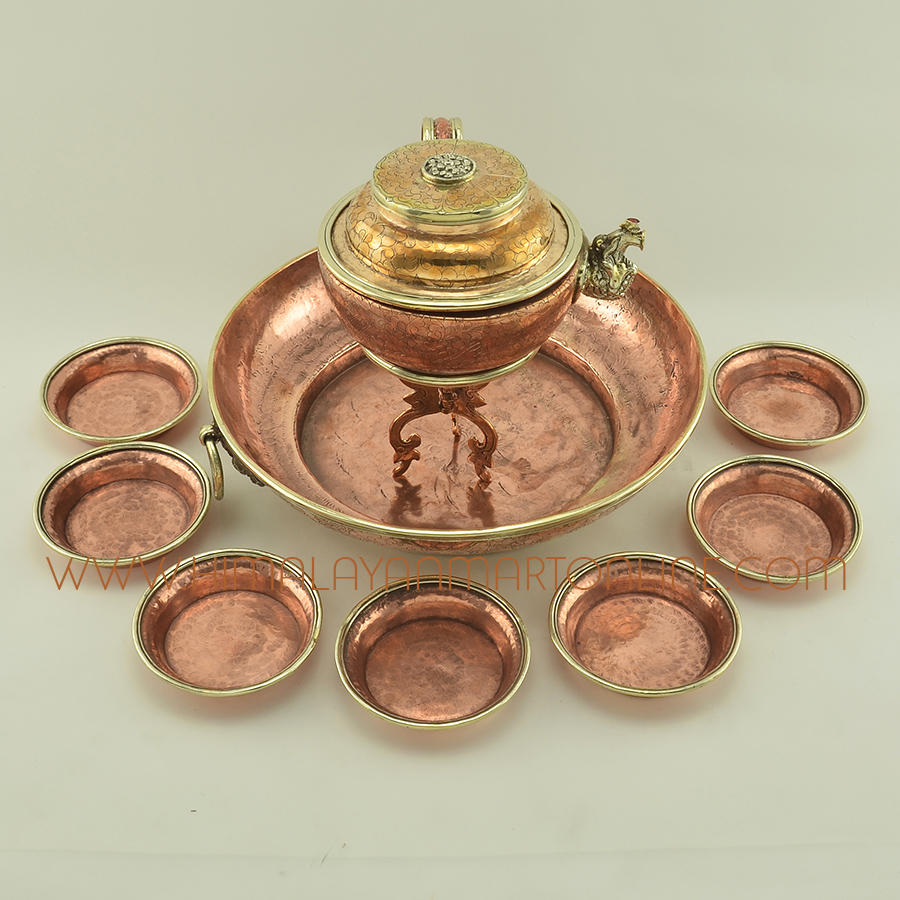
Dzambala Water Offering(Chutor) Set
Dzambala Water Offering Set: Dzambhala Water Offering (Chutor) Set which is also known as Water Torma Set is a whole set of pots which includes a water pot or kettle, a large plate type bowl where the offered water is stored after over filling from the Kettle, a tripod to place Kettle and 7 pieces of saucers or small plates. The Dzambhala Water Offering (Chutor) Set is used to perform water offering to the God of Wealth Dzambhala (Jambhala).

Red Tara – The Wish Fulfilling Tara
Article written August 31, 2020 By hmmart
Red Tara – The Wish Fulfilling Tara
Red Tara is the manifestation of Tara expression of awareness of all phenomena. In Vajrayana Buddhism the practice of Red Tara is based on the ritual called the Mandala of wish-fulfilling essence that focuses on turning material desires into compassion and love. The ritual includes yoga, healing practices and teachings on the nature of mind. The Red Tara empowerment ritual was originated by Amitabha Buddha and passed to Avalokiteshvara, then to an emanation of Tara and the famous Indian master Nagarjuna that transmitted this teaching to Padmasambhava.
Guru Rinpoche left this knowledge to his consort Yeshe Tsogyal, and asked her to hide it as a treasure to be discovered at a later time, which it would produce the most benefit. The teaching was discovered by lama Apong Terton, who lived in last century. Before his death the lama transmitted the ritual to a monk that promised to reveal it to the reincarnation of Apong Terton, Sakya Trizin.
Gestures and Attributes
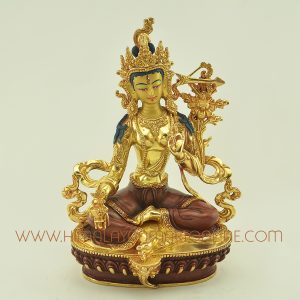
Red Tara is depicted in her peaceful manifestation. She is seated with the right leg slightly extended like the most common representation of Green Tara. The right hand is extended outward across the knee facing upward and holding a long-life vase (Kalasha) and the left hand is positioned in front of the heart holding the stem of a utpala flower with bow and arrow of skillful meaning wisdom on top of it.
Yam Dharmaraj Buddhist Protector – Outer
Article written August 2, 2020 By hmmart
Yam Dharmaraj – Buddhist Protector – Outer
Yam Dharmaraj Buddhist Protector the Lord of Death, King of the Law; is the protector of the Vajrabhairava (Yamantaka) cycle of tantras.
Gestures and Attributes
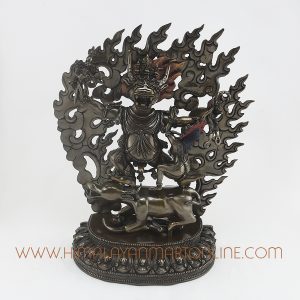
Yam Dharmaraj Buddhist Protector is depicted with one face and two hands in dark blue color and the head is that of a buffalo, three eyes, sharp horns entwined with flame, fierce and angry. Held upraised in the right hand is a bone stick composted of a fused spine and skull. In the left hand is a coiled lasso. Adorned with a crown of skulls and bone ornaments, he wears a necklace of fifty freshly served heads. Appearing extremely animate he stands with his right leg bent and the left extended on the back of a buffalo which is above a human body, sun disc and lotus seat. To the right is the consort Chamundi, blue with one face and two hands. A trident is held aloft in the right hand and a (Kapala) skull cup in the left hand. Both are adorned with wrathful attire, bone ornaments and various skins, completely surround by the swirling orange flames of pristine awareness.
Yama Dharmaraja Buddhist Protector – Outer
Article written August 2, 2020 By hmmart
Yama Dharmaraja – Buddhist Protector – Outer
Yama Dharmaraja Buddhist Protector the Lord of Death, King of the Law; is the protector of the Vajrabhairava (Yamantaka) cycle of tantras.
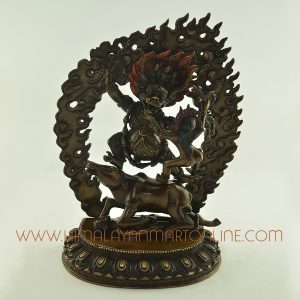
Gestures and Attributes
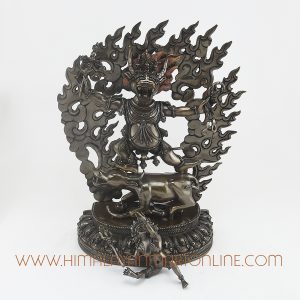
Yama Dharmaraja Buddhist Protector is depicted with one face and two hands in dark blue color and the head is that of a buffalo, three eyes, sharp horns entwined with flame, fierce and angry. Held upraised in the right hand is a bone stick composted of a fused spine and skull. In the left hand is a coiled lasso. Adorned with a crown of skulls and bone ornaments, he wears a necklace of fifty freshly served heads. Appearing extremely animate he stands with his right leg bent and the left extended on the back of a buffalo which is above a human body, sun disc and lotus seat. To the right is the consort Chamundi, blue with one face and two hands. A trident is held aloft in the right hand and a (Kapala) skull cup in the left hand. Both are adorned with wrathful attire, bone ornaments and various skins, completely surround by the swirling orange flames of pristine awareness.
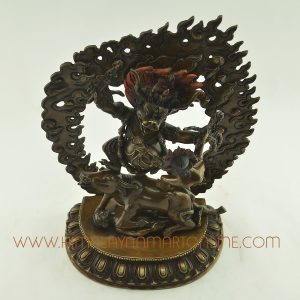
Yama Dharmaraja Buddhist Protector – Inner
Article written August 2, 2020 By hmmart
Yama Dharmaraja – Buddhist Protector
Yama Dharmaraja is the Inner Lord of Death, King of the Law. Dharmaraja is the special protector for the Vajrabhairava cycle of the Tantric practices and is especially associated with the Rwa Lotsawa Tradition.
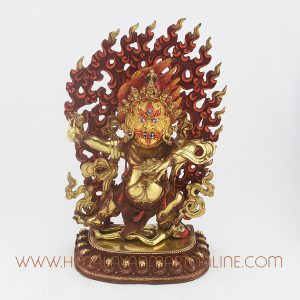
Gestures and Attributes
Yama Dharmaraja is depicted in blue color with one face and two hands; his right hand holds a Kartika (curved knife) and the left hand holds Kapala (blood filled skull cup) to heart. Fearsome and wrath, having the appearance of Raksha demon, his dark yellow hair flows upward flame like, rising above a black half Vajra and the golden crown marked with five dry skulls. Wearing a green scarf and jewels, gold and bone ornaments, he is adorned with a necklace of severed heads and wears a tiger skin around the waist tied with a green sash. Standing with the left leg bent and the right leg extended above a brown corpse, sun disc and lotus blossom above a black triangle mandala filled with blood he dwells completely surrounded within the red flames of pristine awareness.
Sarangi – Traditional Nepali Folk Instrument
Article written July 31, 2020 By hmmart
Sarangi is a Nepali folk musical instrument. It is a chordophone played by bowing. Traditionally in Nepal, the Sarangi was only played by people of Gandarbha or Gaine in local terms (both contested and interchangeable terms), who sing narrative tales and folk song, however; in present days, its popularity extends beyond the Gandarbha community and is widely used and played by other cast members as well. It has also garnered much interest in other music genres, such as Nepali rock and film music. While the Sarangi has become the quintessential Gandarbha instrument, while its counterpart, the arbajo, which is a plucked lute, has fallen into obscurity.
Construction
Traditional Nepali Sarangi is not standardized with regards to shape, construction materials, or scale or key. It is made up of a single piece of wood. Having a neck and hollowed-out double-chambered body, they are often made from woods of trees that are easily available, most often that of Khirra, Saaj, Lakuri, or aap. While the upper chamber is left open, the lower opening, upon which the bridge rests, is generally covered up with dried skin of sheep or goat. The neck is fretless, and the strings are tied upon and tuned with the tuning pegs. The size of Sarangi differs according to the players’ preference.
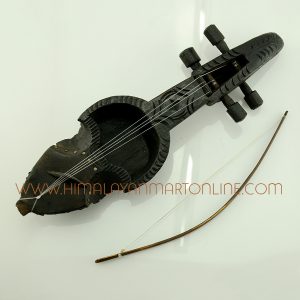
The Sarangi Nepali folk instrument consists of four strings. The original strings were made up of sheep intestine, similar to the use of catgut (made from the intestines of cattle) in many musical traditions around the world. The Gandarbha received intestines of sheep sacrificed during major festivals like Dashain, which they left in a pot for some days. Once the entrails was fully rotten, it was pulled out, leaving behind the fine nerves of the intestine in the pot. These were then woven to make strings. However, these days, badminton strings, nylon and steel strings have generally replaced gut strings. The bow was traditionally strung with horse tail-hair, but in the modern days, nylon bowstrings are common.
Tuning of the Instrument
The range of the Sarangi covers almost two octaves, and it is tuned in 5ths. From right to left, the four strings of Sarangi are tuned to lower fifth, root, root and fifth notes of a particular key. The middle 2 strings are used as drone. The instrument is tuned either by ear at the performer’s discretion, or tuned to keys of western music. This is mostly done in a setting where a standardized key is required to facilitate performing with musical instruments of other cultures, or in a recording studio. For example; if the middle tow strings are tuned at G note, both the first and fourth strings are corresponded to D.
Performance Techniques
There are different methods of producing notes on the Sarangi. Most players play the Sarangi by pressing the strings slightly with their fingers of the left hand and bowing the strings with right hand. However, Bharat Nepali and his students rub their hand fingernails to rub against the strings to create sound.
Also, traditionally, the Gandarbhas used to bow the root note continuously along with the notes of the song. As Sarangi is usually the only instrument used in their songs, except some Nepali percussion like Madal, the continuous sound of the root note (or drone from the 2 middle strings) provides the ambiance. Since now days the Sarangi is also played along with other instruments, performers do not bow the drone string continuously.
Unlike the traditional way of playing the Sarangi in a single key, modern players have started to use modal techniques to play the Sarangi in different keys. Along with the folk tunes, the Sarangi players also experimenting the use of this instrument in modern and western genres these days.
Sakyamuni Buddha Tomba Copper Statue
Article written July 11, 2020 By hmmart
Sakyamuni – The Lion of the Shakyas
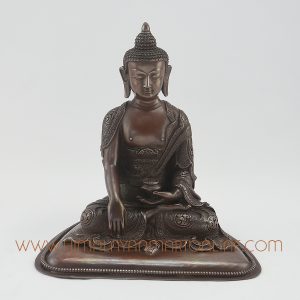
Sakyamuni Buddha Tomba Copper Statue: Sakyamuni is the Buddha of our time. He is the glorious root teacher of all the diverse lineages that make up Buddhism as we know it. Born Siddhartha Gautama more than 2500 years ago, he was the crown prince of the Shakya kingdom located in the Himalayan foothills of what is now southern Nepal. He left luxurious palace life behind him, however, in pursuit of the truth of the origin of suffering and the cessation of fear. His astounding courage, determination, wisdom and compassion led to his perfect enlightenment despite seemingly insurmountable obstacles. His teachings have transformed individuals and nations throughout the world and still speak to us today.
Gestures and Attributes
The Buddha is depicted with his right hand extended to the earth in the Bhumisparsha Mudra like shown in this Sakyamuni Buddha Tomba Copper Statue, the gesture of witness. He is “calling the earth to witness” his supreme victory over the temptations and illusions of the material world as symbolized by the demon Mara. His left hand lies in his lap with palm upward in the gesture of meditation (Dhyana Mudra). In some representations he also holds the begging bowl of an ordained Buddhist monk. The bowl contains three precious nectars indicating that he has conquered the three demons of uncontrolled death, contaminated aggregates, and delusion. Thus, this posture is known as “Buddha Sakyamuni Conquering the Demons” and shows the moment of the Buddha’s full enlightenment under the Bodhi tree.
About this Sakyamuni Buddha Tomba Copper Statue
This statue is a charming portrayal of Sakyamuni. Finely sculpted from copper alloy, the statue has been submitted to an oxidation process to yield a rich and sensuous finish. The Buddha sits gracefully in meditation upon a lotus throne, expressing the calm majesty of one who has mastered himself. With his head slightly inclined, he seems to smile with a secret inner joy, prompting feelings of encouragement and happiness in the observer. His robes are exquisitely carved throughout, showing marvelous detailing especially on the back of the sculpture, where a beautiful lotus blossom is surrounded by intricately carved leaves and vines. And over all, the lovely copper finish lends a pleasing sense of warmth, gently inviting one to linger, leaving thoughts of the world behind.
White Tara Pendant
Article written July 7, 2020 By hmmart
Ghau / Pendant / Prayer Box
White Tara Pendant: Ghau is a small prayer box worn as pendant by Buddhists as portable shrines where prayers and sacred relics are kept and used during their travel to hold their sacred deity inside. Now, Ghau or Prayer Box pendants are often used as jewelry or personal adornment. They are used to carry prayers or prayer concerns or photos, poems, small items, or memories. Ghau pendants can carry your prayers near to your heart throughout the day. They are jewelry that has a history. The Ghau opens to a concealed inner space, and is traditionally used by Tibetan Buddhists to hold a picture of their favorite deity or Lama, a folded-up scroll of sacred mantras, special herbs or sacred relics. The Ghau is used as an amulet to help the wearer to ward off negative energy and attract blessings. A Ghau is also used as a portable shrine and are worn on a cord around the neck and hung close to the heart.
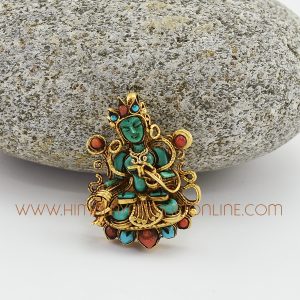
These Ghaus or Pendants are mostly made of silver like this White Tara Pendant; however, the artisans also use copper, brass, gold and other metals. Ghau often have intricate designs of deity, auspicious symbols and mantras inscribed on their outer and inner surface Ghau is often decorated by precious or semi-precious gemstones which have various healing effects on the wearer. Turquoise, considered by many as a master healing stone, Lapis Lazuli and Coral are especially popular in Ghau or Prayer Box design for their beauty and healing properties. Other gemstones used by the craftsman include: amber, carnelian, amethyst, malachite, onyx and topaz.
About this White Tara Pendant – Ritual item
This beautiful Silver Pendant is entirely a hand carved piece; made from Silver which has fine hand carvings and is submitted to a gold plating effect to yield a rich and sensuous finish and besides the decoration of Turquoise and Coral stones make this White Tara Pendant a beautiful piece of art which is entirely a hand craft. This beautiful White Tara Pendant is hand made by the master artisans of Patan, which lies in the Himalayan Kingdom of Nepal; who have been in the business from generations.
Manjushri Pendant
Article written July 7, 2020 By hmmart
Ghau / Pendant / Prayer Box
Manjushri Pendant: Ghau is a small prayer box worn as pendant by Buddhists as portable shrines where prayers and sacred relics are kept and used during their travel to hold their sacred deity inside. Now, Ghau or Prayer Box pendants are often used as jewelry or personal adornment. They are used to carry prayers or prayer concerns or photos, poems, small items, or memories. Ghau pendants can carry your prayers near to your heart throughout the day. They are jewelry that has a history. The Ghau opens to a concealed inner space, and is traditionally used by Tibetan Buddhists to hold a picture of their favorite deity or Lama, a folded-up scroll of sacred mantras, special herbs or sacred relics. The Ghau is used as an amulet to help the wearer to ward off negative energy and attract blessings. A Ghau is also used as a portable shrine and are worn on a cord around the neck and hung close to the heart.
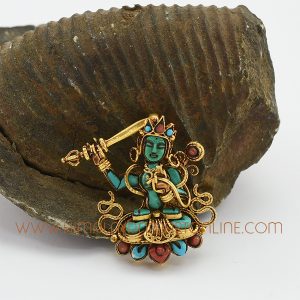
These Ghaus or Pendants are mostly made of silver like this Manjushri Pendant; however, the artisans also use copper, brass, gold and other metals. Ghau often have intricate designs of deity, auspicious symbols and mantras inscribed on their outer and inner surface Ghau is often decorated by precious or semi-precious gemstones which have various healing effects on the wearer. Turquoise, considered by many as a master healing stone, Lapis Lazuli and Coral are especially popular in Ghau or Prayer Box design for their beauty and healing properties. Other gemstones used by the craftsman include: amber, carnelian, amethyst, malachite, onyx and topaz.
About this Manjushri Pendant – Ritual item
This beautiful Silver Pendant is entirely a hand carved piece; made from Silver which has fine hand carvings and is submitted to a gold plating effect to yield a rich and sensuous finish and besides the decoration of Turquoise and Coral stones make this Manjushri Pendant a beautiful piece of art which is entirely a hand craft. This beautiful Manjushri Pendant is hand made by the master artisans of Patan, which lies in the Himalayan Kingdom of Nepal; who have been in the business from generations.
Green Tara Pendant
Article written July 7, 2020 By hmmart
Ghau / Pendant / Prayer Box
Green Tara Pendant: Ghau is a small prayer box worn as pendant by Buddhists as portable shrines where prayers and sacred relics are kept and used during their travel to hold their sacred deity inside. Now, Ghau or Prayer Box pendants are often used as jewelry or personal adornment. They are used to carry prayers or prayer concerns or photos, poems, small items, or memories. Ghau pendants can carry your prayers near to your heart throughout the day. They are jewelry that has a history. The Ghau opens to a concealed inner space, and is traditionally used by Tibetan Buddhists to hold a picture of their favorite deity or Lama, a folded-up scroll of sacred mantras, special herbs or sacred relics. The Ghau is used as an amulet to help the wearer to ward off negative energy and attract blessings. A Ghau is also used as a portable shrine and are worn on a cord around the neck and hung close to the heart.
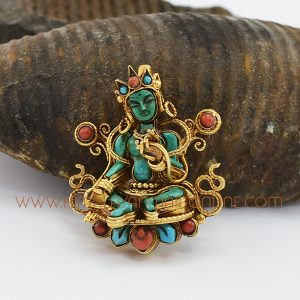
These Ghaus or Pendants are mostly made of silver like this Green Tara Pendant; however, the artisans also use copper, brass, gold and other metals. Ghau often have intricate designs of deity, auspicious symbols and mantras inscribed on their outer and inner surface Ghau is often decorated by precious or semi-precious gemstones which have various healing effects on the wearer. Turquoise, considered by many as a master healing stone, Lapis Lazuli and Coral are especially popular in Ghau or Prayer Box design for their beauty and healing properties. Other gemstones used by the craftsman include: amber, carnelian, amethyst, malachite, onyx and topaz.
About this Green Tara Pendant – Ritual item
This beautiful Pendant is entirely a hand carved piece; made from Silver which has fine hand carvings and is submitted to a gold plating effect to yield a rich and sensuous finish and besides the decoration of Turquoise and Coral stones make this Green Tara Pendant a beautiful piece of art which is entirely a hand craft. This beautiful Green Tara Pendant is hand made by the master artisans of Patan, which lies in the Himalayan Kingdom of Nepal; who have been in the business from generations.