
Dorje Drollo – The Wrathful Emanation of Guru Rinpoche
Article written February 24, 2019 By hmmart
Dorje Drollo – The Wrathful Emanation of Guru Rinpoche
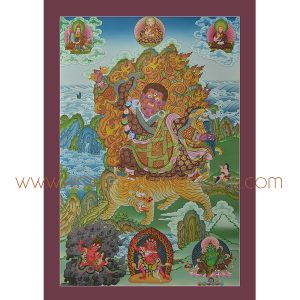
Dorje Drollo is one of the eight manifestations of Guru Padmasambhava with extremely wrathful expression. However, Dorje Drollo rides a tiger side saddle surrounded by the flames of pristine awareness. Additionally, he has the expression of a fierce deity with three glaring eyes. The three eyes symbolize his knowledge of the past, present and future. He wields the Vajra in his right hand which symbolizes the union of mundane knowledge and the ultimate wisdom. Furthermore, he wears the vulture feather on top of his cap similar to Guru Rinpoche and he ultimate wisdom. Guru Padmasambhava manifested in this form in order to subdue the negative and evil forces at the thirteen different places in Himalayan region.
Gesture and Attributes
Dorje Drollo is dark – red or maroon in color and terrifying in appearance, as if the three worlds were on fire. Is presence is overwhelming, with a radiance that outshines the sun and moon, while his three round red wisdom eyes stare in every direction. He expresses his wrath by biting down upon his lower lip with his sharp upper teeth and fangs, his orange facial twists upwards and emits fiery sparks and his matted hair – locks hand down as a tawny mass of curls.
With his right hand raised towards the heavens in the threatening tarjani gesture he holds a nine – pointed Vajra made of meteorite iron that emits a storm of fiery sparks, with each spark taking the form of the syllable HUM, which subdue all spiritual pride. In his left he holds a phurba or dagger made of meteorite iron, which emits a shower of sparks in the form of thousands of Mahakalas. The sharp triangular point of his phurba pierces through the hearts of all demonic enemies. He wears gold and bone ornaments, and like Guru Rinpoche three robes that signifying his accomplishments of discipline, meditation and wisdom. The first is an inner ‘secret’ white robe, showing he has perfected the Bodhisattva – vehicle. The second is a blue robe symbolizing his perfection of the mantra – vehicles. The third is the outer yellow and red embroidered monastic robe of a bhikshu, representing his perfection in upholding all of the pratimoksha vows. As the originator and master of all Buddha activity, he wears the black – hat or Vajra – crown of the Karmapa.
He abides within a blazing mass of awareness – fire and swirling wind, as he stands upon his Dakini – consort in the fierce from of a pregnant tigress, with his right leg bent and his left leg extended in Heruka – posture. The tigress tramples upon the form of an enemy – demon, who lies upon his back above a triangular Dharmodaya or blissful ‘reality – source’, which crowns the summit of the ‘blazing mountain’ and contains a swirling ocean of fresh blood.

Kache Marpo – The Emanation of Hayagriva
Article written February 24, 2019 By hmmart
Kache Marpo – The Emanation of Hayagriva
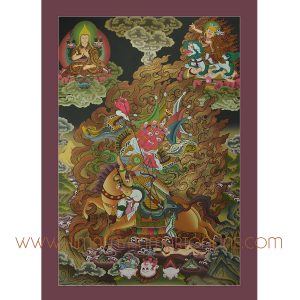
Kache Marpo is a very ancient Buddhist deity originating from the time of Guru Rinpoche, a thousand years ago. Kache Marpo was installed as one of the Dharma Protectors in Samye Monastery by Guru Rinpoche in the past, as one of the protective divinities to help increase the growth of Dharma in the country of Tibet and the surrounding areas. Kache Marpo is considered an emanation of Hayagriva, which makes him a fully accomplished enlightened being and also a Buddha who appears in a worldly form.
Gesture and Attributes
Kache Marpo has a red face, three eyes and two arms. He gnaws his lower lip with his upper teeth and has bared fangs to scare away obstacles and maras. He wears the helmet of an ancient warrior with five flags fluttering in the wind, representing the five Dhyani Buddhas. In ancient times, warriors would wear flags on their backs to denote who they are, where they are from, their rank, and so on. He wears a full set of leather mail on his body which enables him to stop arrows and other projectiles that are shot at him. But in Dharma terms, it represents that he is impenetrable because he has achieved full enlightenment.
In his right hand which is swinging up in the air, he holds a long spear and in his left hand, he holds a noose. The noose is dragging a human-like form, which represents our negative karma, our sufferings, our problems, and our pains in samsara. The human is bound and tied, meaning that Kache Marpo has the power to bind our obstacles. He pierces the human with the long spear held in his right hand, further enforcing his ability to destroy our obstacles.
He rides on a horse over an ocean of blood. The blood represents all suffering that is inherently existent in samsara and the projections within samsara. When he rides over this ocean, it signifies that he is above and beyond any type of suffering.
Iconography
In the Nyingma tradition, he is very much worshipped in the form of Tsiu Marpo. Later when Dorje Shugden manifested, Tsiu Marpo saw the benefits of Dorje Shugden’s practice and activities, and on his own free will, he took an oath to become one of Dorje Shugden’s ministers. So, he is practiced within the Nyingma tradition as Tsiu Marpo and within the Gelugpa tradition as Kache Marpo.
In Tibet, there are many famous Kache Marpo oracles. They can come in peaceful or wrathful form, and are very well known for the accuracy of their advice. Even though they are oracles of Kache Marpo, when the oracle takes trance, Dorje Shugden the King will enter first. After the King leaves, Kache Marpo will then come and speak on behalf of the King (Dorje Shugden).
There is a very famous oracle in Tibet called the Panglung Oracle, whose picture I have included here. During the Cultural Revolution in 1959, he was consulted by H.H. Trijang Rinpoche for the safety of His Holiness the 14th Dalai Lama. When he was consulted, Dorje Shugden entered first, then Kache Marpo entered and pronounced that the Dalai Lama should leave Tibet immediately. This event is well recorded by the monks who witnessed this as well as the monks who actually carried the messages back and forth. So, one of the most famous Kache Marpo oracles in Tibet who was very, very well known for his accuracy was the one who gave the prophecy that the Dalai Lama should leave Tibet.
Why the Statues have to be Consecrated?
Article written September 24, 2018 By hmmart
Tibetan Buddhists believe that a Statue is only an empty shell unless it is properly filled with the consecration materials inside it and consecrated. Therefore, the Statue should be filled with consecration materials inside it by the qualified Buddhist monk or Guru and then have to be blessed it by the Rinpoche or high ranked Guru known as Khempo. After the proper filling and then blessing only it is Buddhist belief that your statue will be aesthetically pleasing and it will also bring you blessings to you.
The process of Consecration of Statues:
1. Filling of Consecration Materials inside the Statue
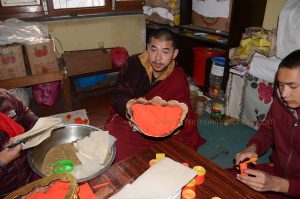
For the Consecration; first the Statue has to be filled with consecration materials which consists of paper mantra rolls of particular deity, five materials (gold, silver, brass, copper and iron), coral stones (if available), lots of incense powder, holy objects (such as soil of holy places, objects of holy persons, etc.) and jhilap or Prasad.
2. Blessing by the Rinpoche or High Ranked Guru or Khempo
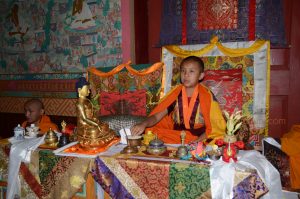
Once the Statue has been properly filled with above ingredients by the qualified Buddhist monk or Guru then comes the second part which is; blessing. The second phase is to bless by the Rinpoche or High Ranked Guru or Khempo. During this blessing process the Rinpoche or Khemp will continuously recite the deity’s mantra for the particular Statue. The Statue will come to live only after the blessing process is completed. So it is must to have the Statues blessed after they are filled.
Consecrating Your Ritual Item
Article written September 11, 2018 By hmmart
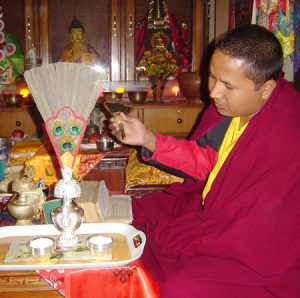 We are also pleased to offer consecration for ritual items upon request. In the Buddhist tradition, consecration is considered essential for any sacred implement used for meditation or devotional practice. A qualified Lama from our Buddhist monastery in the Kathmandu Valley will utter mantras while sprinkling holy water, rice, and purifying herbs in the traditional consecration ceremony.
Because so few consecration materials are required, there is no fee for consecrating ritual items. However, it is customary (and merit-bringing) to make a donation to the Lama for his time and services.
NOTE:
Please note that Buddhist tradition prohibits re-selling or otherwise disposing of consecrated items, thus we are unable to accept returns of consecrated ritual items.
Consecrating Your Thangka Painting
Article written September 11, 2018 By hmmart
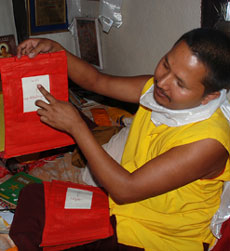 Ritual consecration is also available for all of our thangkas upon request. In the Buddhist tradition, consecration serves to “awaken” the thangka, and is considered essential for any sacred image used for meditation or devotional practice. Your painting will be inscribed with holy mantras and consecrated by a qualified Lama from our Buddhist monastery in the Kathmandu Valley.
Because so few consecration materials are required, there is no fee for consecrating a thangka. However, it is customary (and merit-bringing) to make a donation to the Lama for his time and services.
NOTE:
Please note that Buddhist tradition prohibits re-selling or otherwise disposing of consecrated items, thus we are unable to accept returns of consecrated thangkas.
Dressing Your Statue
Article written September 11, 2018 By hmmart
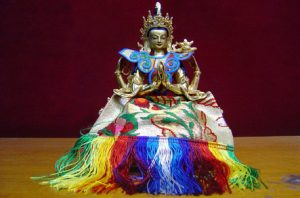 We also offer traditional dress clothing for statues upon request. After consecration, it is a gesture of honor and respect to dress your statue well before placing it on the altar or shrine. Our statue clothing is hand-made from beautiful Tibetan silk. Again, we do not profit from this service, and request only a small fee to cover the cost of the clothing. The fee will vary according to the size and shape of the statue, and generally follows the pricing given in the table below.
Consecrating Your Statues
Article written September 11, 2018 By hmmart
WE are pleased to offer ritual consecration for all of our sculptures upon request. In the Buddhist tradition, consecration serves to “awaken” the statue, and is considered essential for any sacred image used for meditation or devotional practice. Your statue will be filled with hundreds of holy mantras and consecrated by a qualified Buddhist Lama; Rinpoche will also bless the statue after consecration if he is available.
We do not make any profit by providing this service, and request only a small fee to cover the cost of materials such as the tightly rolled strips of paper containing the mantras, the incense, the chhoksing (the wooden “heart” of the statue), and the medicinal and purifying herbs. These costs vary according to the size of the hollow area inside the statue to be filled. In general, the fee ranges from US $ 30 to US $ 150 for 8″ to 24″ statues. In addition, you may offer some payment to the Lama for his time and services. There is no set amount for this offering; he will be happy to accept any amount offered to him. It is believed that a person who bears the cost of consecration receives great blessings from doing so.
NOTE:
Please note that Buddhist tradition prohibits re-selling or otherwise disposing of consecrated items, thus we are unable to accept returns of consecrated statues.
Blessing Ceremony for the Chenrezig / Bernagchen Mahakala and Shakyamuni Buddha Statues
Article written September 9, 2018 By hmmart
Guru Dhendup from Sangye Choeling Monastery in Swayambhu, Kathmandu performing blessing ceremony for the:
a. 12″ Chenrezig Statue
b. 8.5″ Shakyamuni Buddha Statue
c. 8.5″ Bernagchen Mahakala Statue
Note: The Blessing Ceremony was held on 9th September, 2018 in Sangye Choeling Monastery which is located in Swayambhu, Kathmandu
Blessing Ceremony for the 17″ Shakyamuni Buddha Statue & Medicine Buddha Thangka Painting
Article written August 8, 2018 By hmmart
Blessing Buddha Statue and Thangka Painting: Guru Dhendup from Sangye Choeling Monastery in Swayambhu, Kathmandu performing blessing ceremony for the:
a. 17″ Shakyamuni Buddha Statue
b. Medicine Buddha Thangka Painting
Blessing ceremony for the Magnificent 15.5″ Medicine Buddha Statue
Article written August 3, 2018 By hmmart
Guru Dhendup from Sangye Choeling Monastery in Swayambhu, Kathmandu performing blessing ceremony for the:
a. 15.5″ Menla / Medicine Buddha Statue