Ritual items are practical items that help devotees discover and nurture inner peace in Buddhist culture. These have been used for hundreds of years to enhance meditation rituals, prayer and personal reflection time. Today relevance of these ritual items is stronger than ever – in our over-scheduled lives, a few minutes of peaceful practice can strengthen our spiritual identity and improve our health of mind
OM TARE TUTTARE TURE AYUR DATE BHRUM SVAHA ཨོཾ་ཏཱ་རེ་ཏུཏྟཱ་རེ་ཏུ་རེ་ཨྰཿཡྰ་རྡ་ཏེ་པྷྰུྂ་སྭཱ་ཧཱ།
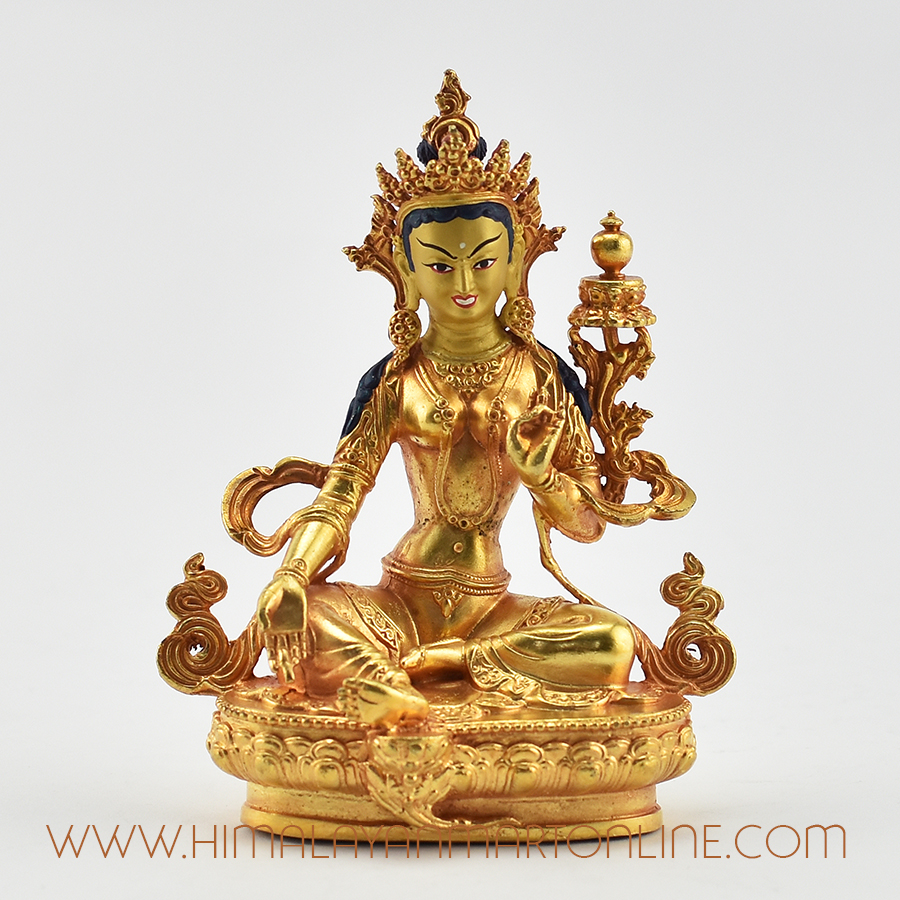
Tara Tsugtor Namgyalma, serene and radiant in golden yellow, emanates from the crown chakra of the Buddha as Prajnaparamita, the embodiment of transcendent wisdom. She stands victorious over all non-virtue and afflictive emotions, guiding beings toward purity and enlightenment.
In her iconography, Tsugtor Namgyalma holds a Utpala flower, upon which rests a vase of immortality. This vase radiates light in all ten directions, symbolizing her boundless compassion and wisdom. The light transforms the radiant essence of both samsara and nirvana into nectar, which fills her vase, signifying the ultimate union and transcendence of dualities. Her peaceful yet powerful presence is a beacon of hope and transformation, reminding practitioners of the potential to overcome negative emotions and cultivate virtues. Through her guidance, they can transcend the cycles of samsara and realize the bliss of nirvana. Tsugtor Namgyalma’s golden glow and the vase of immortality she holds are potent symbols of eternal wisdom and the transformative power of the enlightened heart.
Tsugtor Namgyalma’s iconography is a powerful reminder of the transformative power of the enlightened heart. Her presence serves as a beacon of hope, guiding practitioners toward the realization of the ultimate truth and the transcendence of dualities.
Tsugtor Namgyalma’s iconography is a powerful reminder of the transformative power of the enlightened heart. Her presence serves as a beacon of hope, guiding practitioners toward the realization of the ultimate truth and the transcendence of dualities.
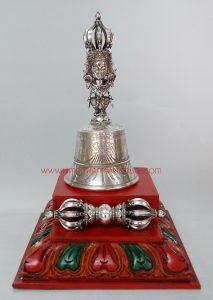
In the intricate tapestry of Buddhist rituals and ceremonies, the Vajra and Bell Set emerges as a sacred ensemble, symbolizing profound spiritual insights and invoking a sense of divine harmony. Rooted in ancient traditions and revered by practitioners, this set holds a significant place in Buddhist religious practices.
The Symbolism of the Vajra:
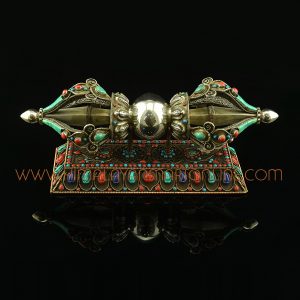
The Vajra, often referred to as the “diamond thunderbolt,” is a symbol of indestructibility and represents the unyielding nature of enlightenment. In Buddhist philosophy, the Vajra embodies the impenetrable reality of ultimate truth and the wisdom that shatters ignorance. Its double-ended, five-pronged design signifies the five elements and the five Buddha families, encapsulating the unity of wisdom and compassion.
The Bell’s Melodious Invocation:
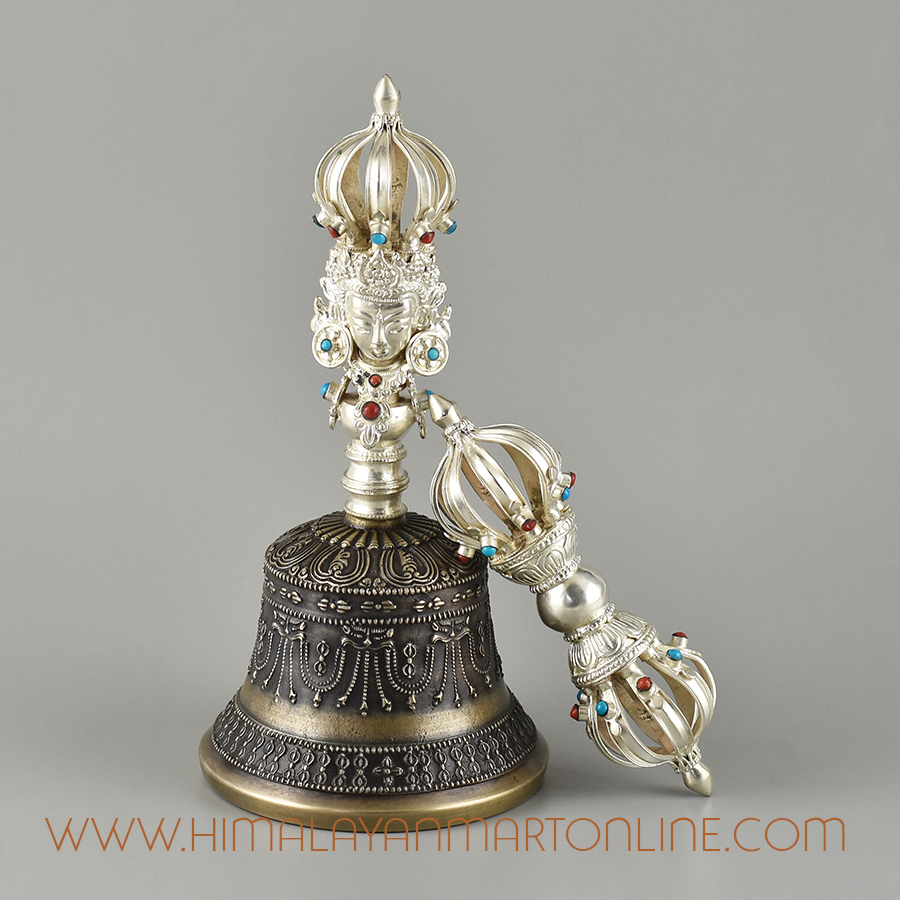
Tibetan Buddhist Sacred Vajra and Bell Set
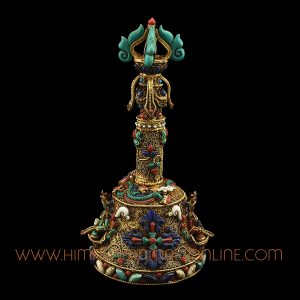
Complementing the Vajra is the Bell, an instrument that adds a melodious dimension to Buddhist rituals. Crafted for fine sound quality, the Bell symbolizes the feminine aspect of wisdom. Its clear, resonant tones are believed to purify the environment and invoke spiritual awareness. In the context of the Vajra and Bell Set, the Bell harmonizes with the Vajra’s powerful symbolism, creating a balanced and transcendent atmosphere during rituals.
Craftsmanship and Ritual Use:
The Vajra and Bell Set is often individually handcrafted by skilled artisans, carrying forward a lineage of sacred artistry. In regions like Patan, Nepal, master artisans from revered clans, such as the Shakya clan, meticulously create these sets. The craftsmanship involves intricate carving with Buddhist symbolic images, ensuring that each set is not only a ritual tool but also a work of art.
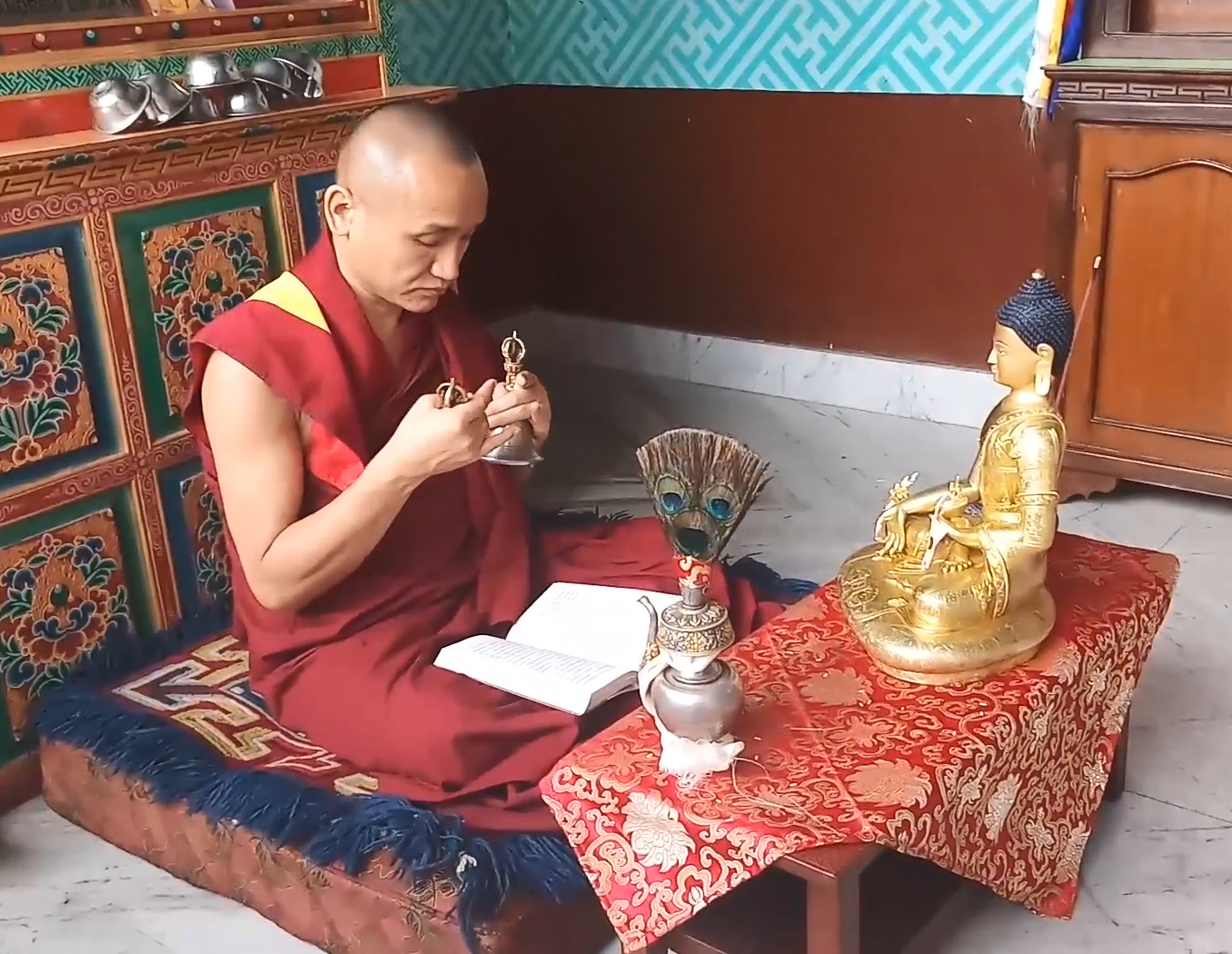
In Buddhist rituals, the Vajra is held in the right hand, representing method or skillful means, while the Bell is held in the left, symbolizing wisdom. The striking together of the Vajra and Bell is a ritualistic dance, harmonizing the dualistic aspects of wisdom and compassion within the practitioner.
Spiritual Significance:
Beyond its aesthetic appeal and ritualistic use, the Vajra and Bell Set holds deep spiritual significance. It serves as a reminder of the interconnectedness of wisdom and compassion, encouraging practitioners to cultivate these qualities on their path to enlightenment. The sound of the Bell, combined with the Vajra’s symbolism, becomes a vehicle for transcendent meditation, leading practitioners toward a heightened state of awareness.
Conclusion: The Vajra and Bell Set, a revered artifact in Buddhist religious practices, encapsulates the essence of wisdom and compassion. Its symbolism, craftsmanship, and ritualistic use create a sacred harmony that resonates through the ages, enriching the spiritual journey of those who engage with it. In the dance of the Vajra and Bell, practitioners find a symbolic representation of the profound balance necessary for the attainment of enlightenment in the Buddhist tradition.
In the intricate tapestry of Buddhist rituals, the Ritual Vase Bhumba Set stands as a symbol of spiritual purity and auspiciousness. Rooted in ancient traditions, this sacred ensemble plays a vital role in various ceremonies and practices, embodying deep symbolic meanings within the Buddhist religion.
The Components of Ritual Vase Bhumba Set:
Ritual Vase (Bhumba): The central element of the set, the Ritual Vase or Bhumba, typically crafted from metal like copper or silver, symbolizes the receptacle of spiritual blessings. Its elegant design and sacred contents make it a vessel of consecration and an essential tool in ritualistic practices.
Sacred Contents: The contents within the Ritual Vase often include purified water, symbolic of the purifying essence of wisdom and compassion. This consecrated water is utilized during rituals to bless individuals and spaces, fostering a sense of spiritual sanctity.
Decorative Elements: Elaborate ornamentation and intricate carvings on the Ritual Vase enhance its sacred aura. Symbols and motifs often associated with Buddhist iconography adorn the vessel, adding layers of meaning to its visual representation.
Symbolism and Ritualistic Use:
The Ritual Vase Bhumpa Set holds deep symbolic significance within Buddhist rituals. The consecrated water within the vase represents the nectar of spiritual awakening, and its use in various ceremonies signifies the act of purifying oneself and the surrounding environment. The pouring of blessed water symbolizes the flow of positive energy and blessings, fostering an atmosphere conducive to spiritual growth.
Cultural Significance:
The Ritual Vase Bhumba Set is deeply embedded in various Buddhist traditions, prominently featuring in ceremonies, consecrations, and rituals conducted by monastics and practitioners alike. Its cultural significance extends beyond its physical form, becoming a vessel through which spiritual teachings and blessings are conveyed.
The Ritual Vase Bhumba Set holds a revered place within Buddhist rituals, embodying the essence of spiritual purity and auspiciousness. Its intricate design, sacred contents, and symbolic significance make it a vessel of profound importance, connecting practitioners with the deeper dimensions of their faith. As the Ritual Vase is raised and its blessed water poured, it becomes a conduit for spiritual energy and a timeless symbol of the continuous flow of wisdom and compassion within the Buddhist tradition.
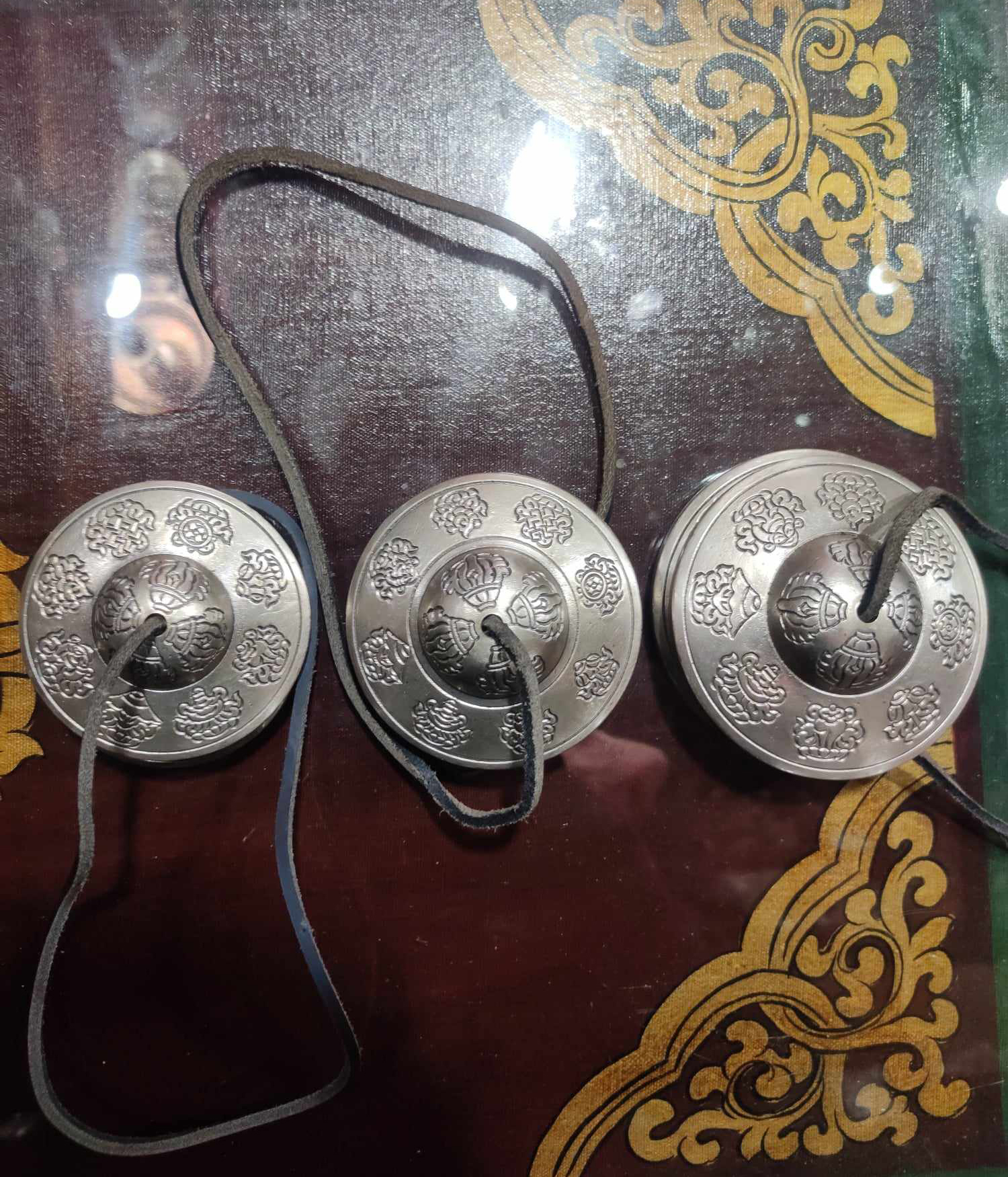
Tingsha Tibetan Hand Cymbals: Tingsha bells, also known as Tingsha cymbals or Tibetan hand cymbals, are small metal instruments used for various purposes, including sound healing, meditation, and spiritual practices. These sacred objects originate from Tibetan and Himalayan traditions and are valued not only for their melodious sound but also for their ability to create an environment conducive to relaxation, meditation, and healing.
Physical Characteristics: Tingsha bells consist of two metal cymbals that are connected by a leather or fabric strap. The cymbals are often made of a high-quality blend of metals, including bronze, copper, and other alloys. They are typically engraved or adorned with intricate designs, symbols, and mantras, adding to their aesthetic and spiritual significance.
Sound Healing and Meditation: The melodious sound produced by Tingsha bells is believed to have therapeutic and spiritual qualities. When struck together, the cymbals create a clear, resonant tone that resonates and lingers in the environment. This sound has the power to cleanse, purify, and harmonize the energy of a space, making it an ideal tool for sound healing sessions and meditation practices.
Sound Vibration and Energy Cleansing: In sound healing, the vibrations emitted by Tingsha bells are thought to influence the energy centers (chakras) and subtle bodies of individuals. The resonant vibrations help release tension, balance energy flows, and clear stagnant or negative energies. Practitioners often move the ringing Tingsha bells around a person’s body or throughout a space to cleanse and align the energy field.
Meditative Practice and Mindfulness: The sound of Tingsha bells serves as a focal point for meditation and mindfulness. When struck gently, the sustained sound invites practitioners to focus their attention and awareness on the present moment. This can facilitate a deeper state of relaxation and inner stillness, aiding meditation practitioners in achieving a tranquil state of mind.
Ceremonial and Ritual Use: Tingsha bells are also used in various ceremonial and ritual contexts. Their clear sound is believed to help connect with divine energies and invoke the presence of enlightened beings. They are commonly used to mark the beginning and end of meditation sessions, prayers, and other spiritual practices.
How to Use Tingsha Tibetan Hand Cymbals:
Hold the Tingsha bells by their leather/fabric strap or gently grasp the cymbals themselves.
Strike the cymbals together at their edges, allowing them to make contact and produce a resonant sound.
Let the sound of the bells resonate in the space, allowing the vibrations to permeate and cleanse the environment.
You can also gently move the ringing bells around a person’s body or throughout a room during a sound healing session.
When using Tingsha bells in meditation, focus your attention on the sound, allowing it to lead you into a state of mindfulness.
In summary, Tingsha bells are revered instruments with deep spiritual and healing significance in Tibetan and Himalayan traditions. Through their resonant sound, they facilitate sound healing, meditation, and energy cleansing practices, helping individuals connect with their inner selves and create a sacred atmosphere of harmony and peace.
The Vajra and Bell are very important ritual implements in Tibetan Buddhism. The Vajra known as Dorje in Tibetan term and the Bell known as Drilbu in Tibetan term are mostly used as pair by every Buddhist monk almost in daily basis as ritual objects in tantric rituals and practice. Most of the Buddhist monks carry these two implements with them where ever they go because they need these items in their ritual performance. Though the Vajra (Tibetan: Dorje) symbolizes masculine inviolability and the Bell (Tibetan: Drilbu) symbolizes feminine wisdom are two different objects but mostly these are used as pair in the practice. These implements are attributes of many Buddhist deities and are held by deities like; Vajrapani, Chakrasamvara, Kalachakra, Vajradhara Buddha, Vajrasattva, Guru Padmasambhava, etc. as a part of their appearance which shows the importance of these two ritual items.
Vajra and Bell Set
Vajra (Tibetan: Dorje)
The Vajra (Dorje) is one of the main ritual implements in Buddhism. The Vajra is an important ritual sacred tool in Vajrayana Buddhism. This Vajra can also found in Hinduism and Tantric practice where it symbolizes the male principle in religious practice. The Vajra – Indestructible Thunderbolt is believed as the destroyer of all kinds of ignorance. In Hindu mythology; The Vajra is symbol of Indra the Vedic god of war and king of Devas accordingly to Hindu mythology.
There are four types of Vajras; a. The nine prongs (pointed) Vajra which is known is Commitment Vajra, in nine prongs (pointed) Vajra; there are eight prongs plus the central hub, b. The five prongs (pointed) Vajra which is known as the Full Knowledge Vajra, c. The three prongs (pointed) Vajra which is used for exorcising inimical forces, and d. The open prongs (pointed) Vajra which is called the Wrathful Vajra.
Out of these four types of Vajras; the Nine pointed and the Five pointed Vajras are found used most commonly.
Vajra / Dorje
In Buddhism
The Vajra (Dorje) is a ritual implement which has very important role in Tibetan Buddhism. The use of Vajra in Buddhism is in all aspect of their religious, mythology, symbolism and philosophy. Many deities in Buddhism like; Vajrasattva, Vajradhara, Vajrapani, Chakrasamvara, Kalachakra, Guru Padmasambhava etc., hold Vajra as their attributes. The Vajra along with its counterpart Bell (Drilbu) is used by Buddhist monks in almost all their ritual performance.
In Hinduism
The Vajra also has its specific role in Hinduism. According to Hindu mythology; Indra the Vedic god of war and king of Devas; holds it as his weapon. It is a powerful weapon which has the combined feathers of all sword, mace and spear in it. As per Hindu mythology; it is believed that the Vajra is made out of thigh bones of sage Dadhichi who gave up his life willingly for a noble cause so that his spine could be used to build weapon and Indra used this weapon to kill Vritrasura who had conquered heaven and terrorized the gods. Due to this supreme sacrifice, sage Dadhichi became a legend. In another incident; Vitra, the serpent of drought had swallowed the cosmic water. Indra using his Vajra weapon split Vitra’s stomach to release the water inside the Vitra’s stomach.
In Tantric Buddhism
The Vajra is used widely in the rituals of the Tantra where it symbolizes male principle where as its counterpart Bell (Drilbu) symbolizes female principle representing compassion. The use of their interaction leads to enlightenment. According to Buddhist mythology; the Vajra destroys all kinds of ignorance, and is indestructible against any evil force. Various deities like; Vajrasattva, Vajradhara, Chakrasamvara, Kalachakra, Vajrapani, Guru Padmasambhava, etc., in Buddhism are depicted holding the Vajra individually or with its counterpart Bell together. Vajrasattva, Vajradhara and some other deities hold the Vajra in their right hand along with the Bell on their left hand and Vajrapani, Guru Padmasambhava and some other deities hold the Vajra on their right hand without its counterpart the Bell.
Bell (Tibetan: Drilbu)
Like Vajra (Dorje) the Bell (Drilbu) is also an important religious implement in Tibetan Buddhism. Like its counterpart Vajra; it plays important role in religious practice. While the Vajra symbolizes the male principle; the Bell symbolizes the female principle. The Bell can be seen held by many deities in Buddhism like; Vajrasattva, Vajradhara, Chakrasamvara, Kalachakra, etc. The Vajra is held by deities in right hand whereas the Bell is held in left hand. In ritual practice; the Vajra symbolizes the male principle and is held on right hand and the Bell symbolizes the female principle and is held in left hand in the practice.
Bell / Drilbu
The symbolism of the Vajra Bell Ritual Implement
Vajras are made of different prongs (points) some with five, some with nine, some with three and some with open prongs. These prongs or (points) symbolize the five wisdoms that are attained through beyond ordinary limits of five kleshas which are greed, anger, delusion, pride and envy. The hub between these signifies emptiness.
Vajra; it is a Sanskrit word and in Tibetan it is called Dorje; which is related to the word for diamond. The Buddhism has very important role of Vajra; which has been shown as attributes of different deities and it us used in ritual ceremonies. According to Hindu mythology; it is used as thunderbolt weapon carried by the Vedic god Indra. The Vajra has been used as important implement in Buddhist and Hindu religion however it the Vajra as an artifact appears throughout the cultures around the world like; the Zeus carries it as thunderbolt weapon as per ancient Greek mythology. As per the Greek mythology; Zeus the Sky god received it from Cyclopes; one eyed giant creature.
In all the religion; the Vajra has been used as a weapon which destroys both internal and external enemies. Like a diamond it symbolizes the indestructible and all penetrating mind of enlightenment.
It is believed that the bell sound calls to mind to purify all kinds of sins. The sound of the Bell is considered by Tibetan Buddhists as beautiful music. The bell is used as musical instrument together with other sacred instruments like Damaru, Tingsha, etc., in ritual ceremony as musical offerings to the Buddhas and other gods. This music is presented as one of eight offerings to the deity that is invoked during the ritual.
How are they used
The Vajra and Bell are often seen held in the hands of deities, and in ritual practice they are held in the hands of the monks during rituals performance, the Vajra in the right hand, the Bell in the left hand. They are moved as pair in prescribed manners in ritual performance. When the arms are crossed holding Vajra and Bell; it symbolizes that the two are united-representing enlightenment. The Vajra is used as weapon which destroys all the negativity and sins and purify minds. The Vajra is used in other religion as well such as; it is used as weapon by the Vedic god Indra as per Hindu mythology and by Zeus as per Greek mythology. The sound of the Bell is believed to purify the minds and is considered by Tibetan Buddhists as the most beautiful music. This music is presented as one of eight offerings to the deity that is invoked during the ritual.
Use of Vajra and Bell in Ritual Ceremony
Vajra and Bell are important ritual objects not only in Buddhism but in other religion as well such as Hindu, Greek, etc. In Buddhist religion; many deities carry Vajra and Bell as their prime attributes. The Vajra is found used in Hindu and other religion such as Greek religion from ancient time. The Vajra is considered as male principle in Buddhist religion which states masculine and bold and believed to destroy all the negativity whereas the Bell is considered as the female principle which has soft and southing sound and believed to purify the negativity in minds. The Vajra and Bell are important ritual objects which are widely used in ritual ceremony in Buddhist religion by the monks. There are many ritual objects like; Damaru, Offering Bowls, Bhumpa – The Ritual Vase, Kapala, etc. which all have significant role in Buddhist tradition.
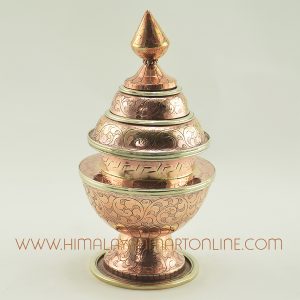
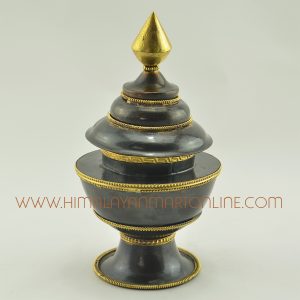
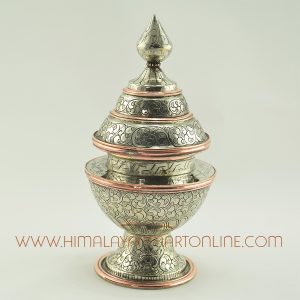
Neshi Dhupur: Neshi is also a Buddhist Ritual Object and is used to store offerings specially rice to the deities in a ritual ceremony. The Neshi is an important ritual object in the Buddhist community and Buddhist religion. The Neshi is store pot like object which is used to keep offerings in a ritual ceremony. Neshi may be found in copper, silver, brass or mixture of different metals.
Nheshi Dhupur: Nheshi is also a Buddhist Ritual Object and is used to store offerings specially rice to the deities in a ritual ceremony. The Nheshi is an important ritual object in the Buddhist community and Buddhist religion. The Nheshi is store pot like object which is used to keep offerings in a ritual ceremony. Nheshi may be found in copper, silver, brass or mixture of different metals.
Nesi Dhupur: Nesi is also a Buddhist Ritual Object and is used to store offerings specially rice to the deities in a ritual ceremony. The Nesi is an important ritual object in the Buddhist community and Buddhist religion. The Nesi is store pot like object which is used to keep offerings in a ritual ceremony. Nesi may be found in copper, silver, brass or mixture of different metals.
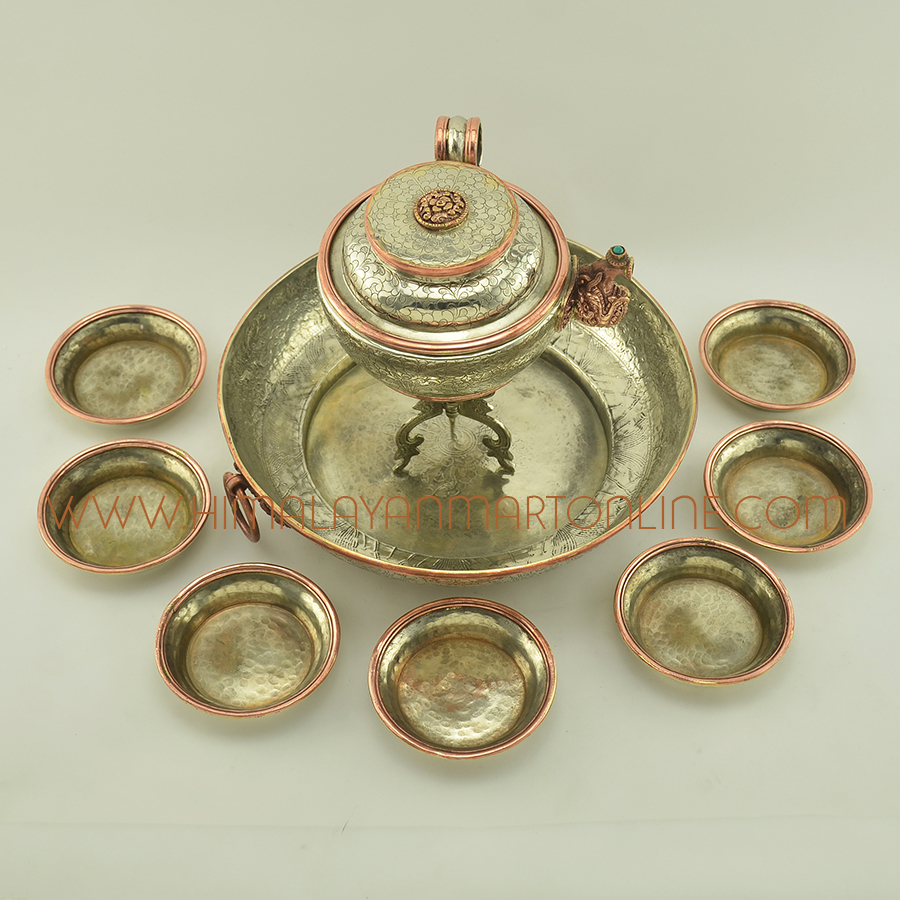
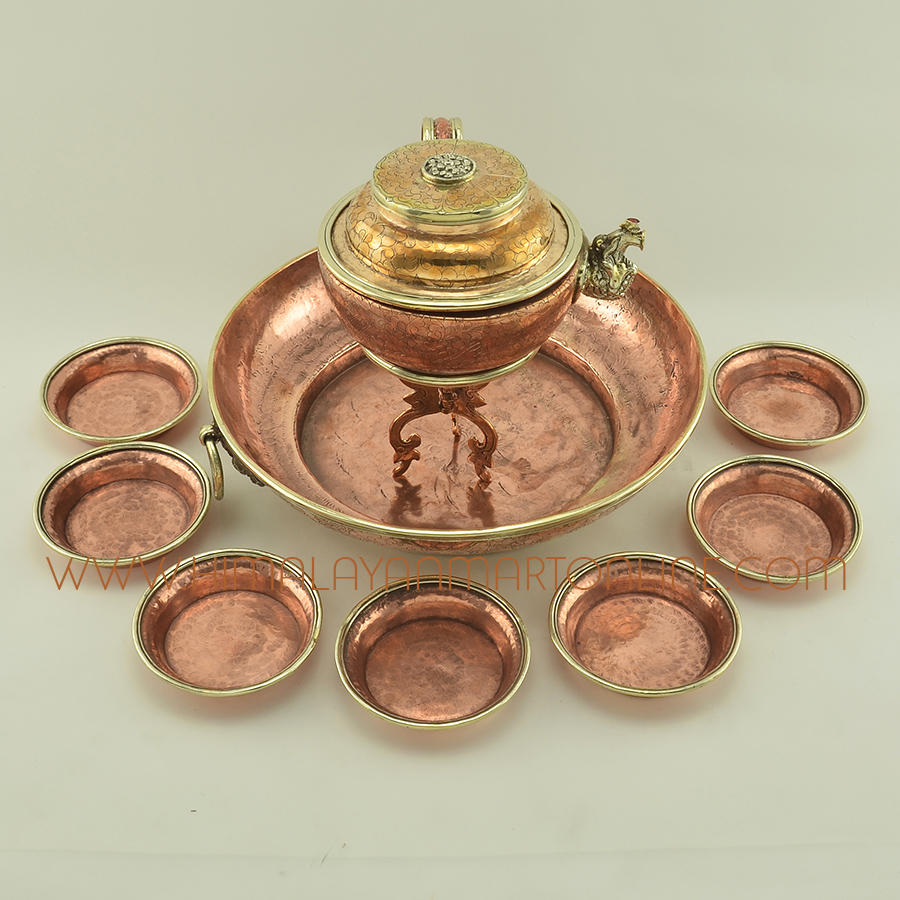
Jambala Water Offering Set: Jambala Water Offering (Chutor) Set which is also known as Water Torma Set is a whole set of pots which includes a water pot or kettle, a large plate type bowl where the offered water is stored after over filling from the Kettle, a tripod to place Kettle and 7 pieces of saucers or small plates. The Jambala Water Offering (Chutor) Set is used to perform water offering to the God of Wealth Dzambhala (Dzambhala).
Dzambala Water Offering Set: Dzambhala Water Offering (Chutor) Set which is also known as Water Torma Set is a whole set of pots which includes a water pot or kettle, a large plate type bowl where the offered water is stored after over filling from the Kettle, a tripod to place Kettle and 7 pieces of saucers or small plates. The Dzambhala Water Offering (Chutor) Set is used to perform water offering to the God of Wealth Dzambhala (Jambhala).
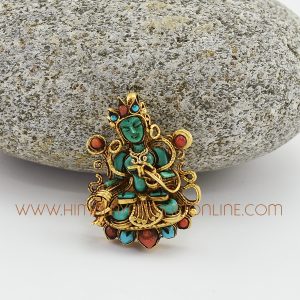
White Tara Pendant: Ghau is a small prayer box worn as pendant by Buddhists as portable shrines where prayers and sacred relics are kept and used during their travel to hold their sacred deity inside. Now, Ghau or Prayer Box pendants are often used as jewelry or personal adornment. They are used to carry prayers or prayer concerns or photos, poems, small items, or memories. Ghau pendants can carry your prayers near to your heart throughout the day. They are jewelry that has a history. The Ghau opens to a concealed inner space, and is traditionally used by Tibetan Buddhists to hold a picture of their favorite deity or Lama, a folded-up scroll of sacred mantras, special herbs or sacred relics. The Ghau is used as an amulet to help the wearer to ward off negative energy and attract blessings. A Ghau is also used as a portable shrine and are worn on a cord around the neck and hung close to the heart.
These Ghaus or Pendants are mostly made of silver like this White Tara Pendant; however, the artisans also use copper, brass, gold and other metals. Ghau often have intricate designs of deity, auspicious symbols and mantras inscribed on their outer and inner surface Ghau is often decorated by precious or semi-precious gemstones which have various healing effects on the wearer. Turquoise, considered by many as a master healing stone, Lapis Lazuli and Coral are especially popular in Ghau or Prayer Box design for their beauty and healing properties. Other gemstones used by the craftsman include: amber, carnelian, amethyst, malachite, onyx and topaz.
About this White Tara Pendant – Ritual item
This beautiful Silver Pendant is entirely a hand carved piece; made from Silver which has fine hand carvings and is submitted to a gold plating effect to yield a rich and sensuous finish and besides the decoration of Turquoise and Coral stones make this White Tara Pendant a beautiful piece of art which is entirely a hand craft. This beautiful White Tara Pendant is hand made by the master artisans of Patan, which lies in the Himalayan Kingdom of Nepal; who have been in the business from generations.
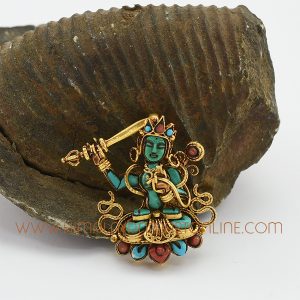
Manjushri Pendant: Ghau is a small prayer box worn as pendant by Buddhists as portable shrines where prayers and sacred relics are kept and used during their travel to hold their sacred deity inside. Now, Ghau or Prayer Box pendants are often used as jewelry or personal adornment. They are used to carry prayers or prayer concerns or photos, poems, small items, or memories. Ghau pendants can carry your prayers near to your heart throughout the day. They are jewelry that has a history. The Ghau opens to a concealed inner space, and is traditionally used by Tibetan Buddhists to hold a picture of their favorite deity or Lama, a folded-up scroll of sacred mantras, special herbs or sacred relics. The Ghau is used as an amulet to help the wearer to ward off negative energy and attract blessings. A Ghau is also used as a portable shrine and are worn on a cord around the neck and hung close to the heart.
These Ghaus or Pendants are mostly made of silver like this Manjushri Pendant; however, the artisans also use copper, brass, gold and other metals. Ghau often have intricate designs of deity, auspicious symbols and mantras inscribed on their outer and inner surface Ghau is often decorated by precious or semi-precious gemstones which have various healing effects on the wearer. Turquoise, considered by many as a master healing stone, Lapis Lazuli and Coral are especially popular in Ghau or Prayer Box design for their beauty and healing properties. Other gemstones used by the craftsman include: amber, carnelian, amethyst, malachite, onyx and topaz.
About this Manjushri Pendant – Ritual item
This beautiful Silver Pendant is entirely a hand carved piece; made from Silver which has fine hand carvings and is submitted to a gold plating effect to yield a rich and sensuous finish and besides the decoration of Turquoise and Coral stones make this Manjushri Pendant a beautiful piece of art which is entirely a hand craft. This beautiful Manjushri Pendant is hand made by the master artisans of Patan, which lies in the Himalayan Kingdom of Nepal; who have been in the business from generations.