
The Vajra and Bell are very important ritual implements in Tibetan Buddhism. The Vajra known as Dorje in Tibetan term and the Bell known as Drilbu in Tibetan term are mostly used as pair by every Buddhist monk almost in daily basis as ritual objects in tantric rituals and practice. Most of the Buddhist monks carry these two implements with them where ever they go because they need these items in their ritual performance. Though the Vajra (Tibetan: Dorje) symbolizes masculine inviolability and the Bell (Tibetan: Drilbu) symbolizes feminine wisdom are two different objects but mostly these are used as pair in the practice. These implements are attributes of many Buddhist deities and are held by deities like; Vajrapani, Chakrasamvara, Kalachakra, Vajradhara Buddha, Vajrasattva, Guru Padmasambhava, etc. as a part of their appearance which shows the importance of these two ritual items.
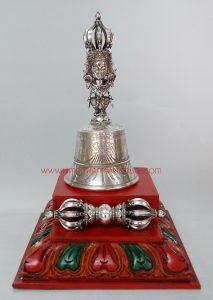
Vajra (Tibetan: Dorje)
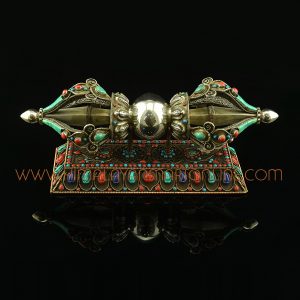
The Vajra (Dorje) is one of the main ritual implements in Buddhism. The Vajra is an important ritual sacred tool in Vajrayana Buddhism. This Vajra can also found in Hinduism and Tantric practice where it symbolizes the male principle in religious practice. The Vajra – Indestructible Thunderbolt is believed as the destroyer of all kinds of ignorance. In Hindu mythology; The Vajra is symbol of Indra the Vedic god of war and king of Devas accordingly to Hindu mythology.
There are four types of Vajras; a. The nine prongs (pointed) Vajra which is known is Commitment Vajra, in nine prongs (pointed) Vajra; there are eight prongs plus the central hub, b. The five prongs (pointed) Vajra which is known as the Full Knowledge Vajra, c. The three prongs (pointed) Vajra which is used for exorcising inimical forces, and d. The open prongs (pointed) Vajra which is called the Wrathful Vajra.
Out of these four types of Vajras; the Nine pointed and the Five pointed Vajras are found used most commonly.
In Buddhism
The Vajra (Dorje) is a ritual implement which has very important role in Tibetan Buddhism. The use of Vajra in Buddhism is in all aspect of their religious, mythology, symbolism and philosophy. Many deities in Buddhism like; Vajrasattva, Vajradhara, Vajrapani, Chakrasamvara, Kalachakra, Guru Padmasambhava etc., hold Vajra as their attributes. The Vajra along with its counterpart Bell (Drilbu) is used by Buddhist monks in almost all their ritual performance.
In Hinduism
The Vajra also has its specific role in Hinduism. According to Hindu mythology; Indra the Vedic god of war and king of Devas; holds it as his weapon. It is a powerful weapon which has the combined feathers of all sword, mace and spear in it. As per Hindu mythology; it is believed that the Vajra is made out of thigh bones of sage Dadhichi who gave up his life willingly for a noble cause so that his spine could be used to build weapon and Indra used this weapon to kill Vritrasura who had conquered heaven and terrorized the gods. Due to this supreme sacrifice, sage Dadhichi became a legend. In another incident; Vitra, the serpent of drought had swallowed the cosmic water. Indra using his Vajra weapon split Vitra’s stomach to release the water inside the Vitra’s stomach.
In Tantric Buddhism
The Vajra is used widely in the rituals of the Tantra where it symbolizes male principle where as its counterpart Bell (Drilbu) symbolizes female principle representing compassion. The use of their interaction leads to enlightenment. According to Buddhist mythology; the Vajra destroys all kinds of ignorance, and is indestructible against any evil force. Various deities like; Vajrasattva, Vajradhara, Chakrasamvara, Kalachakra, Vajrapani, Guru Padmasambhava, etc., in Buddhism are depicted holding the Vajra individually or with its counterpart Bell together. Vajrasattva, Vajradhara and some other deities hold the Vajra in their right hand along with the Bell on their left hand and Vajrapani, Guru Padmasambhava and some other deities hold the Vajra on their right hand without its counterpart the Bell.
Bell (Tibetan: Drilbu)
Like Vajra (Dorje) the Bell (Drilbu) is also an important religious implement in Tibetan Buddhism. Like its counterpart Vajra; it plays important role in religious practice. While the Vajra symbolizes the male principle; the Bell symbolizes the female principle. The Bell can be seen held by many deities in Buddhism like; Vajrasattva, Vajradhara, Chakrasamvara, Kalachakra, etc. The Vajra is held by deities in right hand whereas the Bell is held in left hand. In ritual practice; the Vajra symbolizes the male principle and is held on right hand and the Bell symbolizes the female principle and is held in left hand in the practice.
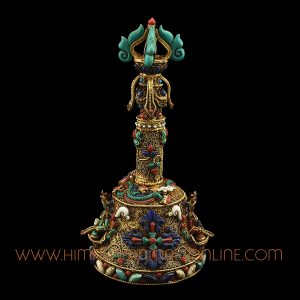
The symbolism of the Vajra Bell Ritual Implement
Vajras are made of different prongs (points) some with five, some with nine, some with three and some with open prongs. These prongs or (points) symbolize the five wisdoms that are attained through beyond ordinary limits of five kleshas which are greed, anger, delusion, pride and envy. The hub between these signifies emptiness.
Vajra; it is a Sanskrit word and in Tibetan it is called Dorje; which is related to the word for diamond. The Buddhism has very important role of Vajra; which has been shown as attributes of different deities and it us used in ritual ceremonies. According to Hindu mythology; it is used as thunderbolt weapon carried by the Vedic god Indra. The Vajra has been used as important implement in Buddhist and Hindu religion however it the Vajra as an artifact appears throughout the cultures around the world like; the Zeus carries it as thunderbolt weapon as per ancient Greek mythology. As per the Greek mythology; Zeus the Sky god received it from Cyclopes; one eyed giant creature.
In all the religion; the Vajra has been used as a weapon which destroys both internal and external enemies. Like a diamond it symbolizes the indestructible and all penetrating mind of enlightenment.
It is believed that the bell sound calls to mind to purify all kinds of sins. The sound of the Bell is considered by Tibetan Buddhists as beautiful music. The bell is used as musical instrument together with other sacred instruments like Damaru, Tingsha, etc., in ritual ceremony as musical offerings to the Buddhas and other gods. This music is presented as one of eight offerings to the deity that is invoked during the ritual.
How are they used
The Vajra and Bell are often seen held in the hands of deities, and in ritual practice they are held in the hands of the monks during rituals performance, the Vajra in the right hand, the Bell in the left hand. They are moved as pair in prescribed manners in ritual performance. When the arms are crossed holding Vajra and Bell; it symbolizes that the two are united-representing enlightenment. The Vajra is used as weapon which destroys all the negativity and sins and purify minds. The Vajra is used in other religion as well such as; it is used as weapon by the Vedic god Indra as per Hindu mythology and by Zeus as per Greek mythology. The sound of the Bell is believed to purify the minds and is considered by Tibetan Buddhists as the most beautiful music. This music is presented as one of eight offerings to the deity that is invoked during the ritual.
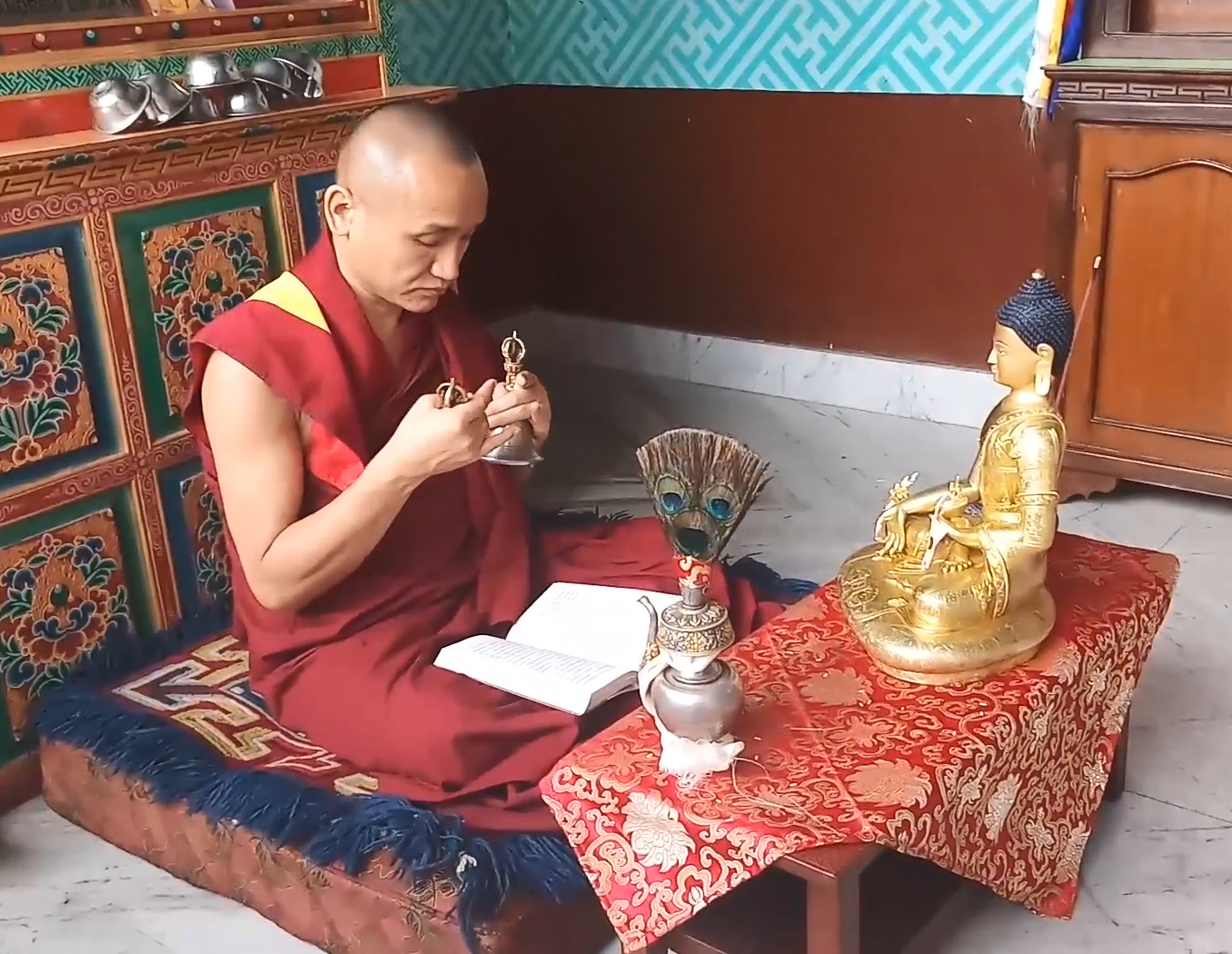
Vajra and Bell are important ritual objects not only in Buddhism but in other religion as well such as Hindu, Greek, etc. In Buddhist religion; many deities carry Vajra and Bell as their prime attributes. The Vajra is found used in Hindu and other religion such as Greek religion from ancient time. The Vajra is considered as male principle in Buddhist religion which states masculine and bold and believed to destroy all the negativity whereas the Bell is considered as the female principle which has soft and southing sound and believed to purify the negativity in minds. The Vajra and Bell are important ritual objects which are widely used in ritual ceremony in Buddhist religion by the monks. There are many ritual objects like; Damaru, Offering Bowls, Bhumpa – The Ritual Vase, Kapala, etc. which all have significant role in Buddhist tradition.
