Hindu Iconography: The Hindus follow different forms or deities in their practice and here you will find the information of some of the Hindu deities or figures or images which are practiced by the Hindus in different parts of the world.
Naag Kanya – The Guardian Goddess of the Three Realms
Naag Kanya — also known as Nag Kanya or Naga Kanya — snake of the rainbow, daughter of the serpent, guardian of treasures, benevolent goddess of the three realms. In Hindu mythology, Nagas are serpentine spirits who reside in the underworld, protecting and offering the teachings of the Mother Goddess. They are said to guard all esoteric and mystical teachings, offering them only to those who come humbly to receive. In turn, they offer protection and gifts to the seeker.
The Nagas are also known as apsaras, or elemental nymphs who preside over both the natural world as well as the unseen. They are petitioned for weather-related blessings, and it is considered highly disrespectful to pollute environments in which they are said to live. Washing soiled clothes in a Naga – inhabited stream can result in illnesses or Naga afflictions, such as cancer and skin disease.
Amongst the snake guardian elementals, Naag Kanya is Queen. She stands out as a well-loved spiritual ally in the Eastern traditions of India, Nepal, and parts of China.
Naag Kanya
In some mythological traditions, Naag Kanya is a singular goddess. But in others, “Naag Kanya” are a full tribe of serpent faerie beings. Most stories connect her with Lakshmi, the Hindu goddess of good fortune and abundance. Naag Kanya is also said to be a companion or ally of Vishnu — unlike the other Nagas, who fear being eaten by Garuda, Vishnu’s mythical bird mount. In the Buddhist traditions, Nag Kanya is regarded as a Tantric goddess and protector of Dharma.
Among devotees, Naag Kanya is said to bring enormous blessings–everything from prosperity, rain, friendship, romance, spiritual growth & enlightenment, good opportunities, generosity, protection, wisdom, and support. Their power is so great that no temple can house them—instead, they roam freely across the earth, giving their blessings wherever a humble home offering pleases them.
Gestures and Attributes
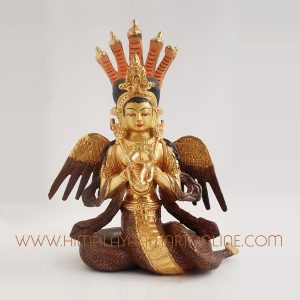
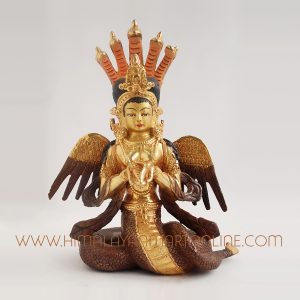
Naag Kanya is most often depicted as a woman with the lower body of a serpent, the torso of a human female, and bird wings, with hooded cobras presiding up above her crown and a conch shell in her hands. Some stories and images depict her with 5 cobras, others with 7 or 9. The number of snakes above Naag Kanya’s crown indicates one who has accessed a very high level of initiation; a fully activated Kundalini energy.
Naga Kanya – The Guardian Goddess of the Three Realms
Naga Kanya — also known as Nag Kanya or Naag Kanya — snake of the rainbow, daughter of the serpent, guardian of treasures, benevolent goddess of the three realms. In Hindu mythology, Nagas are serpentine spirits who reside in the underworld, protecting and offering the teachings of the Mother Goddess. They are said to guard all esoteric and mystical teachings, offering them only to those who come humbly to receive. In turn, they offer protection and gifts to the seeker.
The Nagas are also known as apsaras, or elemental nymphs who preside over both the natural world as well as the unseen. They are petitioned for weather-related blessings, and it is considered highly disrespectful to pollute environments in which they are said to live. Washing soiled clothes in a Naga – inhabited stream can result in illnesses or Naga afflictions, such as cancer and skin disease.
Amongst the snake guardian elementals, Naga Kanya is Queen. She stands out as a well-loved spiritual ally in the Eastern traditions of India, Nepal, and parts of China.
Naga Kanya
In some mythological traditions, Naga Kanya is a singular goddess. But in others, “Naga Kanya” are a full tribe of serpent faerie beings. Most stories connect Naga Kanya with Lakshmi, the Hindu goddess of good fortune and abundance. Nag Kanya is also said to be a companion or ally of Vishnu — unlike the other Nagas, who fear being eaten by Garuda, Vishnu’s mythical bird mount. In the Buddhist traditions, Nag Kanya is regarded as a Tantric goddess and protector of Dharma.
Among devotees, Naga Kanya is said to bring enormous blessings–everything from prosperity, rain, friendship, romance, spiritual growth & enlightenment, good opportunities, generosity, protection, wisdom, and support. Their power is so great that no temple can house them—instead, they roam freely across the earth, giving their blessings wherever a humble home offering pleases them.
Gestures and Attributes
Naga Kanya is most often depicted as a woman with the lower body of a serpent, the torso of a human female, and bird wings, with hooded cobras presiding up above her crown and a conch shell in her hands. Some stories and images depict her with 5 cobras, others with 7 or 9. The number of snakes above Naga Kanya’s crown indicates one who has accessed a very high level of initiation; a fully activated Kundalini energy.
Nag Kanya – The Guardian Goddess of the Three Realms
Nag Kanya — also known as Naga Kanya or Naag Kanya — snake of the rainbow, daughter of the serpent, guardian of treasures, benevolent goddess of the three realms. In Hindu mythology, Nagas are serpentine spirits who reside in the underworld, protecting and offering the teachings of the Mother Goddess. They are said to guard all esoteric and mystical teachings, offering them only to those who come humbly to receive. In turn, they offer protection and gifts to the seeker.
The Nagas are also known as apsaras, or elemental nymphs who preside over both the natural world as well as the unseen. They are petitioned for weather-related blessings, and it is considered highly disrespectful to pollute environments in which they are said to live. Washing soiled clothes in a Naga – inhabited stream can result in illnesses or Naga afflictions, such as cancer and skin disease.
Amongst the snake guardian elementals, Nag Kanya is Queen. She stands out as a well-loved spiritual ally in the Eastern traditions of India, Nepal, and parts of China.
Nag Kanya
In some mythological traditions, Nag Kanya is a singular goddess. But in others, “Nag Kanya” are a full tribe of serpent faerie beings. Most stories connect Nag Kanya with Lakshmi, the Hindu goddess of good fortune and abundance. Naga Kanya is also said to be a companion or ally of Vishnu — unlike the other Nagas, who fear being eaten by Garuda, Vishnu’s mythical bird mount. In the Buddhist traditions, Naga Kanya is regarded as a Tantric goddess and protector of Dharma.
Among devotees, Nag Kanya is said to bring enormous blessings–everything from prosperity, rain, friendship, romance, spiritual growth & enlightenment, good opportunities, generosity, protection, wisdom, and support. Their power is so great that no temple can house them—instead, they roam freely across the earth, giving their blessings wherever a humble home offering pleases them.
Gestures and Attributes
Nag Kanya is most often depicted as a woman with the lower body of a serpent, the torso of a human female, and bird wings, with hooded cobras presiding up above her crown and a conch shell in her hands. Some stories and images depict her with 5 cobras, others with 7 or 9. The number of snakes above Nag Kanya’s crown indicates one who has accessed a very high level of initiation; a fully activated Kundalini energy.
Nagpash Yantra is an astrological situation which is fashioned when all of the planets are located in Rahu and Ketu. Rahu is considered as snake and Ketu is its tail. It is also known as Kaal Sarp Yoga which is made from two Sanskrit words; Kaal meaning death and Sarp meaning Serpent. It is energized by 1001 Nagpash Mantra. The one who takes start on this yoga undergo from varied troubles. The Nagpash Yoga is dreaded yoga that may trigger one’s life to be miserable. Folks with Nagpash Yoga have their life stuffed with struggle. An individual underneath the difficulty of this yoga brings a lifetime of ache and misfortune. It causes setbacks in life and generates obstacles in achievement of each work you encourage. Folks having Kaal Sarp Dosha shall carry our Puja on Naag-Panchami in addition to set up energized Nagpash Yantra of their home to guard themselves from the evil impact of this yoga. It reduces the in poor health results of the Kaal Sarp Yoga, which causes set backs in life and creates obstacles within the accomplishment of each work. The Kaal Sarp Yantra or Nagpash Yantra is a curse of snakes.
Nagpash Yantra
It is beneficial for relief from malefic effects of Rahu and Ketu and solves problems, happiness in life, enhance strength, builds confidence, speech power, progress in business, gain in wealth, prosperity, success in tasks, protection from evils, family security, removes obstacles from life and divine blessings. Worshiping the consecrated Nagpash Yantra reduces in the poor health results of the Nagpash Yoga.
The Garuda is a large bird or bird like mythical creature that appears in both Hindu and Buddhist mythology. He is the Hindu name for the constellation Aquila and the Brahminy kite and Phoenix are considered to be the contemporary representations of Garuda. Indonesia adopts a more stylistic approach to the Garuda’s depiction as its national symbol, where it depicts a Javanese eagle.
Garuda is the king of birds. Its name derives from the root Gri, to swallow: he devours the snakes. He is represented with a human upper body, big eyes, beak, short blue horns, yellow hair standing on ed, bird’s claws and wings. However, sometimes, mainly in Hindu iconography, he is represented in human form with wings. He is very big bird and comes out of the egg fully grown. Garuda symbolizes the space element and the power of the sun, which can dry up the waters. Therefore, he is the natural enemy of snakes and he devours or controls them. He represents the spiritual energy of which devours the delusions of jealousy and hatred, which are represented by the snake. He is also the openness: he can stretch out his wings and soar into space. He represents the great freedom of the mind which can open and is not uptied by confliction emotions the wise mind which reaches everywhere, like the rays of the sun, and brings about the growth of life and wisdom. Specifically, in Buddhism Garuda is related of the perfection of gibing Dana parmita, just as the rays of the sun give life to the earth.
The myth of the great bird devouring the snake seems to have originated in Mesopotamia. The snake represents the subconscious or hidden aspects of the mind, those feelings and thoughts which crawl underneath the surface. He can perceive any tiny snake and instantly fall upon in. Similarly, by practicing awareness of all our feelings, thoughts and actions we can develop the wisdom which can perceive perfectly the workings of our mind and in that way, we can achieve complete freedom to act utilizing out of mind in the most beneficial way.
In Hindu Iconography he is the vehicle of Vishnu. In Buddhism, he is the vehicle of Amoghasiddhi. The Buddha who embodies the all accomplishing wisdom. He is also the vehicle of a from Lokeshvara Hariharihar vahana. He is also a deity of his own who is supposed to cure snakebite, epilepsy and diseases caused by Nagas. An image of Garuda is found in the toranas, the semicircular tympanum above the temple doors.
The emerald, also called Garuda stone is considered a protection against poison and Garuda images appear in jewelry as a protection against snake bite.
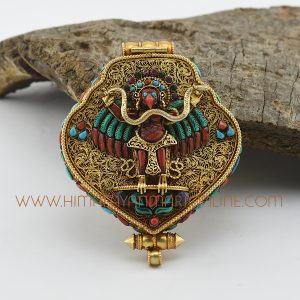
Garuda Ghau Pendant Prayer Box
In Hinduism:
In Hindu religion; he is Hindu divinity, usually the mount(vahana) of the God Vishnu. He is depicted as having the golden body of a strong man with a white face, red wings and an eagle’s beak and with a crown on his head. The ancient deity was said to be massive, large enough to block out the sun.
Garuda is known as the eternal sworn enemy of the Naga serpent race and known for feeding exclusively on snakes, such behavior may have referred to the actual short-toed Eagle of India. The image of Garuda is often used as the charm or amulet to protect the bear from snake attack and its poison, since the king of birds is an implacable enemy and “devourer of serpent”. Garudi Vidya is the Mantra against snake poison to remove all kinds of evil.
His stature in Hindu religion can be gauged by the fact that an independent Upanishad, the Garudopanishad, and a Purana, is devoted to him. Various names have been attributed to Garuda-Chirada, Gaganeshvara, Kamayusha, Kashyapi, Khageshvara, Nagantaka, Sitanana, Sudhahara, Suparna, Tarkshya, Vainateya, Vishnuratha and others. The Vedas provide the earliest reference of Garuda, though by the name of Syena, where this mighty bird is said to have brought nectar to earth from heaven. The Puranas, which came into existence much later, mention him as doing the name thing, which indicates that Syena (Sanskrit for eagle) and Garuda are the same. One of the faces of Sri Panchamukha Hanuman is Mahavira Garuda. This face points towards the west. Worship of Garuda is believed to remove the effects of poisons from one’s body. In Tamil Vaishnavism Garuda and Hanuman are known as “Periya Thiruvadi” and “Siriya Thiruvadi” respectively.
In the Bhagavad-Gita (Ch.10, Verse30), in the middle of the battlefield “Kurukshetra”, Krishna explaining his omnipresence, says – “as son of Vinata, I am in the form of Garuda, the king of the bird community (Garuda)” indicating the importance of Garuda.
He wears the serpent Adisesha on his left wrist and the serpant Gulika on his right wrist. The serpent Vasuki forms his sacred thread. The cobra Takshaka forms his belt on his hip. The snake Karkotaka is worn as his necklace. The snakes Padma and Mahapadma are his ear rings. The snake Shankachuda adorns his divine hair. He is flanked by his tow wives ‘Rudra’ and ‘Sukeerthi’ or Sukirthi. These are all invoked in Vedanta Desika’s Garuda Panchashath and Garuda Dndaka compositions. Garuda flanked with his consorts ‘Rudra’ and ‘Sukirthi’ can be seen worshiped in an ancient Soumya Keshava temple in Bindiganavile (or Mayura puri in Sanskrit) in Karnataka state of India.
Garuda Vyuha is worshiped in Tantra for Abhichara and to protect against Abhichara. However, the interesting thing is that he is the Sankarshna form of the lord who during creation primarily possesses the knowledge aspect of the lord (among Vasudeva, Sanskarshana, Pradyumna and Aniruddha forms). The important point is that he represents the five vayus with us: prana, vyana, Udana, samana, brahmana through his five forms satya, Suparna, Garuda, Tarkshya, Vihageshwara. These five vayus through yoga can be controlled through Pranayama which can lead to Kundalini Awakening leading to higher levels of consciousness. He plays an important role in Krishna Avatar in which Krishna and Satyabhama ride on Garuda to kill Narakasura. On another occasion, lord Hari rides on Garuda to save the devotee elephant. It is also said that Garuda’s wings when flying will chant the Vedas.
In the Mahabharata
Birth and deeds
The story of Garuda’s birth and deeds is told in the first book of the great epic Mahabharata. According to the epic, when he first burst forth from his egg, he appeared as a raging inferno equal to the cosmic conflagration that consumes the world at the end of every age. Frightened, the Gods begged him for mercy. Garuda, hearing their plea, reduced himself in size and energy.
Garuda’s father was the creator-rishi Kasyapa. He had two wives, Vinata and Kadru, who were daughters of Prajapathi Daksha, on the pleadings of his wives, granted them their wishes; Vinata wished for two sons and Kadru wished for thousand snakes as her sons. Both laid eggs, while the thousand eggs of Kadru hatched early (after steaming the eggs to hatch) into snakes, the hatching of two eggs of Vinata did not take place for a long time. Impatient, Vinata broke open one egg, which was half formed with the upper half only as a human and was thus deformed. Her half formed son cursed her that she would be slave for her sister (she was her rival) for a long time by which time her second son would be born who would save her from his curse; her first son who flew away and came to prominence as Aruna, the red spectacle seen as the sun rises in the morning, and as also charioteer of the sun. The second egg hatched after a long time during which period Vinata was the servant of her sister as she had lost a bet with her. When the second egg hatched, a fully grown, shining and of mighty sized bird emerged as Garuda, the king of birds. He was thus born.
One day, Vinata entered into and lost a foolish bet, as a result of which she became enslaved to her sister. Resolving to release his mother from this state of bondage, Garuda approached the serpents and asked them what it would take to purchase her freedom. Their reply was that Garuda would have to bring them the elixir of immortality, also called amrita. It was a tail order. The amrita at that time found itself in the possession of the Gods, who guarded it jealously, since it was source of their immortality. The had ringed the elixir with a massive fire that covered the sky. They had blocked the way to the elixir with a fierce mechanical contraption of sharp rotating blades. And finally, they had stationed two gigantic poisonous snakes next to the elixir as deadly guardians.
Undaunted, Garuda hastened toward the abode of the Gods intent on robbing them of their treasure. Knowing of his design, the Gods met him in full battle-array. He, however, defeated the entire host and scattered them in all directions. Taking the water of many rivers into his mouth, he extinguished the protective fire the Gods had thrown up. Reducing his size, he crept past the rotating blades of their murderous machine. And finally, he mangled the two gigantic serpents they had posted as guards. Taking the elixir into his mouth without swallowing it, he launched again into the air and headed toward the eagerly waiting serpents. On route, he encountered Vinshu, rather than fight, the two exchanged promises. Vishnu promised him the gift of immortality even without drinking from the elixir, and he promised to become Vishnu’s mount (vahan). Flying onward, he met Indra the God of the sky. Another exchange of promises occurred. He promised that once he had delivered the elixir, thus fulfilling the request of the serpents, he would make it possible for the Indra to regain possession of the elixir and to take it back to the Gods. Indra in turn promised him the serpents as food.
At long last, Garuda alighted in front of the waiting serpents. Placing the elixir on the grass, and thereby liberating his mother Vinata from her servitude, he urged the serpents to perform their religious ablutions before consuming it. As they hurried off to do so, Indra swooped in to make off with the elixir. The serpents came back from their ablutions and saw the elixir gone but with small droplets of it on the grass. They tried to lick the droplets and thereby split their tongues in two. From then onward, serpents have split tongues and shed their skin as a kind of immortality.
From that day onward, he was the alloy of the Gods and the trusty mount (vahana) of Vishnu, as well as the implacable enemy of snakes, upon whom he preyed at every opportunity.
Descendants
According to the Mahabharata, Garuda had six sons from whom were descended the race of birds. The members of this race were of great might and without compassion, subsisting as they did on their relatives the snakes. Vishnu was their protector.
As a symbol
Throughout the Mahabharata, he is invoked as a symbol of impetuous violent force, of speed, and of martial prowess. Powerful warriors advancing rapidly on doomed foes are likened to Garuda swooping down on a serpent. Defeated warriors are like snakes beaten down by Garuda. The field marshal Drona uses a military named after Garuda. Krishna even carries the image of Garuda on his banner.
In Buddhism
In Buddhist mythology, the Garuda are enormous predatory birds with intelligence and social organization. Another name for the Garuda is Suparna, meaning “well-winged, having good wings”. Like the Naga, they combine the characteristics of animals and diving beings, and may be considered to be among the lowest Devas.
The exact size of the Garuda is uncertain, but its wings are said to have a span of many miles. This may be a poetic exaggeration, but it is also said that when a Garuda’s wings flap, they create hurricane-like winds that darken the sky and blow down houses. A human being is so small compared to a Garuda that a man can hide in the plumage of one without being noticed. They are also capable of tearing up entire banyan trees from their roots and carrying them off. Garudas are the great golden-winged Peng birds. They also have the ability to grow large or small, and to appear and disappear at will. Their wingspan is 330 yojanas (one yojana being 40 miles long). With one flap of its wings, a Peng bird dries up the waters of the sea so that it can bobble up all the exposed Dragons. With another flap of its wings, it can level the mountains by moving them into the ocean.
There were also the four Garuda-kings: Great-Power-Virtue Garuda-King, Great-Body Garuda-King, Great-Fulfillment Garuda-King and Free-At-Will Garuda-King, each accompanied by hundreds of thousands of attendants.
The Garudas have kings and cities, and at least some of them have the magical power of changing into human form when they have dealings with people. On some occasions Garuda kings have had romances with human women in this form. Their dwellings are in groves of the simbali, or silk-cotton tree.
The Garudas are enemies to the Nagas, a race of intelligent serpent or dragon like beings, whom they hunt. The Garudas at one time caught the Nagas by seizing them by their heads; but the Nagas learned that by swallowing large stones, they could make themselves too heavy to be carried by the Garudas, wearing them out and killing from exhaustion. This secret was divulged to one of the Garudas by the Ascetic Karambiya, who taught him how to seize a Naga by the tail and force him to vomit up the stones inside.
The Garudas were among the beings appointed by Sakra to guard Mount Sumeru and the Traystrimsa Heaven from the attacks of the Asuras.
In the Mahasamyatta Sutta, the Buddha is shown making temporary peace between the Garudas and Nagas.
The Thai rendering of the Krut (Garuda) as Vishnu vehicle and Garuda’s quest for elixir was based on Indian legend of Garuda. It was told that Garuda overcame many heavenly beings in order to gain the ambrosia (amrita) elixir. No one was able to get the better of him, not even Narai (Vishnu). At last, a truce was called and an agreement was made to settle the rancor and smooth all the ruffled feathers. It was agreed that when Narai is in his heavenly palace, Garuda will be positioned in a superior status, atop the pillar above Narai’s residence. However, whenever Narai wants to travel anywhere, Garuda must serve as his transport.
The Sanskrit word Garuda has been borrowed and modified in the languages of several countries. In Burmese, Garudas are called galone. In Burmese Astrology, the vehicle of the Sunday planet is the galone. In the Kapampangan Language of the Philippines, the native word for eagle is Galura. In Japanese a Garuda is called Karura (however, the from Garuda is used in recent Japanese fiction).
For the Mongols, the Garuda is called Khan Garuda or Khangarid. Before and after each round of Mongolian wrestling, wrestlers perform the Garuda Ritual, a stylized imitation of the Khangarid and a hawk.
In the Qing Dynasty fiction, the story of Yue Fei (1684), he sites at the head of the Buddha’s throne. But when a celestial bat (an embodiment of the Aquarius constellation) flatulates during the Buddha’s expounding of the Lotus Sutra, Garuda kills her and is exiled from paradise. He is later reborn as Song Dynasty General Yue Fei. The bat is reborn as Lady Wang, wife of the traitor Prime Minister Qin Hui, and is instrumental in formulating the “Eastern Window” plot that leads to Yue’s eventual political execution. It is interesting to note the story of Yue Fei plays on the legendary animosity between Garuda and the Nagas when the celestial bird-born Yue Fei defeats a magic serpent who transforms into the unearthly spear he uses throughout his military career. Literary critic C.T. Hsia explains the reason whey Qian Cai, the book’s author, linked Yue with Garuda is because of the homology in their Chinese names. Yue Fei’s style name is Great Peng, the Golden-Winged Illumination King.