
GURU GAMPOPA – THE MAN FROM GAMPO
Article written March 5, 2020 By hmmart
GURU GAMPOPA – THE MAN FROM GAMPO
In East Tibet, Gampopa (1079 – 1135) was the son of a doctor, and a doctor himself. Gampopa was trained as a physician who devoted himself to the Dharma after the death of his wife. Guru Gampopa became the heart son of Milarepa and was the root guru of the first Karmapa, Dusum Khyempa. It is his synthesis of the traditions of Dharma teachings melded with the experiential meditative teaching of Milarepa that formed the Kagyu tradition, as we know it today. Guru Gampopa wrote the “Jewel Ornament of Liberation” and is usually depicted wearing robes and a red hat, which has become synonymous with the Kagyu School.
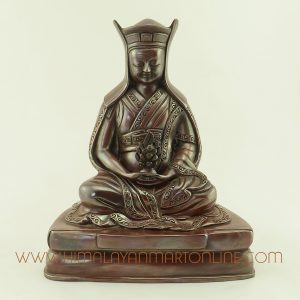
Gampopa married in his early twenties, and fathered two sons. Several years later, an epidemic took both their lives, despite his skill. His wife falling sick of the same disease, and similarly failing to respond to his ministrations, begged him as she died not to marry again, but to become a monk.
One might question her motives, but nevertheless, at the age of twenty – six, Gampopa became a novice in the Kadampa tradition. Guru Gampopa applied himself, working with many masters, and achieved a high degree of proficiency before – at thirty – two – hearing talk of Milarepa. Feeling a surge of devotion in response to these tales, and understanding that this must be his true teacher, he set out on a grueling but eventually successful search to find him.
Guru Gampopa, a talented writer, of great insight, was entrusted by Milarepa with the complete Kagyu transmission – the only one of Milarepa’s students so honored – before leaving Milarepa to go into retreat at Dagpo in South – East Tibet. There he founded the monastery of Daglha Gampo, where he drew many disciples. Four of these were to found the four “major” Kagyu branches. Eight “minor” branches would appear later. One of the four, Dusum Khyenpa was both the next Kagyu lineage – holder, and the first Karmapa.
- Visit Guru Gampopa Statues Collection
- Visit Guru Gampopa Thangka Painting Collection

SAKYAMUNI BUDDHA – THE LION OF THE SAKYAS
Article written March 5, 2020 By hmmart
SAKYAMUNI BUDDHA – THE LION OF THE SAKYAS
Sakyamuni Buddha is the Buddha of our time. He is the glorious root teacher of all the diverse lineages that make up Buddhism as we know it. Born Siddhartha Gautama more than 2500 years ago, he was the crown prince of the Sakya kingdom located in the Himalayan foothills of what is now southern Nepal. He left luxurious palace life behind him, however, in pursuit of the truth of the origin of suffering and the cessation of fear. His astounding courage, determination, wisdom and compassion led to his perfect enlightenment despite seemingly insurmountable obstacles. His teachings have transformed individuals and nations throughout the world and still speak to us today.
GESTURES AND ATTRIBUTES
The Sakyamuni Buddha is depicted with his right hand extended to the earth in the Bhumisparsha Mudra, the gesture of witness. Sakyamuni Buddha is “calling the earth to witness” his supreme victory over the temptations and illusions of the material world as symbolized by the demon Mara. Sakyamuni Buddha’s left hand lies in his lap with palm upward in the gesture of meditation (Dhyana Mudra). In some representations he also holds the begging bowl of an ordained Buddhist monk. The bowl contains three precious nectars indicating that he has conquered the three demons of uncontrolled death, contaminated aggregates, and delusion. Thus, this posture is known as “Buddha Sakyamuni Conquering the Demons” and shows the moment of the Buddha’s full enlightenment under the Bodhi tree.
The essence of the Sakyamuni Buddha’s early preaching was said to be the four Noble truths:
1) life is fundamentally disappointment and suffering.
2) suffering is a result of one’s desires for pleasure, power, and continued existence;
3) to stop disappointment and suffering on must stop desiring; and
4) the way to stop desiring and thus suffering is the Noble eight fold path – right views, right intention, right speech, right action, right livelihood, right effort, right awareness and right concentration. The realization of the truth of Anatman (no eternal self) was taught as essential for the indescribable state of release called nirvana
SHAKYAMUNI BUDDHA – THE LION OF THE SHAKYAS
Article written March 5, 2020 By hmmart
SHAKYAMUNI BUDDHA – THE LION OF THE SHAKYAS
Shakyamuni Buddha is the Buddha of our time. He is the glorious root teacher of all the diverse lineages that make up Buddhism as we know it. Born Siddhartha Gautama more than 2500 years ago, he was the crown prince of the Shakya kingdom located in the Himalayan foothills of what is now southern Nepal. He left luxurious palace life behind him, however, in pursuit of the truth of the origin of suffering and the cessation of fear. His astounding courage, determination, wisdom and compassion led to his perfect enlightenment despite seemingly insurmountable obstacles. His teachings have transformed individuals and nations throughout the world and still speak to us today.
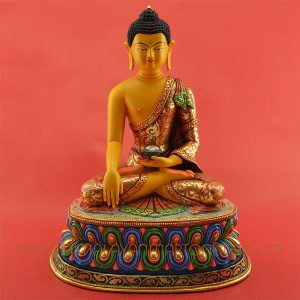
GESTURES AND ATTRIBUTES
The Shakyamuni Buddha is depicted with his right hand extended to the earth in the Bhumisparsha Mudra, the gesture of witness. He is “calling the earth to witness” his supreme victory over the temptations and illusions of the material world as symbolized by the demon Mara. His left hand lies in his lap with palm upward in the gesture of meditation (Dhyana Mudra). In some representations he also holds the begging bowl of an ordained Buddhist monk. The bowl contains three precious nectars indicating that he has conquered the three demons of uncontrolled death, contaminated aggregates, and delusion. Thus, this posture is known as “Buddha Shakyamuni Conquering the Demons” and shows the moment of the Buddha’s full enlightenment under the Bodhi tree.
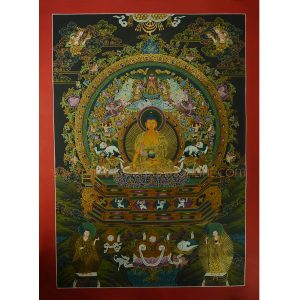
The essence of the Shakyamuni Buddha’s early preaching was said to be the four Noble truths:
1) life is fundamentally disappointment and suffering.
2) suffering is a result of one’s desires for pleasure, power, and continued existence;
3) to stop disappointment and suffering on must stop desiring; and
4) the way to stop desiring and thus suffering is the Noble eight fold path – right views, right intention, right speech, right action, right livelihood, right effort, right awareness and right concentration. The realization of the truth of Anatman (no eternal self) was taught as essential for the indescribable state of release called nirvana
AMITABHA BUDDHA – THE BUDDHA OF INFINITE LIGHT
Article written March 4, 2020 By hmmart
AMITABHA BUDDHA – THE BUDDHA OF INFINITE LIGHT
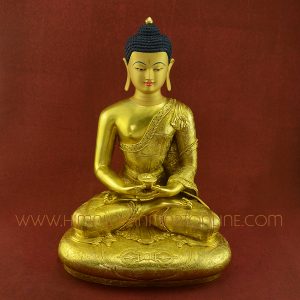
The name Amitabha means “Infinite Light” Amitabha’s Discriminating Wisdom conquers the poison of the passions–all cravings, covetousness, greed and lust. With this wisdom, the disciple discerns all beings separately yet knows every being as an individual expression of the One. In the mandala of the Dhyani Buddhas, Amitabha is positioned to the west. His color is rose (red), the color of the setting sun. Amitabha Buddha rules over the element of fire and personifies the Skandha of perception. Thus, the eye and the faculty of seeing are associated with Amitabha Buddha. The peacock, with on its plumes, is his throne-bearer. The peacock symbolizes grace.
According to the Larger Sutra of Immeasurable Life, the magnificence of Amitabha Buddha surpasses that of all other great beings, thus he is known as the Buddha of all the Buddhas. Buddha Shakyamuni once said of Amitabha, “The majestic glory of his light could not be exhaustively described if I praised it continuously, day and night, for the period of one kapala.”
Amitabha dwells in a pure celestial realm, created via the power of his infinite merit accumulated over countless lifetimes as a Bodhisattva. His light shines brilliantly from this celestial realm, pervading the entire universe. According to the Sutra, if sentient beings encounter his light, their defilement are removed; if they see his light, they are relieved and freed from affliction. At the end of their lives, beings who have faith in Amitabha reach emancipation, as he gives them rebirth in his Pure Land. And as Shakyamuni explains, “Sentient beings who are born in that Buddha-land all reside among those assured of nirvana.”
GESTURES AND ATTRIBUTES
Amitabha is depicted in Dhyana Mudra, the gesture of meditation, with both palms face up and lying in his lap. His right hand, resting on top, symbolizes the state of enlightenment, while his left hand, resting below, represents the world of appearance. Thus, Amitabha’s posture expresses his mastery over the world of appearance through enlightenment, and signifies the enlightened state of mind for which samsara and nirvana are one. In some representations, he holds the traditional begging bowl of an ordained Buddhist monk. The bowl is filled with amrita, the elixir of awakening and immortality, and symbolizes Amitabha’s infinite openness and receptivity toward all sentient beings.
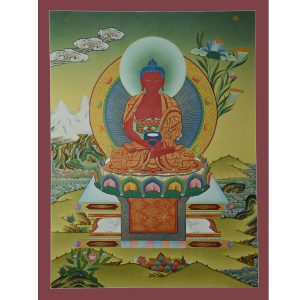
Amitabha’s symbol is the Padma, or Lotus, placed between him and Vairochana in this mandala. In Buddhism, the lotus can symbolize many things, including spiritual unfoldment, purity, the true nature of beings realized through enlightenment, and compassion, the purified form of passion. Devotees aspire to be reborn in Amitabha’s Western Paradise, known as Sukhavati, where conditions are ideal for attaining enlightenment. His Mudra is the Dhyana (meditation) Mudra. His bija is Hrih and his mantra is Om Amitabha Hrih. Some consider Amitabha to be synonymous with Amitayus, the Buddha of Infinite Life. Others honor Amitayus as a form of Amitabha or as a separate Buddha. Amitayus is usually depicted holding a vessel of the elixir of immortal life.
MEDICINE BUDDHA / SANGYE MENLHA – THE SUPREME HEALER
Article written March 4, 2020 By hmmart
MEDICINE BUDDHA / SANGYE MENLHA – THE SUPREME HEALER
Medicine Buddha: Noble One, you should think of yourself as someone who is sick,
Of the Dharma as the remedy,
Of the Buddha as a skillful doctor,
And of your diligent practice as the way to recovery.
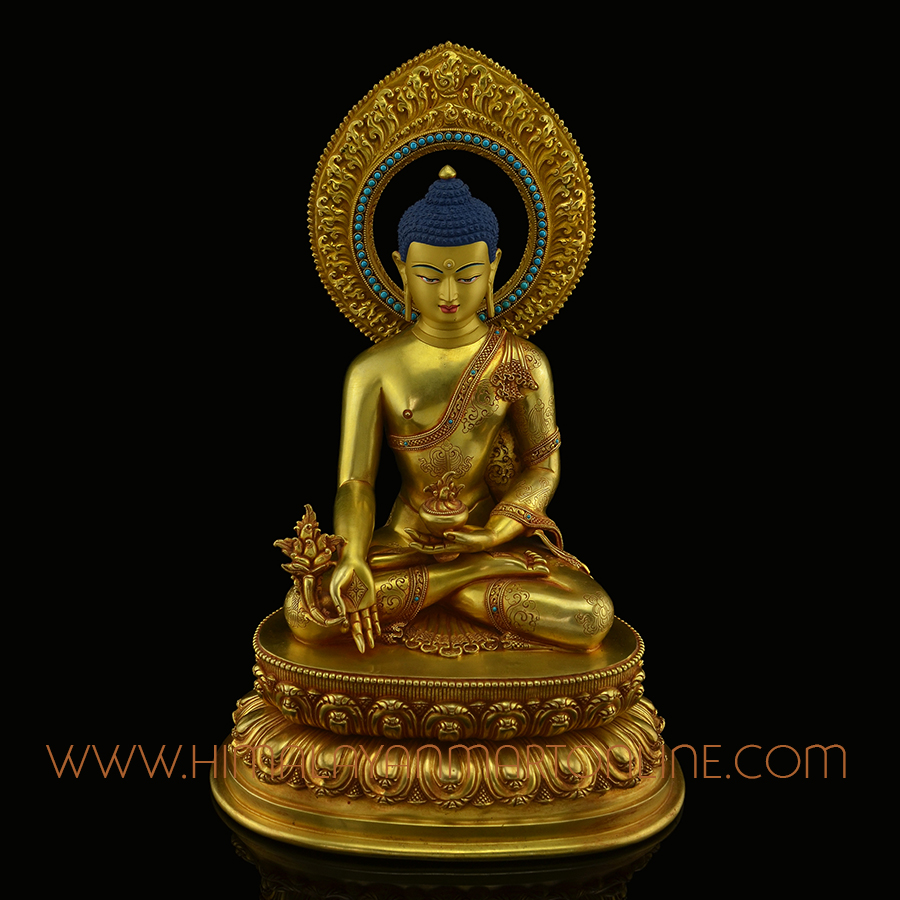
The Medicine Buddha / Sangye Menlha, or Bhaisajyaguru, is the Buddha of Healing. Meditating on the Medicine Buddha is considered to be a powerful method for increasing healing powers, allowing practitioners to alleviate their own sufferings as well as those of others. Through his boundless compassion and generosity, Bhaisajyaguru helps sincere seekers overcome physical illness and infirmity. But even more importantly, the Buddha is the skillful doctor who heals the great disease afflicting all sentient beings. By providing the Dharma as a profound antidote to the poisons of attachment, hatred and ignorance, he lifts the veil of delusion and points the way to freedom.
GESTURES AND ATTRIBUTES
The Medicine Buddha / Sangye Menlha is depicted with his right hand extended downward, palm open, with thumb and index finger touching. This posture is known as Varada Mudra, or the gesture of granting wishes. This mudra symbolizes Bhaisajyaguru’s kindness, charity and compassion toward all beings. In the same hand he lightly grasps a sprig of the Myrobalan plant, an important healing herb in Ayurvedic medicine. It is believed that this plant has the power not only to heal the body, but also to free one from the inner sicknesses of attachment, hatred and ignorance. His left hand lies in his lap with palm upward in the gesture of meditation (Dhyana Mudra), representing the eradication of all sickness and suffering through the realization of absolute truth. In the same hand he holds the traditional begging bowl of an ordained Buddhist monk. The bowl contains a sacred medicinal nectar that cures all ills, hindrances and obstacles.
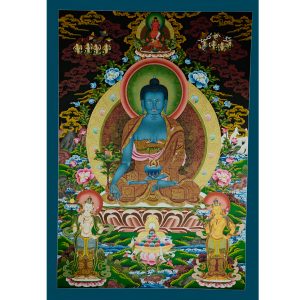
The Bhaishajyaguru sutra makes this Buddha far more than a healer of either the body or the spirit. Medicine Buddha is conceived, rather, as supreme and cosmic figure that illuminates the entire world and possesses infinite knowledge. It is also interesting to note that the sutra places considerable importance on the worship of the healing Buddha’s image. The worshiper should “bathe, and with a pure mind try to be friendly to all beings. After this he is to circumambulate the image with music…” The Chinese translation further states that “if one makes an image of this Buddha, or if one recites the text of the sutra, he will escape from the nine ways of death”.
MAITREYA BUDDHA – THE FUTURE BUDDHA
Article written March 4, 2020 By hmmart
MAITREYA BUDDHA – THE FUTURE BUDDHA
Maitreya Buddha is the Buddha of Future, and also known as The Laughing Buddha, is the one to follow up the historical Buddha Shakyamuni Buddha. Maitreya Buddha waits in Tushita Heaven for the moment he is to appear on earth as the Buddha of the fifth world cycle. Maitreya Buddha is a future Buddha who is expected to come to earth from Tusita (Tushita) Heaven. Shakyamuni Buddha predicted that due to the inevitable degeneration of the times, his own teachings would last just four thousand years before disappearing from this world. People will grow more and more immoral and their lifespan will gradually decrease, as will their health, stature and fortune. While such delusions as miserliness, hatred and jealousy gain strength, the world will go through prolonged periods of famine, disease and continuous warfare until it eventually resembles a vast battlefield of graveyard. Thereupon Maitreya will appear, not in his fully evolved Buddha form, but as a person of regal bearing, very handsome and taller than those around him. On seeing this unusual being, people will be filled with wonder and faith, and will ask how he came to have such an attractive appearance. Maitreya will reply that this is due to his practice of patience, avoiding giving harm to others, and if others will also abide in love and tolerance, they could become similar to him.
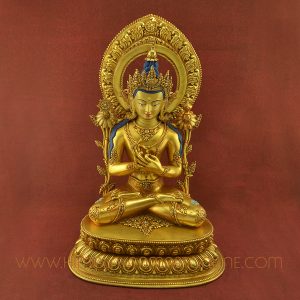
Maitreya’s appearance will mark a great turning point in the fortunes of this world. As more and more beings follow his example, their store of merit, and consequently their lifespan, will increase. Eventually people will live in health for such a long time that the sufferings of old age and death will scarcely be known. At that time, their observance of morality will grow lax as people become more and more involved in the pleasures of their existence. With this laxity will come another gradual shortening and degeneration of their lifespan until eventually beings once again will become suitable ripe to take sincere interest in the spiritual path. When the human lifespan as increased again to many thousands of years, and when the planet will be entirely dominated by a benevolent wheel – turning sovereign (Chakravartin) named Shankha, it is at this time that Maitreya Buddha will descend from the Tushita Buddha field (Devaloka) where he now resides, to appear in this world as the fifth founding Buddha of this world age. Maitreya will be born the son of a Brahmin priest, and will renounce the world and attain enlightenment in a single day, not requiring six long years. The world in this time will be politically neutralized, and therefore the warrior class and its martial virtues will be obsolete. Thus he will be born among the intellectuals, the priests, and his teaching will bring the gentler emotions to the fore. Maitreya Buddha is supposed to be passing the life of a Bodhisattva in the Tusita (Tushita) Heaven preparatory to his descent to earth in Human form. It is said that he will come to earth full 4000 years after the disappearance of Gautama Buddha for the deliverance all sentient beings. Maitreya may be represented as a standing figure adorned with rich ornaments and holding in his right hand the stalk of a lotus. Maitreya may also be represented seated as a Buddha, with legs either interlocked or dangling down. His color is yellow, and his images sometimes bear the figures of Dhyani Buddhas.
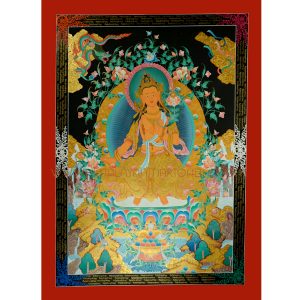
The Maitreya Buddha represents a very important figure in Buddhism. It is believed that if one diligently cultivates one’s virtues in this lifetime, one will be reborn into Tushita Heaven where he or she wills me the Maitreya Buddha. Furthermore he or she will also be present at the Maitreya Buddha’s first Dharma Talk after his enlightenment and attain enlightenment himself. Hence the tradition of worshiping the Maitreya, Amitabha and Avalokiteshvara Bodhisattvas remains strong among the Buddhist community even today.
GESTURES AND ATTRIBUTES
Maitreya Buddha is seated on a throne, with both feet on the ground, poised in readiness to rise as he awaits the call of his time. His hands, held at the level of his heart, form the Dharmachakra Mudra, the gesture of teaching and turning the Wheel of Dharma. Between the thumb and index finger of each hand he holds the stem of a lotus flower, indicating his radiant power and purity. Beside his right ear one lotus blooms and supports a golden Wheel of Dharma, which as it turns carries beings along spiritual paths to liberation and enlightenment. Beside his left ear the second lotus blossom supports a long-necked vase brimming with nectar; symbolizing the nectar of pure Dharma which Maitreya Buddha will one day pour onto the world. Above Maitreya’s head is a beautiful parasol, indicating that he offers protection and refuge to all beings.
Blessing ceremony for the 7.25″ Medicine Buddha / Menla Statue
Article written August 2, 2019 By hmmart
Medicine Buddha Statue Blessing: Guru Wangda from Sangye Choeling Monastery in Swayambhu, Kathmandu performing blessing ceremony for the:
a. 7.25″ Medicine Buddha / Menla Statue
Why Butter lamps / Lights Offering?
Article written March 7, 2019 By hmmart
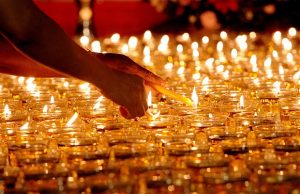
Why offering butter lamps or lights? Is that just a cultural tradition? What is the benefit of making butter lamps / light offerings? Why should one make butter lamp offerings? Because we are not accustomed to the practice, these doubts often arise.
Phakchok Rinpoche explains the meaning of traditional butter lamp offerings.
Why offering butter lamps or lights? Light means understanding because light represents wisdom. And light removes and dispels misunderstanding. All of our suffering comes from not knowing and not seeing. Offering lights or butter lamps indirectly removes confusion. Moreover, to be successful in life we need to have clear ideas and good understanding. And we should not just believe that success and good results are based on luck. Instead, when we have problems, we need clear understanding and wisdom to solve those problems.
Vast Offerings
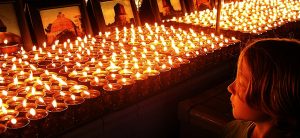
Why butter lamps or lights offerings? And why so many? For example, we hear about big offerings of 100,000 butter lamps. How does this benefit? The effect of making large offerings is immense. Because of this, Rinpoche reminds us that we all should make big offerings. Vast offerings reduce obstacles and achieve big results. And the good news is that even large light offerings are relatively easy for us to arrange. The traditional offerings are butter lamps, as in the photo on this page. But, we can also use candles and lanterns. Nowadays, especially inside buildings, we often use electric or battery-operated lights.
Correct Motivation
It is very important to have correct motivation when we make offerings. Therefore, we should pause before we start our offerings to recall the vast attitude of bodhicitta. Here we include a beautiful aspiration prayer by Mipham Rinpoche. The Tibetan/English text for the prayer can be found at Chants for the Meditation Session at Lhasey Lotsawa.
Guru Kelsang Blessing Shakyamuni Buddha & Maitreya Buddha Statues
Article written March 7, 2019 By hmmart
Guru Kelsang from Sangye Choeling Monastery in Swayambhu, Kathmandu performing blessing ceremony for the:
a. 12.5″ Shakyamuni Buddha Statue
b. 3.75″ Maitreya Buddha Statue
Tibetan Ghau Pendant – Buddhist Ritual Prayer Box
Article written February 24, 2019 By hmmart
Ghau – Pendant – A Ritual Prayer Box
Ghau is a small prayer box worn as pendant by Buddhists as portable shrines where prayers and sacred relics are kept and used during their travel to hold their sacred deity inside. Now, Ghau or Prayer Box pendants are often used as jewelry or personal adornment. They are used to carry prayers or prayer concerns or photos, poems, small items, or memories. Ghau pendants can carry your prayers near to your heart throughout the day. They are jewelry that has a history. The Ghau opens to a concealed inner space, and is traditionally used by Tibetan Buddhists to hold a picture of their favorite deity or Lama, a folded up scroll of sacred mantras, special herbs or sacred relics. The Ghau is used as an amulet to help the wearer to ward off negative energy and attract blessings. A Ghau are also used as a portable shrine and are worn on a cord around the neck and hung close to the heart.
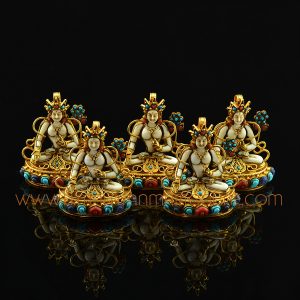
The Ghau is mostly made of silver, however the artisans also use copper, brass, gold and other metals. Ghau often have intricate designs of deity, auspicious symbols and mantras inscribed on their outer and inner surface Ghau is often decorated by semi precious gemstones which have various healing effects on the wearer. Turquoise, considered by many as a master healing stone, Lapis Lazuli and Coral are especially popular in Ghau or Prayer Box design for their beauty and healing properties. Other gemstones used by the craftsman include: amber, carnelian, amethyst, malachite, onyx and topaz.