
AMITABHA BUDDHA – THE BUDDHA OF INFINITE LIGHT
The name Amitabha means “Infinite Light” Amitabha’s Discriminating Wisdom conquers the poison of the passions–all cravings, covetousness, greed and lust. With this wisdom, the disciple discerns all beings separately yet knows every being as an individual expression of the One. In the mandala of the Dhyani Buddhas, Amitabha is positioned to the west. His color is rose (red), the color of the setting sun. Amitabha Buddha rules over the element of fire and personifies the Skandha of perception. Thus, the eye and the faculty of seeing are associated with Amitabha Buddha. The peacock, with on its plumes, is his throne-bearer. The peacock symbolizes grace.
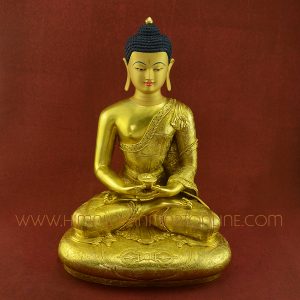
According to the Larger Sutra of Immeasurable Life, the magnificence of Amitabha Buddha surpasses that of all other great beings, thus he is known as the Buddha of all the Buddhas. Buddha Shakyamuni once said of Amitabha, “The majestic glory of his light could not be exhaustively described if I praised it continuously, day and night, for the period of one kapala.”
Amitabha dwells in a pure celestial realm, created via the power of his infinite merit accumulated over countless lifetimes as a Bodhisattva. His light shines brilliantly from this celestial realm, pervading the entire universe. According to the Sutra, if sentient beings encounter his light, their defilement are removed; if they see his light, they are relieved and freed from affliction. At the end of their lives, beings who have faith in Amitabha reach emancipation, as he gives them rebirth in his Pure Land. And as Shakyamuni explains, “Sentient beings who are born in that Buddha-land all reside among those assured of nirvana.”
GESTURES AND ATTRIBUTES
Amitabha is depicted in Dhyana Mudra, the gesture of meditation, with both palms face up and lying in his lap. His right hand, resting on top, symbolizes the state of enlightenment, while his left hand, resting below, represents the world of appearance. Thus, Amitabha’s posture expresses his mastery over the world of appearance through enlightenment, and signifies the enlightened state of mind for which samsara and nirvana are one. In some representations, he holds the traditional begging bowl of an ordained Buddhist monk. The bowl is filled with amrita, the elixir of awakening and immortality, and symbolizes Amitabha’s infinite openness and receptivity toward all sentient beings.
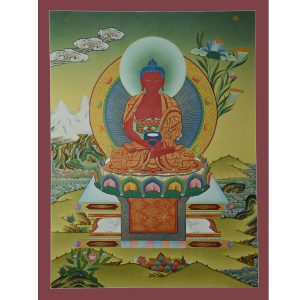
Amitabha’s symbol is the Padma, or Lotus, placed between him and Vairochana in this mandala. In Buddhism, the lotus can symbolize many things, including spiritual unfoldment, purity, the true nature of beings realized through enlightenment, and compassion, the purified form of passion. Devotees aspire to be reborn in Amitabha’s Western Paradise, known as Sukhavati, where conditions are ideal for attaining enlightenment. His Mudra is the Dhyana (meditation) Mudra. His bija is Hrih and his mantra is Om Amitabha Hrih. Some consider Amitabha to be synonymous with Amitayus, the Buddha of Infinite Life. Others honor Amitayus as a form of Amitabha or as a separate Buddha. Amitayus is usually depicted holding a vessel of the elixir of immortal life.
