Varada Mudra: The Gesture of Compassion and Generosity

Varada Mudra an Introduction:

In the realm of traditional Tibetan and Indian art and spiritual iconography, the Varada Mudra stands out as a symbolic and revered hand gesture. This ancient gesture, commonly seen in depictions of various deities and enlightened beings, holds deep spiritual significance, embodying qualities of compassion, generosity, and the granting of boons. Let’s explore the origins, cultural contexts, and the profound symbolism behind the Varada Mudra.

Origins and Meaning:

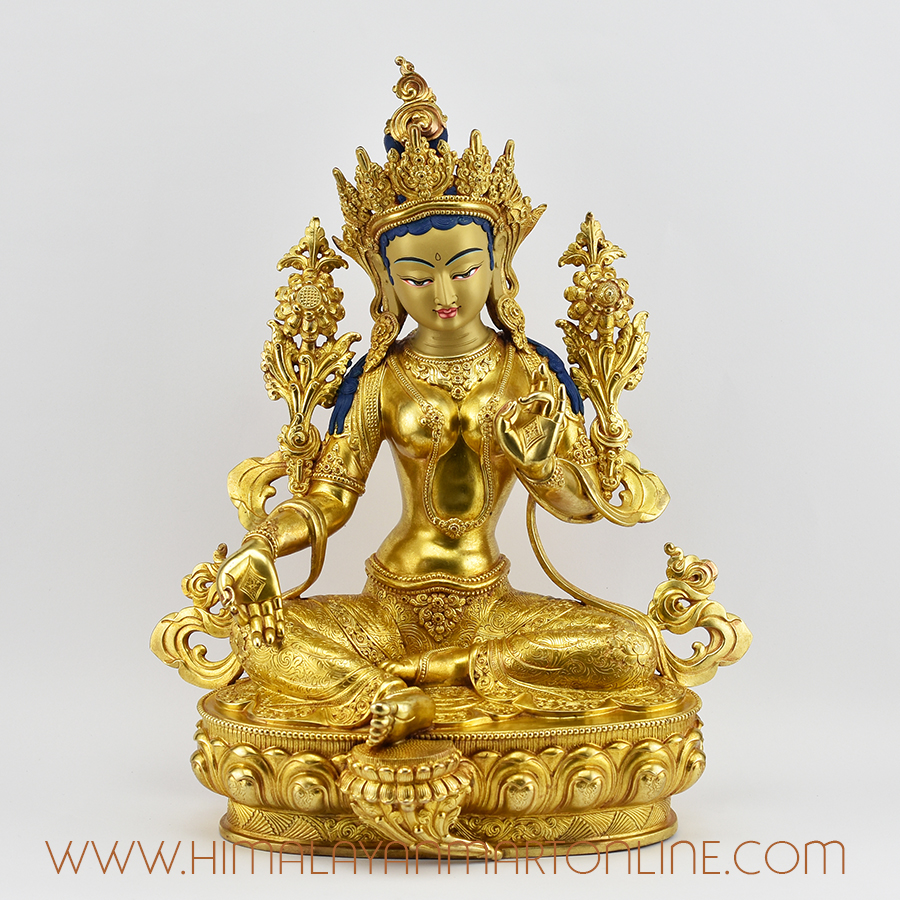
The term “Varada Mudra” is derived from the Sanskrit language, where “Varada” translates to “granting wishes” or “boon-bestowing,” and “Mudra” refers to a symbolic hand gesture. The Varada Mudra is formed by extending the open right hand downward, with the fingers pointing towards the ground. This gesture signifies the act of giving, granting, or offering blessings and protection to those who seek them.
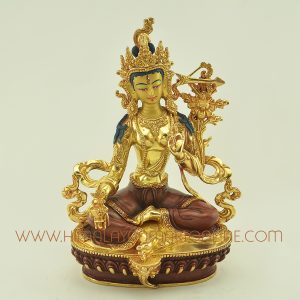
Tibetan Green Tara Statue

Symbolism in Hinduism:

In Hindu iconography, the Varada Mudra is commonly associated with various deities, particularly those known for their compassion and benevolence. Lord Shiva, the auspicious Lord of Destruction, often depicts the Varada Mudra to convey his willingness to grant blessings and protect his devotees. Goddess Lakshmi, the embodiment of wealth and prosperity, is also frequently portrayed with the Varada Mudra, symbolizing her bestowal of abundance and well-being.

The Varada Mudra is a visual representation of the divine act of giving and the boundless generosity of the gods. It signifies the removal of obstacles, the granting of wishes, and the compassion that flows freely from the divine to the devotee.

Buddhist Representation:

In Buddhism, the Varada Mudra is similarly significant and is often associated with various Buddhas and Bodhisattvas. For example, the historical Buddha, Siddhartha Gautama, is depicted in the Varada Mudra to symbolize the fulfillment of wishes and the compassionate acceptance of all beings. Avalokiteshvara, the Bodhisattva of Compassion, also commonly adopts the Varada Mudra, embodying the readiness to grant spiritual and worldly gifts to those in need.
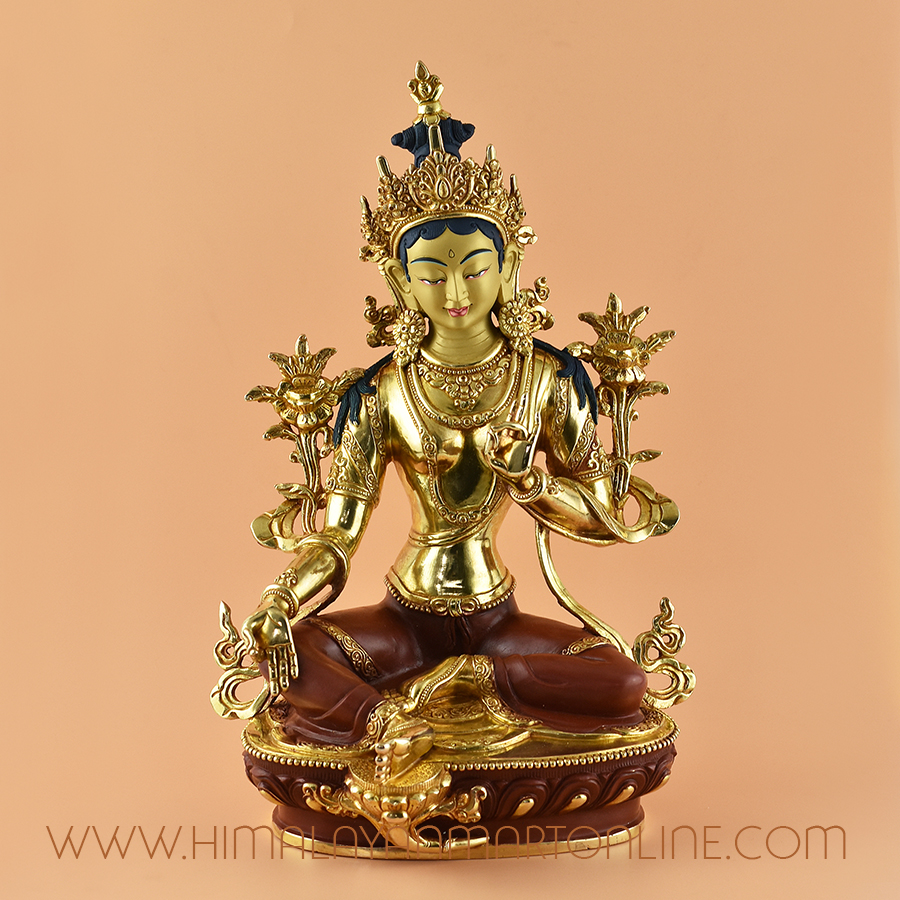
Varada Mudra

Cultural Context and Spiritual Implications:

The Varada Mudra transcends specific religious boundaries and resonates with a broader spiritual message. It emphasizes the virtues of generosity, compassion, and the act of giving without expecting anything in return. This mudra serves as a reminder to individuals on their spiritual journey to cultivate a selfless and open-hearted approach to life.
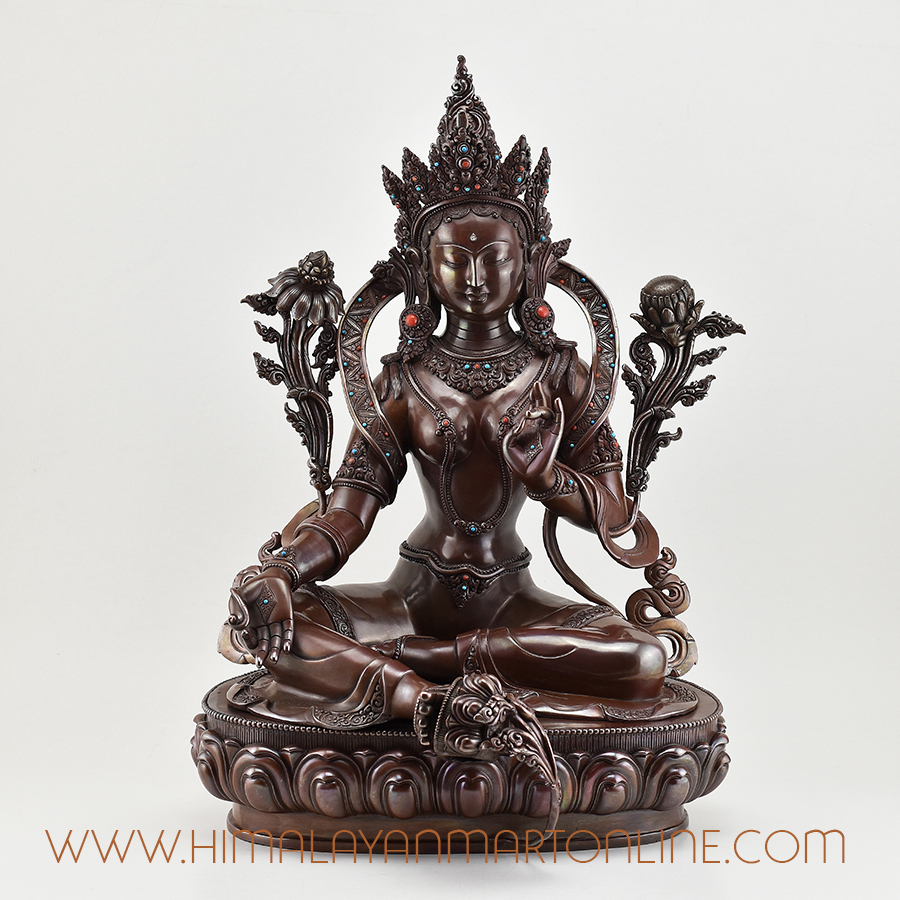
Oxidized Green Tara Statue

Practical Application in Daily Life:

While the Varada Mudra has deep spiritual roots, its principles can be applied in everyday life. Embracing a mindset of generosity and compassion towards others fosters a harmonious and supportive community. The act of giving, whether material or non-material, can create a positive ripple effect, contributing to the well-being of individuals and society as a whole.

Conclusion:

The Varada Mudra, with its downward-pointing hand symbolizing the bestowal of blessings and boons, holds a timeless and universal message. Whether seen in Hindu or Buddhist iconography, this gesture invites individuals to embody qualities of compassion, generosity, and the selfless act of giving. As we navigate our spiritual and daily lives, the Varada Mudra serves as a visual and symbolic guide, encouraging us to approach the world with an open hand and a heart ready to share the gifts of kindness and goodwill.
Buddha on a Lotus Base

The Buddha seated on a lotus base represents a classic and revered iconography in Buddhist art and symbolism. The lotus, often associated with purity and enlightenment, serves as a powerful metaphor for the journey of spiritual awakening.

In this depiction, the Buddha is elegantly seated atop a single lotus flower. The choice of a lotus as the base holds deep significance, as the lotus grows from the mud yet remains unstained—a symbol of purity emerging from the impurities of the material world. The single lotus, in particular, signifies a focused and centered state of being.

Buddha on Lotus Base: Shakyamuni Buddha / Sangye Ompame

The Buddha’s posture, known as the meditation or Dhyana mudra, reflects a state of deep contemplation and tranquility. The hands are typically placed in the lap, right hand over the left, with both palms facing upward. This mudra signifies the Buddha’s meditation under the Bodhi tree, where he attained enlightenment.

The lotus base not only complements the symbolism of the Buddha’s enlightenment but also adds an aesthetic elegance to the overall sculpture. The unfolding petals of the lotus represent the gradual opening of the heart and mind towards enlightenment, mirroring the stages of spiritual development. This portrayal captures the essence of the Buddha’s teachings—the journey from ignorance to enlightenment, from the murky depths of worldly attachments to the pristine clarity of spiritual insight. The combination of the Buddha and the lotus base creates a harmonious and visually striking representation, inviting contemplation and reflection on the path to awakening.

The timeless image of the Buddha seated on a lotus base is not merely an artistic representation but a visual narrative of spiritual evolution. The lotus serves as a poignant reminder of purity emerging from the impurities of life, creating a captivating and spiritually resonant tableau that continues to inspire seekers on their journey towards enlightenment.

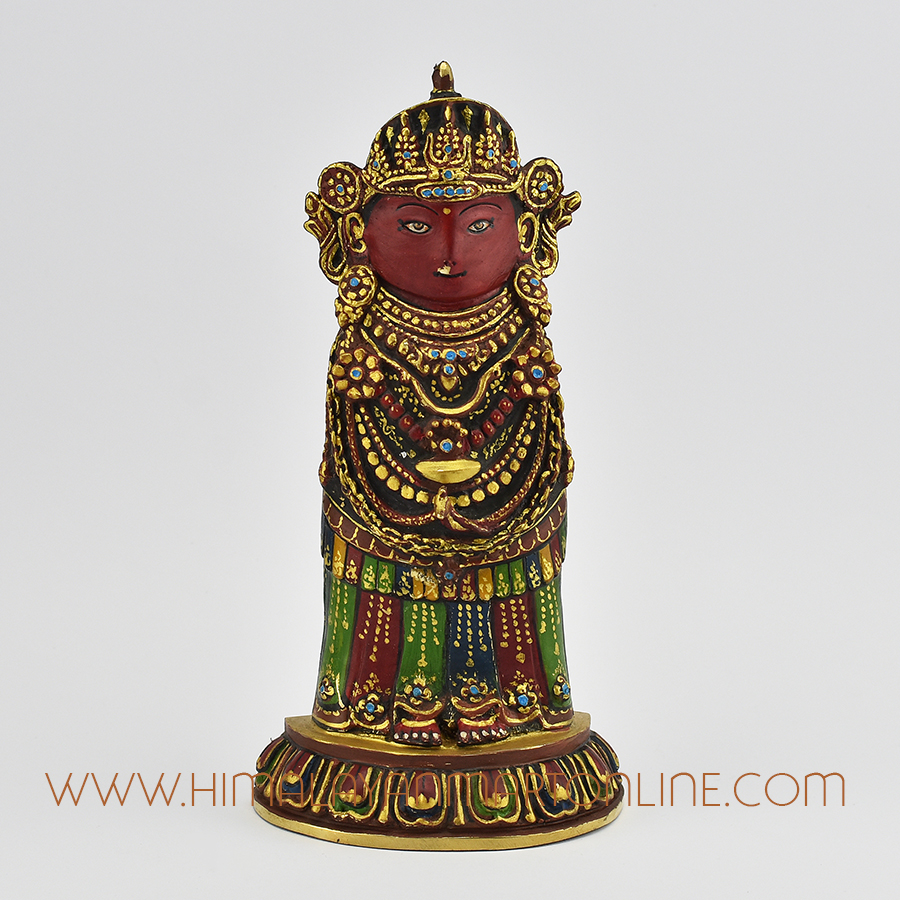
Rato Machhindranath – Living Goddess of Rain

In the Kathmandu Valley of Nepal, amidst the bustling streets and ancient temples, a remarkable tradition unfolds every year signifying the harmonious blend of spirituality and culture that defines the region. At the heart of this tradition stands Rato Machhindranath, a deity revered as the Living Goddess of Rain. In this article, we delve into the rich history, cultural significance, and enduring relevance of Rato Machhindranath.

Rato Machhindranath Statue

The Origins of Rato Machhindranath

Rato Machhindranath is a deity associated with the Newar community of the Kathmandu Valley, known for its distinct culture and religious practices. The name “Machhindranath” is derived from the Sanskrit words “Matsya” (fish) and “Indra” (king), referring to a legendary fish that King Gunakamadeva caught while performing a religious penance. This divine event is believed to have brought rain to the parched land, and Machhindranath was subsequently venerated as the deity responsible for ensuring rainfall and agricultural prosperity.

The Chariot Festival: A Spectacle of Devotion

The most iconic and grand celebration of Rato Machhindranath’s presence is the Rato Machhindranath Jatra, a month-long chariot festival that takes place annually. This festival typically occurs in the spring, usually April or May, coinciding with the onset of the monsoon season. The main attraction of the festival is the enormous wooden chariot of Rato Machhindranath, which is pulled through the narrow streets of Kathmandu by hundreds of devotees.

The chariot, adorned with intricate woodwork and vibrant decorations, symbolizes the deity’s journey to bring rain to the valley. The festival provides an opportunity for people from all walks of life to come together, fostering a sense of belonging and unity. It also serves as a platform for showcasing traditional music, dance, and art forms, preserving the cultural heritage of the Kathmandu Valley. Rato Machhindranath, the Living Goddess of Rain, stands as a testament to the profound relationship between spirituality, culture, and community in Nepal’s Kathmandu Valley. The annual chariot festival, with grandeur and devotion, encapsulates the essence of this revered deity and the enduring traditions of the Newar people. As Rato Machhindranath’s chariot traverses the streets, it symbolizes not only the hope for rain but also the unity and cultural richness of the region – a living testament to Nepal’s vibrant spiritual and cultural heritage.

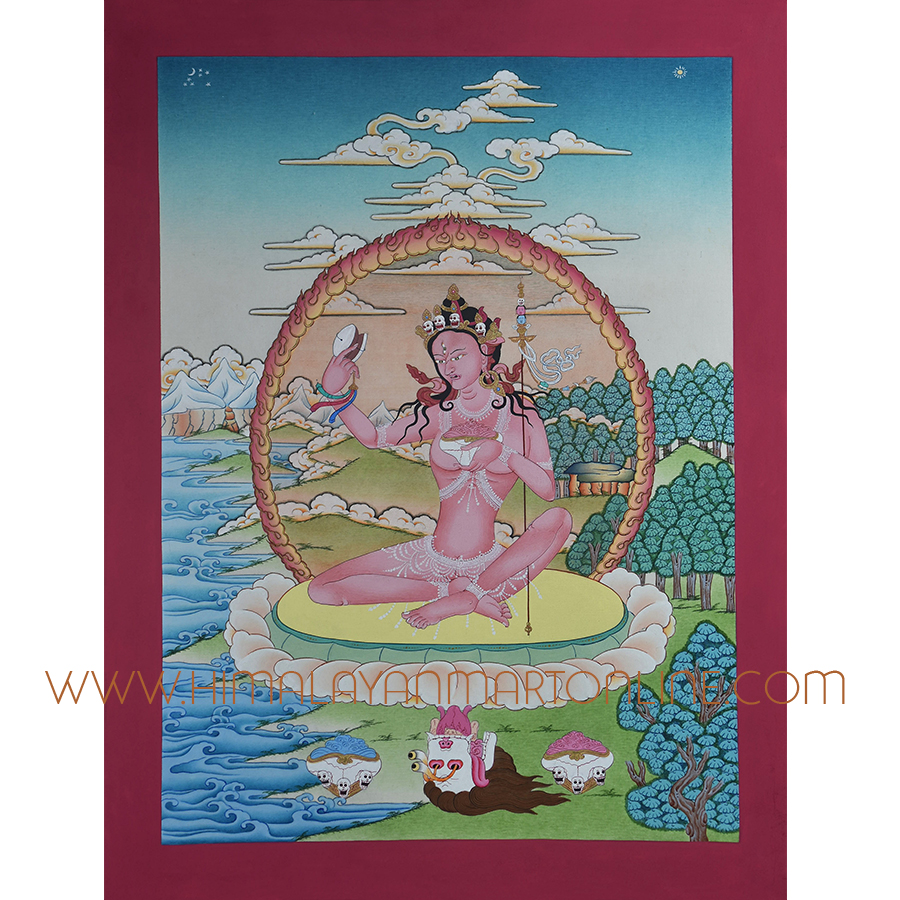
Niguma Thangka Scroll Painting

Niguma – The Lady of Illusion

Niguma was a great yogini and female Tantric master who lived during the 11th century. She was a Dakini who defied social conventions by being one of the few influential female lineage holders of ancient India to have proliferated an important Tantric lineage. Niguma was closely related to Guru Naropa; it is believed that Niguma received teachings on the Six Yogas from Naropa. The corpus of her teachings have become the foundation of the Shangpa Kagyu Buddhist tradition. The Shangpa Kagyu is hailed as one of the “Eight Great Chariots of the Practice Lineages” which means that it is one of the most important Buddhist traditions brought from India to Tibet. The legacy of the great yogini Niguma as a meditator, teacher, mystic, and founder of a lineage endures to this day.

Gesture and Attributes

Niguma is depicted as a black Dakini in semi wrathful form with three eyes including the one in the center of her forehead. She wears crown made from skulls, necklaces, armlets and anklets. Her right hand holds a Damaru and her left hand holds a Kapala filled with blood. She also holds a Khatvanga similar to that of Vajrayogini.

Niguma Thangka Scroll Painting

About this Niguma Thangka Scroll Painting

This is a Tibetan Style Thangka Scroll Painting which is entirely hand painted by the experienced artisan using same ancient techniques. This Niguma Thangka Scroll Painting is hand painted on cotton canvas with 24 karat gold detailing; by the artisans of Patan in Nepal who have been in the business from generations.

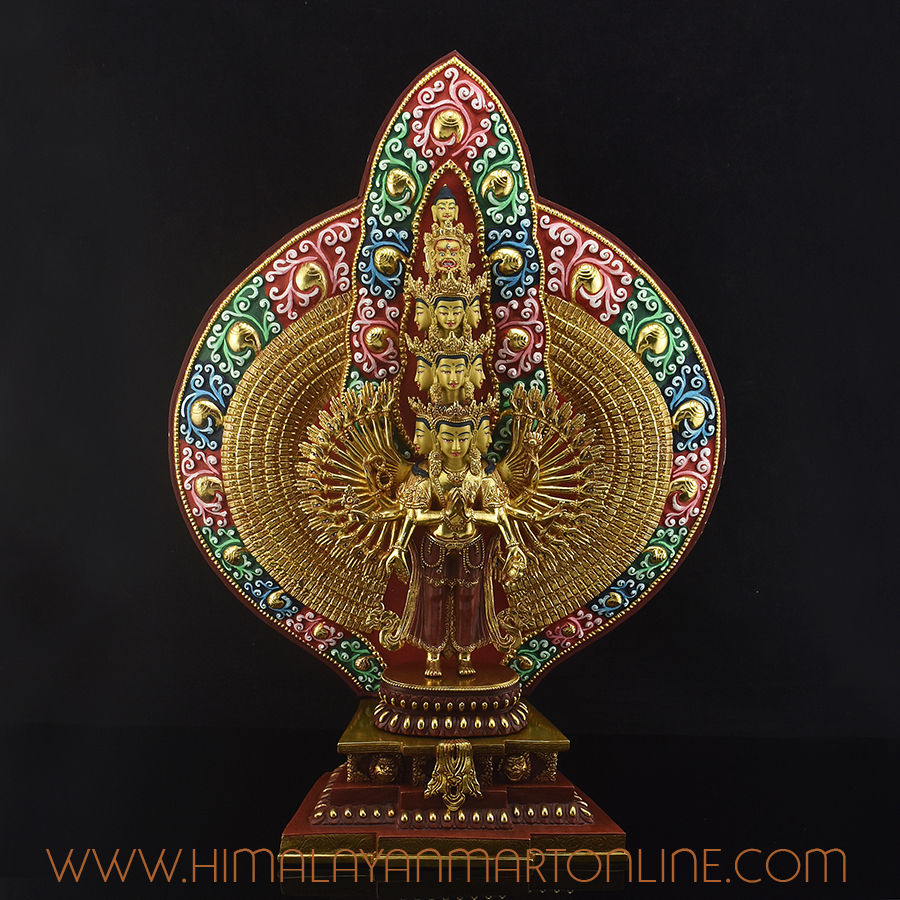
Thousand Armed Avalokiteshvara / Chenrezig – Bodhisattva of Boundless Compassion

Thousand Armed Avalokiteshvara: Avalokiteshvara (Guan Yin in Chinese; Chenrezig in Tibetan; Kannon in Japanese) is the Bodhisattva of Compassion. Among the Bodhisattvas, it is Avalokeshvara who has the largest number of forms and is perhaps the most venerated and most popular Buddhist deity. His sex, originally masculine, is sometimes considered feminine in China and Japan, although this discrimination is unsupported by any canonical text and was often considered in China and Japan as the ‘mother of the human race’ and, in this respect, worshiped in the form of a woman.

Among the 108 forms of Lokiteshvara, Avalokeshvara is one who refuses to accept Nirvana since he considers such acceptance selfish in view of the ignorance of the great majority of the people who have not yet attained that stage. His sacrifice symbolizes infinite compassion (Karuna), sharing of mankind’s misery, willingness to help those in distress. Avalokeshvara holds in his hand the indestructible jewel. He is savior and protector from danger. So, his invocation (Mantra) “OM MANI PADME HUM” is found inscribed on rocks, loose stones, prayer wheels, etc.

Avalokiteshvara is known from very early in the development of the Mahayana doctrines and, until Buddhism disappeared from India, enjoyed great favor there. His cult passed from India to South-East Asia and Java, where it met with great success, and also in Nepal, Tibet (where he arrived with Buddhism and where King Srong – Tsong Gampo, 519-650, was considered to be his incarnation), and in China, from where he went on to Korea and Japan. All these countries imagined him in different forms according to their own temperaments and spirituality.

500Thousand Armed Avalokiteshvara

Gestures and Attributes of Thousand Armed Avalokiteshvara

It is said that Chenrezig once grew exhausted and discouraged from the overwhelming task of rescuing sentient beings. While struggling to comprehend the needs of so many, his head and body exploded into a thousand pieces. Buddha Amitabha came to Chenrezig’s aid and helped prepare the Bodhisattva for his monumental task. Amitabha endowed Chenrezig with eleven heads, with which to hear the cries of the suffering, and also with a thousand arms, with which to aid the suffering multitudes.

Chenrezig’s eleven faces are arranged in three tiers, topped by the wrathful face of Vajrapani, and, at the very top, the face of Buddha Amitabha. The skin of a deer is draped over Chenrezig’s left shoulder and heart, symbolizing his compassionate nature. His first two principal hands are pressed together at his heart in deference to his teacher, Amitabha; and his other principal hands hold a crystal rosary, a lotus blossom, an undrawn bow and arrow, an eight-spoked Dharma wheel, and a golden water pot. Each of Chenrezig’s one thousand hands has an eye in the center of its palm, symbolizing the union of the five method perfections (five fingers) with the sixth perfection of wisdom (eye).

Red Tara – The Wish Fulfilling Tara

Red Tara – The Wish Fulfilling Tara

Red Tara is the manifestation of Tara expression of awareness of all phenomena. In Vajrayana Buddhism the practice of Red Tara is based on the ritual called the Mandala of wish-fulfilling essence that focuses on turning material desires into compassion and love. The ritual includes yoga, healing practices and teachings on the nature of mind. The Red Tara empowerment ritual was originated by Amitabha Buddha and passed to Avalokiteshvara, then to an emanation of Tara and the famous Indian master Nagarjuna that transmitted this teaching to Padmasambhava.

Red Tara – The Wish Fulfilling Tara

Guru Rinpoche left this knowledge to his consort Yeshe Tsogyal, and asked her to hide it as a treasure to be discovered at a later time, which it would produce the most benefit. The teaching was discovered by lama Apong Terton, who lived in last century. Before his death the lama transmitted the ritual to a monk that promised to reveal it to the reincarnation of Apong Terton, Sakya Trizin.

Gestures and Attributes

Red Tara is depicted in her peaceful manifestation. She is seated with the right leg slightly extended like the most common representation of Green Tara. The right hand is extended outward across the knee facing upward and holding a long-life vase (Kalasha) and the left hand is positioned in front of the heart holding the stem of a utpala flower with bow and arrow of skillful meaning wisdom on top of it.

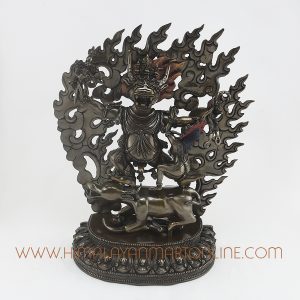
Yam Dharmaraj Buddhist Protector – Outer

Yam Dharmaraj – Buddhist Protector – Outer

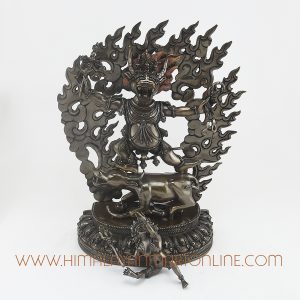
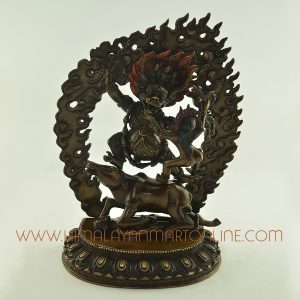
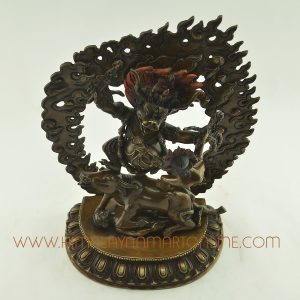
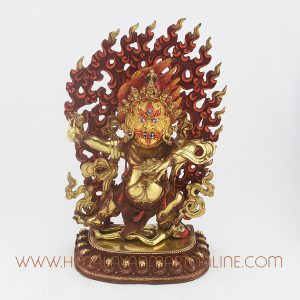
Yam Dharmaraj Buddhist Protector the Lord of Death, King of the Law; is the protector of the Vajrabhairava (Yamantaka) cycle of tantras.

Yam Dharmaraj Buddhist Protector

Gestures and Attributes

Yam Dharmaraj Buddhist Protector is depicted with one face and two hands in dark blue color and the head is that of a buffalo, three eyes, sharp horns entwined with flame, fierce and angry. Held upraised in the right hand is a bone stick composted of a fused spine and skull. In the left hand is a coiled lasso. Adorned with a crown of skulls and bone ornaments, he wears a necklace of fifty freshly served heads. Appearing extremely animate he stands with his right leg bent and the left extended on the back of a buffalo which is above a human body, sun disc and lotus seat. To the right is the consort Chamundi, blue with one face and two hands. A trident is held aloft in the right hand and a (Kapala) skull cup in the left hand. Both are adorned with wrathful attire, bone ornaments and various skins, completely surround by the swirling orange flames of pristine awareness.

Yam Dharmaraj Buddhist Protector Outer

Yama Dharmaraja Buddhist Protector – Outer

Yama Dharmaraja – Buddhist Protector – Outer

Yama Dharmaraja Buddhist Protector the Lord of Death, King of the Law; is the protector of the Vajrabhairava (Yamantaka) cycle of tantras.

Yama Dharmaraja Buddhist Protector

Gestures and Attributes

Yama Dharmaraja Buddhist Protector is depicted with one face and two hands in dark blue color and the head is that of a buffalo, three eyes, sharp horns entwined with flame, fierce and angry. Held upraised in the right hand is a bone stick composted of a fused spine and skull. In the left hand is a coiled lasso. Adorned with a crown of skulls and bone ornaments, he wears a necklace of fifty freshly served heads. Appearing extremely animate he stands with his right leg bent and the left extended on the back of a buffalo which is above a human body, sun disc and lotus seat. To the right is the consort Chamundi, blue with one face and two hands. A trident is held aloft in the right hand and a (Kapala) skull cup in the left hand. Both are adorned with wrathful attire, bone ornaments and various skins, completely surround by the swirling orange flames of pristine awareness.

Yama Dharmaraja Buddhist Protector Outer

Yama Dharmaraja Buddhist Protector – Inner

Yama Dharmaraja – Buddhist Protector

Yama Dharmaraja is the Inner Lord of Death, King of the Law. Dharmaraja is the special protector for the Vajrabhairava cycle of the Tantric practices and is especially associated with the Rwa Lotsawa Tradition.

Yama Dharmaraja Inner

Gestures and Attributes

Yama Dharmaraja is depicted in blue color with one face and two hands; his right hand holds a Kartika (curved knife) and the left hand holds Kapala (blood filled skull cup) to heart. Fearsome and wrath, having the appearance of Raksha demon, his dark yellow hair flows upward flame like, rising above a black half Vajra and the golden crown marked with five dry skulls. Wearing a green scarf and jewels, gold and bone ornaments, he is adorned with a necklace of severed heads and wears a tiger skin around the waist tied with a green sash. Standing with the left leg bent and the right leg extended above a brown corpse, sun disc and lotus blossom above a black triangle mandala filled with blood he dwells completely surrounded within the red flames of pristine awareness.

Sakyamuni Buddha Tomba Copper Statue

Sakyamuni – The Lion of the Shakyas

Sakyamuni Buddha Tomba Copper Statue: Sakyamuni is the Buddha of our time. He is the glorious root teacher of all the diverse lineages that make up Buddhism as we know it. Born Siddhartha Gautama more than 2500 years ago, he was the crown prince of the Shakya kingdom located in the Himalayan foothills of what is now southern Nepal. He left luxurious palace life behind him, however, in pursuit of the truth of the origin of suffering and the cessation of fear. His astounding courage, determination, wisdom and compassion led to his perfect enlightenment despite seemingly insurmountable obstacles. His teachings have transformed individuals and nations throughout the world and still speak to us today.

Sakyamuni Buddha Tomba Copper Statue

Gestures and Attributes

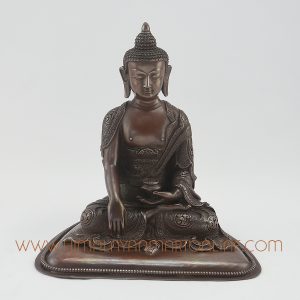
The Buddha is depicted with his right hand extended to the earth in the Bhumisparsha Mudra like shown in this Sakyamuni Buddha Tomba Copper Statue, the gesture of witness. He is “calling the earth to witness” his supreme victory over the temptations and illusions of the material world as symbolized by the demon Mara. His left hand lies in his lap with palm upward in the gesture of meditation (Dhyana Mudra). In some representations he also holds the begging bowl of an ordained Buddhist monk. The bowl contains three precious nectars indicating that he has conquered the three demons of uncontrolled death, contaminated aggregates, and delusion. Thus, this posture is known as “Buddha Sakyamuni Conquering the Demons” and shows the moment of the Buddha’s full enlightenment under the Bodhi tree.

About this Sakyamuni Buddha Tomba Copper Statue

This statue is a charming portrayal of Sakyamuni. Finely sculpted from copper alloy, the statue has been submitted to an oxidation process to yield a rich and sensuous finish. The Buddha sits gracefully in meditation upon a lotus throne, expressing the calm majesty of one who has mastered himself. With his head slightly inclined, he seems to smile with a secret inner joy, prompting feelings of encouragement and happiness in the observer. His robes are exquisitely carved throughout, showing marvelous detailing especially on the back of the sculpture, where a beautiful lotus blossom is surrounded by intricately carved leaves and vines. And over all, the lovely copper finish lends a pleasing sense of warmth, gently inviting one to linger, leaving thoughts of the world behind.

White Tara Dolkar Statue

White Tara – The Divine Mother

White Tara Dolkar Statue: White Tara’s compassion for living beings and her desire to save them from suffering is said to be even stronger than a mother’s love for her children. As the personification of enlightened maternal compassion, she has infinite sympathy for those facing the challenges of worldly existence. She is the female aspect of the universe and the source of all life; thus, she lovingly engenders, nourishes and smiles at the vitality of creation. Meditation on the goddess grants health, long life, fearlessness, patience and peace; and she is especially cherished for her swiftness in responding to the prayers of those who call upon her. Her color white symbolizes her radiant purity, but white also expresses her fundamental nature, which is ultimate Truth, complete and undifferentiated.

White Tara Dolkar Statue

Gestures and Attributes

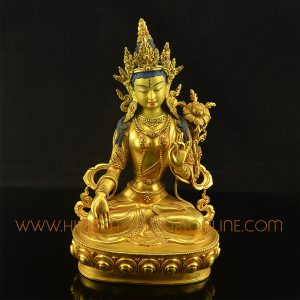
White Tara is depicted in a posture of graceful contemplative ease with both legs raised and crossed, displaying a regal elegance and serenity like in this; White Tara Dolkar Statue. Her right hand is extended downward, palm open, with thumb and index finger touching. This hand position is known as Varada Mudra, or the gesture of granting wishes and protection. Her left hand, raised to shoulder height with fingers extended and palm turned outward, is in the gesture of granting refuge and freeing from fears (Abhaya Mudra). Each of her hands also holds the stem of a beautiful lotus flower that floats above her shoulder as a symbol of her radiant purity and power. A distinctive characteristic of White Tara, shown in this representation, is her seven eyes. She has the two usual eyes plus one in the center of her forehead and one in each of her hands and feet. These eyes indicate that she sees all the suffering and cries for help in the universe, and symbolize her divine omniscience.


About this White Tara Dolkar Statue

Expertly cast from copper alloy using Lost Wax Method and gilded with 24 karat gold with hand painted face, this statue is a beautiful portrayal of White Tara / Dolkar. This White Tara Dolkar Statue was individually handcrafted in Patan, Nepal by master artisans of the Shakya clan who are considered among the best in the world. These craftsmen are the modern heirs to a centuries-old tradition of creating sacred art for use in temples and monasteries. The fine metalworking techniques have been passed down from generation to generation since ancient times.


Guru Rinpoche Padmasambhava Statue

Guru Rinpoche / Padmasambhava – Precious Master

Guru Rinpoche Padmasambhava Statue: Buddhism was first introduced to Tibet in the eighth century when King Trisong Detsen invited the Indian master Santaraksita to teach the sacred Dharma to the Tibetan people. When Santaraksita arrived and he and the king began to build the first monastery, resentful mountain spirits interfered and created many obstacles. Realizing that the help of a realized master with control over physical reality was needed, the king invited Guru Padmasambhava to come and tame the angry spirits of Tibet.


Guru Rinpoche / Padmasambhava(as shown in this Guru Rinpoche Padmasambhava Statue), regarded as an emanation of Buddha Amitabha, was born miraculously from a lotus blossom in the land of Oddiyana located in present-day Pakistan. He was known far and wide for his miracle powers, including his ability to subdue spirits. At the request of the king, Guru Padmasambhava journeyed to Tibet and engaged the local nature spirits in magical combat. Conquering these spirits, he bound them by oath to protect the Dharma for all time. Evidence of his victories in these battles can still be seen throughout the valleys and villages of Tibet, where he is affectionately known as “Guru Padmasambhava,” meaning “Precious Master.”


The King, Santaraksita and Guru Padmasambhava then worked together to establish Buddhism in the country. The King founded temples and Santaraksita ordained monks, while Guru Padmasambhava worked at a more mysterious level. Guru Padmasambhava established the secret and powerful practices of Tantric Buddhism and gave profound and extraordinary teachings to his closest disciples, including the king. In addition, foreseeing that a future king would one day try to destroy Tibetan Buddhism, Guru Padmasambhava concealed religious treasures throughout the Himalayan region. These treasures would be revealed centuries later by seers destined to receive them.

Guru Rinpoche Padmasambhava Statue

Guru Rinpoche / Padmasambhava did not die but flew away with his consort on the rays of the sun. It is believed by many, especially those within the Nyingma school (which traces its lineage directly to Guru Padmasambhava), that he is still living, and remains full of compassion for sentient beings. Dwelling at the level of spontaneous presence, the great Guru has the power to bestow blessings instantly and grant wishes immediately. He remains to this day the deeply beloved focus of practice for many Tibetan.


Gestures and Attributes

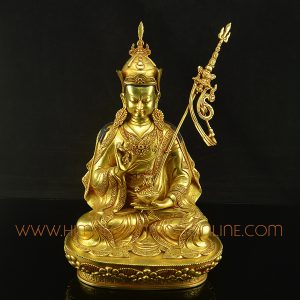
Here, Guru Rinpoche / Padmasambhava can be seen in his most well-known representation like in this; Guru Rinpoche Padmasambhava Statue. His eyes are open in a piercing gaze; his face is wrathful and smiling, blazing magnificently with mysterious power. He cradles a Khatvanga in his left arm, representing his consort Mandarava, who arouses realization of emptiness. His Khatvanga is crowned with three severed heads and a trident, symbolizing Guru Padmasambhava’s liberation from the three kayas of desire, form and formlessness.


He wears a lotus hat ornamented with a sun and moon, representing skillful means and wisdom. His hat also has a Vajra top, symbolizing his unshakable samadhi, and is crowned with a vulture feather, representing his realization of the highest view. In his right hand he holds a Vajra, an implement used in Tantric ritual to symbolize the union of conventional and ultimate truth. His left-hand rests in his lap in the gesture of meditation (Dhyana Mudra) and holds a skull cup containing the vase of immortality like shown in this Guru Rinpoche Padmasambhava Statue. The vase is filled with the nectar of deathless wisdom and is adorned with leaves of a sacred flowering tree. The vase further serves as a reminder of Guru Padmasambhava’s connection to Buddha Amitabha, as it is the special emblem of Amitayus (an aspect of Amitabha).


About this Guru Rinpoche Padmasambhava Statue

This fine quality statue is a beautiful representation of the beloved Guru Rinpoche / Padmasambhava. Expertly sculpted from copper alloy using lost wax method and fully gilded with 24 karat gold, the statue has been finely hand-carved. This Guru Rinpoche Padmasambhava Statue was individually handcrafted in Patan, Nepal by master artisans of the Shakya clan who are considered among the best in the world. These craftsmen are the modern heirs to centuries – old tradition of creating sacred art for use in temples and monasteries. The fine metalworking techniques have been passed down from generation to generation since ancient times.


Subscribe To Our Newsletter