Chhepu – The Mythical Creature

Chhepu – The Mythical Creature

Chhepu is one among the three brothers Garuda, Chhepu and Hiti Manga. It is told that once the mother of these brothers, requested her husband to give birth of such a son who would be the bravest, most truthful and entitled with all superior marks. Her husband told her to wait for a certain period. She being impatience to wait for a long period, looked the nest whether he was born or not. She found Chhepu in a prematured condition only with formation of head.
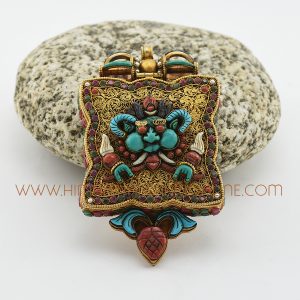
Chhepu Ghau Pendant Prayer Box

Chhepu is depicted in his wrathful appearance devouring showing only half of Chhepu’s body and devouring Naga(snake).


It is also told that Chhepu disappeared from the world as he did not want to see the kaliyuga, the great yuga, when the evil would completely triumphant over the good and the world would be destroyed by Vishnu in his incarnation as kalki, the destroyer. Knowing his bravery, truthfulness and entitled with all the superior marks Manjushree wanted to see him and requested him to show his full form. He appeared slowly amidst the cloud. Manjushree, as an veteran artist, immediately drew his form by his foot secretly without the knowledge of Chhepu. When Manjushree could finish to draw his head only he came to know Manjushree’s deception and immediately disappeared. Due to his bravery, truthfulness and all superior marks, he was given the place at the top of the main entrance of the shrines for the protection from all the dangers. Nagas(serpents) are the food of Chhepu.


Along the stories of Manjushree, comes an interesting and fascinating story attached to Chhepu – The Mythical Creature:

Long time ago, the Kathmandu Valley was only a huge lake inhabited by the countless number of aquatic animals. The majority of them were the Nagas (serpents). So this valley was also known as Naga Daha, meaning the “Home of the Serpents’.


One day Manjushree Bodhisattva (a Buddhist god from China) came to visit this valley. He liked the valley. He liked the valley so much that he wanted to make a beautiful town out of it . With this intention he immediately cut through the southern hill of the valley with one stroke of this his legendary sword (Chandrahara) and drained off the water. This compelled all the inhabitants of the lake to leave, as they could not do anything against the almighty Manjushree. But a creature called Chhepu stayed put. When by his yogic power Manjushree sensed that there was someone still hidden somewhere under the remnant of the lake, he commanded the latter to leave the water instantly. He was terrified when he saw that he could not go against the power of Manjushree. So, he said he would leave the lake if Manjushree would promise not to look at his horrible feature when he moved out of the lake. According to the promise, Manjushree closed his eyes and Chhepu prepared to come out of the water. As the fear-stricken creature pushed half of his ugly body above the surface, Manjushree could not help but open eyes stealthily, out of curiosity. When Chhepu saw Manjushree open his eyes, he got so upset that he quickly dived back deep under the water to hide himself again. Manjushree, ashamed of breaking his promise, soon negotiated with Chhepu assuring him that he would never bother again to seen by anyone). He also promised that he would allow him to occupy a very significant place in the holy temples of Nepal (he was going to build up soon in the valley) and remain there half-hidden forever.


This story seems to explain a lot about our architectural tradition of showing only half of Chhepu’s body above the tympanums of the temple doorways. Whether this mythical story contains any grain of truth or not matters the least. What counts in the cultural value it reflects and the artistic fascination it leaves for one and all to understand and appreciate.
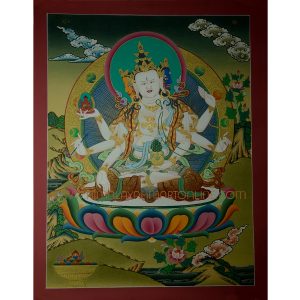
 

NAMGYALMA BUDDHA – THE CROWNED MOTHER BUDDHA

NAMGYALMA BUDDHA – THE CROWNED MOTHER BUDDHA

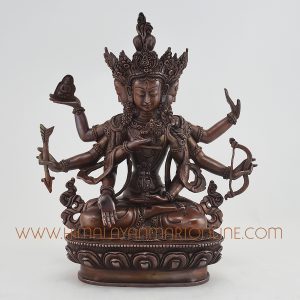
Namgyalma Buddha the victorious hair or crowned mother Buddha. Namgyalma is a female Bodhisattva with three faces and eight arms and one of the three reverend deities of longevity. Her middle face and eight arms are white, symbolizing the elimination of disasters. There is an eye on each side of her forehead and a coronal is twisting around her painted on her crown. As required by the sutra of measurements for the construction of statues, this mother Buddha should be moulded as a maiden of 16 years old. Half of hair should be braided with the remaining hair hanging down and the tip being longer than her elbows. Her face should resemble sesame and her eyes red lotus petals. The yellow face on the left side symbolizes benefit and longevity and the blue face on the right side symbolizes the defeat of devils.


Namgyalma Buddha
Namgyalma Buddha

GESTURES AND ATTRIBUTES

The Mother Buddha is holding a double Dorje on the one hand of her main arm and rope on the other hand. While the palm of her third hand is facing the front to gratify peoples wishes. On the left side, her first hand is holding up, while her second hand is grasping a bow and her third hand is holding an Amrita- Kalash with a flower in bloom. According to the Buddhist scriptures, the followers who practices Buddhism should regard the victorious hair Crowned Mother Buddha as a female Bodhisattva who rids of miseries and disasters. Practicing her dharma can help lengthen their span of life, increase their happiness and wisdom, eliminate their sins and shield them from evil omen.


Namgyalma Buddha
Namgyalma Buddha

Virupa

VIRUPA – THE DAKINI MASTER

Virupa was a famous Mahasiddha from Bengal who lived during the ninth century AD. As a young boy he entered the acclaimed Buddhist monastery of Somapuri. He studied diligently and was extremely devoted to his practice of the Dakini Vajravarahi. But upon experiencing no results after twelve years of intense meditation, he threw away his rosary in discouragement. Vajravarahi then appeared to him in a shining vision, and gave him a beautiful new rosary and comforted him with words of praise and encouragement. Deeply inspired, he applied even greater effort to his practice, and eventually attained the supreme realization of Mahamudra.

Virupa
Virupa

Leaving his monastery, he traveled throughout India as a wandering yogin, and stories abound of the many miraculous deeds he performed. He is known to have walked on water, restored dead pigeons to life, stopped the sun’s movement in the sky, and subjugated a tribe of flesh-eating ghouls. He also has a connection with the Hindu god Indra, whom he swore to the Buddha’s allegiance. At the end of his long life, he was welcomed with honor into the Paradise of the Dakinis.


GESTURES AND ATTRIBUTES

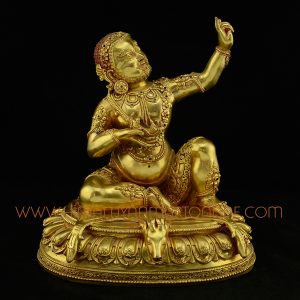
Virupa is depicted in his popular posture with his right hand and his gazes are directed towards the sun sitting upon a deerskin, the traditional meditation seat of a wandering yogin, and an ancient symbol of renunciation. His left hand is held aloft in the wrathful gesture known as the “posture of holding the sun”. This posture recalls Virupa’s miraculous act of stopping the sun in its path, where he held it motionless in the sky for several days. His right hand holds a skull cup or Kapala, signifying his attainment of the union of great bliss and emptiness, and his power over the duality of life and death.


Guru Je Tsongkhapa

Guru Je Tsongkhapa and His Spiritual Sons

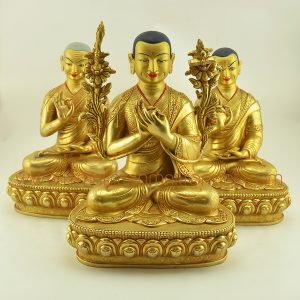
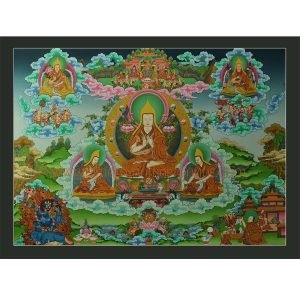
Je Tsongkhapa is often depicted with his two main disciples, Gyaltsabje and Khedrubje. He is thought to be a manifestation of Manjushri, the nature of all the Buddhas’ wisdom; Gyaltsabje a manifestation of Avalokiteshvara, the nature of all the Buddhas’ compassion; and Khadrubje a manifestation of Vajrapani, the nature of all the Buddhas’ power.


Je Tsongkhapa was the holder of all three old Kadam lineages that were passed down from Atisha through Dromtonpa. He performed an extensive retreat on Atisha’s Lamrim teachings at Reting Monastery, where he received visions of Atisha, Dromtonpa, and other Lamrim lineage Gurus. With the help of these Gurus and the Wisdom Bodhisattva Manjushri, with whom he conversed directly, he wrote several famous texts, including his Great Exposition of the Stages of the Path. Three lineages have descended from Je Tsongkhapa, and these are known as “New Kadam Lineages”; all three are still practiced today.

Guru Je Tsongkhapa and His Spiritual Sons

Je Tsongkhapa’s appearance in Tibet is believed to have been prophesied by Buddha Shakyamuni. He lived in Tibet from 1357 to 1419 AD, where he appeared in the aspect of an ordinary practitioner, although he was an enlightened being. He demonstrated a perfect example of how to build the foundation for the spiritual path, how to progress on that path, and how to complete it. By giving teachings and showing a good example, he led many disciples to gain pure, authentic realizations of the Buddha’s teachings. It is believed that even today, faithful practitioners who follow Je Tsongkhapa’s pure Dharma can accomplish enlightenment within a single lifetime.

Guru Je Tsongkhapa and His Spiritual Sons

Gestures and Attributes

Guru Je Tsongkhapa and his two Sons wear the robes of ordained persons, signifying that they have completed the perfection of moral discipline; they also wear yellow long-eared hats, signifying that they have completed the perfection of wisdom. Their lotus thrones signify their complete purity of body and mind. He holds his two hands at the level of his heart, in the gesture of turning the Wheel of Dharma, indicating that he can dispel the ignorance of sentient beings by giving teachings. He holds the stems of upala flowers, which support a wisdom sword and a scripture of the Perfection of Wisdom Sutra in Eight Thousand Lines. These signify that he principally teaches the Madhyamika-Prasangika view explained in the Perfection of Wisdom Sutras (symbolized by the scripture) by means of his omniscient wisdom (symbolized by the sword), motivated by love and compassion (symbolized by the two flowers).

The right hands of the two Sons are at the level of their hearts in the gesture of expounding Dharma, and their left hands are in the gesture of meditation holding scriptures, signifying that Guru Je Tsongkhapa’s doctrine will spread throughout the world.


Guru Milarepa

MILAREPA – BUDDHIST MASTER OF TIBET

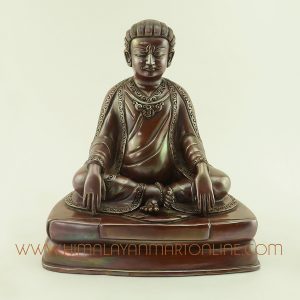
Milarepa is believed to be the most beloved and highly accomplished Buddhist master of Tibet. He was born in the year of the water-dragon of an aristocratic family living in Kya Ngatsa in Gungthang, West Tibet. His father’s name was Mila Sherab Gyaltsen and his mother’s name was Nyangtsa Kargyen. He was given the name Mila Thöpaga, thös-pa meaning “to hear” and ga meaning “joy,” so his name was “Mila Who is a Joy to Hear.” He had a younger sister named Peta Palden.

Guru Milarepa
Guru Milarepa

His songs on enlightened experiences are still sung today by the learned and lay people alike. Milarepa during his early career committed many evil deeds through black magic, and sending hailstorms too. He later regretted his evil deeds and eventually found his worthy and enlightened Marapa, who put him on trials and hardships in other to test his guru devotion and eagerness to practice dharma teachings. He later conferred on him the series of empowerment and essential teachings of Maha Mudra which he received from Naropa. Milarepa meditated on these tantric teachings with great zeal in wild and forlorn mountains for 6 years and eventually achieved the realization of Vajradharahood in his very life time. Millions of devotees took inspiration from his practice and verification of Buddhist teachings.


GESTURES AND ATTRIBUTES

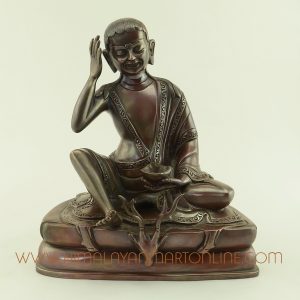
Milarepa is often depicted as in the illustration shown here, with his right hand raised to his right ear in a listening gesture, symbolling his way of teaching the Buddhist wisdom through songs or poems. He can be easily recognized by the right hand held up to his right ear. He spent much of his life meditating in mountain caves. In the Indian ascetic tradition, he sits on an animal skin. In his left hand is a skull-cup. The use of bone served as a constant reminder of the temporary nature of human existence. The presence of blue azurite in this figure’s hair indicates that it has been used for worship.


Guru Marpa

MARPA – THE FOUNDER OF KAGYUDPA TRADITION

Marpa was the founder of Kagyudpa tradition of Tibetan Buddhism. Marpa was one of four sons born of a well-to-do family living in Lodrak Chukhyer, southern Tibet. His father was Wangchuk Oser and his mother Gyamo Sa Dode. He was born in 1012 A.D. in the region of Lodrak, Tibet, right above the border of Bhutan. It is recorded that just the sight of the boy created a sense of fear and awe in everybody who saw him because he was very energetic and quite aggressive. Due to his unpopularity, his father sent him to study under Drogmi Sakya Yeshe Lotsawa, who was a renowned translator and teacher residing at Mangkhar (situated between Lhasa and Kathmandu). In his childhood he quickly learned reading and writing. He learnt Sanskrit from Drogmi Sakya Yeshe Lotsava(993-1050) who was well versed in Path and Fruition doctrine of Sakyapa Lineage tradition that is passed down from father to son; he had received the transmissions of Virupa, a pious monk living at Somapuri Monastery before he became a wandering yogi and master of the historical lineage of the patriarchs.


Guru Marpa
Guru Marpa

GESTURES AND ATTRIBUTES

Marpa is said to be a very fat one with hair standing five fingers straight up off his head and with angry looking face. But in some commentaries of Venerable Karma Chagme, he is described as having matted hair and wearing a Chuba with big Chinese style sleeves and a large cap.


Having been frustrated with his inability to learn more teachings from Drogmi Sakya Yeshe Lotsawa; he toured India three times via Nepal. At that time in Tibet there were few teachers from whom Marpa could receive further instructions, so – three times in all – he crossed the high passes separating Tibet from Nepal and India in search of more profound instructions from Mahapanditas, “great sages.” The journey was hard and took months, sometimes years. Thrangu Rinpoche taught that one needed to have great strength and courage to undergo such a challenge and that Marpa’s steadfast resolution was not based on a view to only benefit himself or for short-term purposes. He had two Nepali Gurus, Paindapa and Chitherpa from whom he learnt the Chakrasamvara and Chatuhpith Tantras for three years. These two Nepalese teachers gave Marpa a great deal of dharma instruction and language. Marpa mastered the Tibetan arts, language and literature, and Sanskrit under Drogmi Lotsawa’s tutelage in 3 years (other texts state in 15 years). Marpa with his great zeal and assiduity learnt the vast range of Tantric teachings from Naropa, Maitripa, Kukkuripa and others.  He came back to Tibet with these vast resources and taught his disciples extensively. Among his disciples, Tibet’s great yogi Milarepa was the foremost and he had many outstanding disciples of his own through whom Kagyudpa lineage is continued uninterruptedly till today.


GURU GAMPOPA – THE MAN FROM GAMPO

GURU GAMPOPA – THE MAN FROM GAMPO

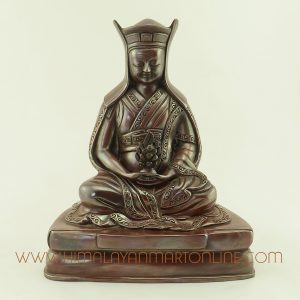
In East Tibet, Gampopa (1079 – 1135) was the son of a doctor, and a doctor himself. Gampopa was trained as a physician who devoted himself to the Dharma after the death of his wife. Guru Gampopa became the heart son of Milarepa and was the root guru of the first Karmapa, Dusum Khyempa. It is his synthesis of the traditions of Dharma teachings melded with the experiential meditative teaching of Milarepa that formed the Kagyu tradition, as we know it today. Guru Gampopa wrote the “Jewel Ornament of Liberation” and is usually depicted wearing robes and a red hat, which has become synonymous with the Kagyu School.


Guru Gampopa
Guru Gampopa


Gampopa married in his early twenties, and fathered two sons. Several years later, an epidemic took both their lives, despite his skill. His wife falling sick of the same disease, and similarly failing to respond to his ministrations, begged him as she died not to marry again, but to become a monk.


One might question her motives, but nevertheless, at the age of twenty – six, Gampopa became a novice in the Kadampa tradition. Guru Gampopa applied himself, working with many masters, and achieved a high degree of proficiency before – at thirty – two – hearing talk of Milarepa. Feeling a surge of devotion in response to these tales, and understanding that this must be his true teacher, he set out on a grueling but eventually successful search to find him.


Guru Gampopa, a talented writer, of great insight, was entrusted by Milarepa with the complete Kagyu transmission – the only one of Milarepa’s students so honored – before leaving Milarepa to go into retreat at Dagpo in South – East Tibet. There he founded the monastery of Daglha Gampo, where he drew many disciples. Four of these were to found the four “major” Kagyu branches. Eight “minor” branches would appear later. One of the four, Dusum Khyenpa was both the next Kagyu lineage – holder, and the first Karmapa.


SAKYAMUNI BUDDHA – THE LION OF THE SAKYAS

SAKYAMUNI BUDDHA – THE LION OF THE SAKYAS

Sakyamuni Buddha is the Buddha of our time. He is the glorious root teacher of all the diverse lineages that make up Buddhism as we know it. Born Siddhartha Gautama more than 2500 years ago, he was the crown prince of the Sakya kingdom located in the Himalayan foothills of what is now southern Nepal. He left luxurious palace life behind him, however, in pursuit of the truth of the origin of suffering and the cessation of fear. His astounding courage, determination, wisdom and compassion led to his perfect enlightenment despite seemingly insurmountable obstacles. His teachings have transformed individuals and nations throughout the world and still speak to us today.


GESTURES AND ATTRIBUTES

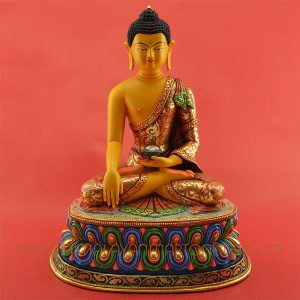
The Sakyamuni Buddha is depicted with his right hand extended to the earth in the Bhumisparsha Mudra, the gesture of witness. Sakyamuni Buddha is “calling the earth to witness” his supreme victory over the temptations and illusions of the material world as symbolized by the demon Mara. Sakyamuni Buddha’s left hand lies in his lap with palm upward in the gesture of meditation (Dhyana Mudra). In some representations he also holds the begging bowl of an ordained Buddhist monk. The bowl contains three precious nectars indicating that he has conquered the three demons of uncontrolled death, contaminated aggregates, and delusion. Thus, this posture is known as “Buddha Sakyamuni Conquering the Demons” and shows the moment of the Buddha’s full enlightenment under the Bodhi tree.


The essence of the Sakyamuni Buddha’s early preaching was said to be the four Noble truths:

1) life is fundamentally disappointment and suffering.

2) suffering is a result of one’s desires for pleasure, power, and continued existence;

3) to stop disappointment and suffering on must stop desiring; and

4) the way to stop desiring and thus suffering is the Noble eight fold path – right views, right intention, right speech, right action, right livelihood, right effort, right awareness and right concentration. The realization of the truth of Anatman (no eternal self) was taught as essential for the indescribable state of release called nirvana


SHAKYAMUNI BUDDHA – THE LION OF THE SHAKYAS

SHAKYAMUNI BUDDHA – THE LION OF THE SHAKYAS

Shakyamuni Buddha is the Buddha of our time. He is the glorious root teacher of all the diverse lineages that make up Buddhism as we know it. Born Siddhartha Gautama more than 2500 years ago, he was the crown prince of the Shakya kingdom located in the Himalayan foothills of what is now southern Nepal. He left luxurious palace life behind him, however, in pursuit of the truth of the origin of suffering and the cessation of fear. His astounding courage, determination, wisdom and compassion led to his perfect enlightenment despite seemingly insurmountable obstacles. His teachings have transformed individuals and nations throughout the world and still speak to us today.


Shakyamuni Buddha Tomba


GESTURES AND ATTRIBUTES

The Shakyamuni Buddha is depicted with his right hand extended to the earth in the Bhumisparsha Mudra, the gesture of witness. He is “calling the earth to witness” his supreme victory over the temptations and illusions of the material world as symbolized by the demon Mara. His left hand lies in his lap with palm upward in the gesture of meditation (Dhyana Mudra). In some representations he also holds the begging bowl of an ordained Buddhist monk. The bowl contains three precious nectars indicating that he has conquered the three demons of uncontrolled death, contaminated aggregates, and delusion. Thus, this posture is known as “Buddha Shakyamuni Conquering the Demons” and shows the moment of the Buddha’s full enlightenment under the Bodhi tree.


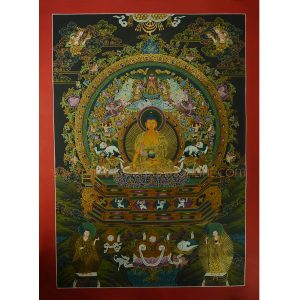
Shakyamuni Buddha Tomba Thangka Painting


The essence of the Shakyamuni Buddha’s early preaching was said to be the four Noble truths:

1) life is fundamentally disappointment and suffering.

2) suffering is a result of one’s desires for pleasure, power, and continued existence;

3) to stop disappointment and suffering on must stop desiring; and

4) the way to stop desiring and thus suffering is the Noble eight fold path – right views, right intention, right speech, right action, right livelihood, right effort, right awareness and right concentration. The realization of the truth of Anatman (no eternal self) was taught as essential for the indescribable state of release called nirvana


AMITABHA BUDDHA – THE BUDDHA OF INFINITE LIGHT

AMITABHA BUDDHA – THE BUDDHA OF INFINITE LIGHT

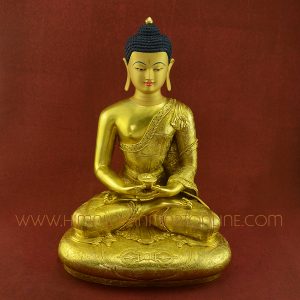
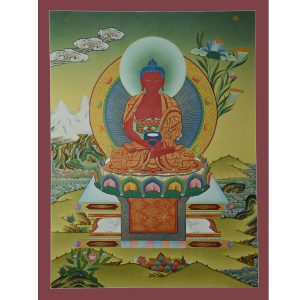
The name Amitabha means “Infinite Light” Amitabha’s Discriminating Wisdom conquers the poison of the passions–all cravings, covetousness, greed and lust. With this wisdom, the disciple discerns all beings separately yet knows every being as an individual expression of the One. In the mandala of the Dhyani Buddhas, Amitabha is positioned to the west. His color is rose (red), the color of the setting sun. Amitabha Buddha rules over the element of fire and personifies the Skandha of perception. Thus, the eye and the faculty of seeing are associated with Amitabha Buddha. The peacock, with on its plumes, is his throne-bearer. The peacock symbolizes grace.


Amitabha Buddha Sangye Opame


According to the Larger Sutra of Immeasurable Life, the magnificence of Amitabha Buddha surpasses that of all other great beings, thus he is known as the Buddha of all the Buddhas. Buddha Shakyamuni once said of Amitabha, “The majestic glory of his light could not be exhaustively described if I praised it continuously, day and night, for the period of one kapala.”


Amitabha dwells in a pure celestial realm, created via the power of his infinite merit accumulated over countless lifetimes as a Bodhisattva. His light shines brilliantly from this celestial realm, pervading the entire universe. According to the Sutra, if sentient beings encounter his light, their defilement are removed; if they see his light, they are relieved and freed from affliction. At the end of their lives, beings who have faith in Amitabha reach emancipation, as he gives them rebirth in his Pure Land. And as Shakyamuni explains, “Sentient beings who are born in that Buddha-land all reside among those assured of nirvana.”


GESTURES AND ATTRIBUTES

Amitabha is depicted in Dhyana Mudra, the gesture of meditation, with both palms face up and lying in his lap. His right hand, resting on top, symbolizes the state of enlightenment, while his left hand, resting below, represents the world of appearance. Thus, Amitabha’s posture expresses his mastery over the world of appearance through enlightenment, and signifies the enlightened state of mind for which samsara and nirvana are one. In some representations, he holds the traditional begging bowl of an ordained Buddhist monk. The bowl is filled with amrita, the elixir of awakening and immortality, and symbolizes Amitabha’s infinite openness and receptivity toward all sentient beings.


Amitabha Buddha Sangye Opame


Amitabha’s symbol is the Padma, or Lotus, placed between him and Vairochana in this mandala. In Buddhism, the lotus can symbolize many things, including spiritual unfoldment, purity, the true nature of beings realized through enlightenment, and compassion, the purified form of passion. Devotees aspire to be reborn in Amitabha’s Western Paradise, known as Sukhavati, where conditions are ideal for attaining enlightenment. His Mudra is the Dhyana (meditation) Mudra. His bija is Hrih and his mantra is Om Amitabha Hrih. Some consider Amitabha to be synonymous with Amitayus, the Buddha of Infinite Life. Others honor Amitayus as a form of Amitabha or as a separate Buddha. Amitayus is usually depicted holding a vessel of the elixir of immortal life.


MEDICINE BUDDHA / SANGYE MENLHA – THE SUPREME HEALER

MEDICINE BUDDHA / SANGYE MENLHA – THE SUPREME HEALER

Medicine Buddha: Noble One, you should think of yourself as someone who is sick,

Of the Dharma as the remedy,

Of the Buddha as a skillful doctor,

And of your diligent practice as the way to recovery.


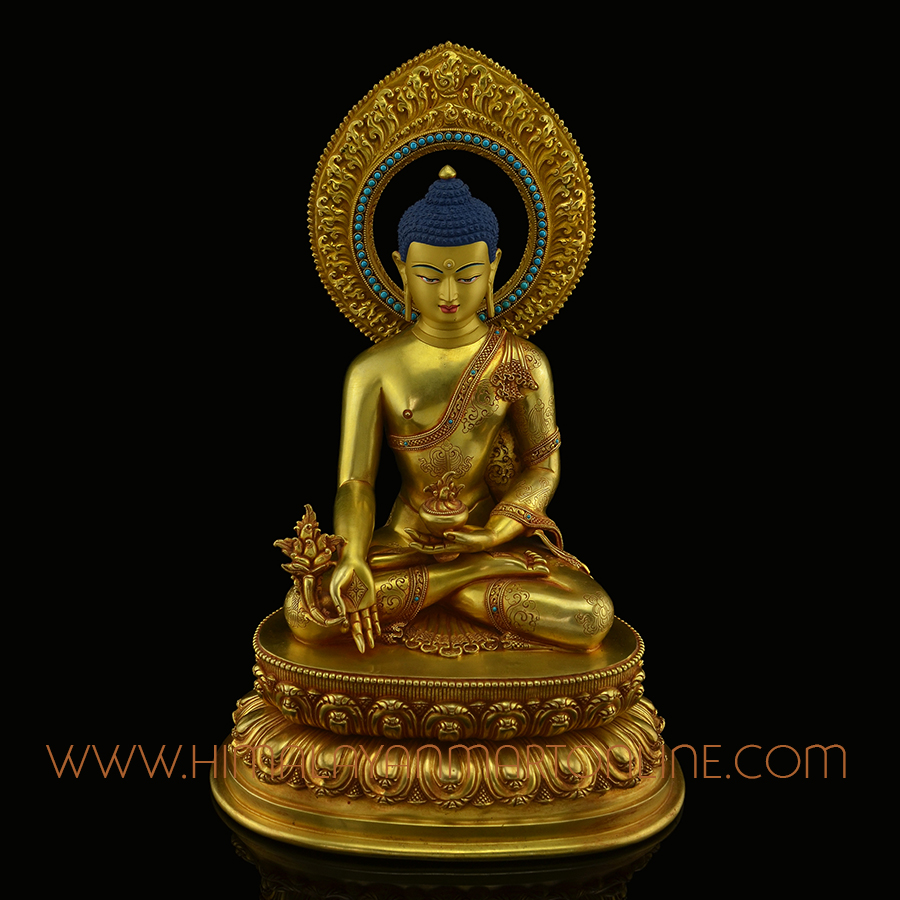
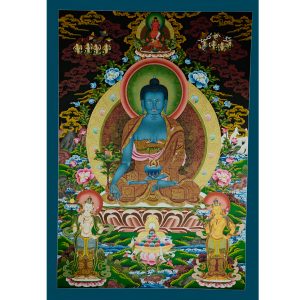
The Medicine Buddha / Sangye Menlha, or Bhaisajyaguru, is the Buddha of Healing. Meditating on the Medicine Buddha is considered to be a powerful method for increasing healing powers, allowing practitioners to alleviate their own sufferings as well as those of others. Through his boundless compassion and generosity, Bhaisajyaguru helps sincere seekers overcome physical illness and infirmity. But even more importantly, the Buddha is the skillful doctor who heals the great disease afflicting all sentient beings. By providing the Dharma as a profound antidote to the poisons of attachment, hatred and ignorance, he lifts the veil of delusion and points the way to freedom.


Medicine Buddha Sangye Menlha


GESTURES AND ATTRIBUTES

The Medicine Buddha / Sangye Menlha is depicted with his right hand extended downward, palm open, with thumb and index finger touching. This posture is known as Varada Mudra, or the gesture of granting wishes. This mudra symbolizes Bhaisajyaguru’s kindness, charity and compassion toward all beings. In the same hand he lightly grasps a sprig of the Myrobalan plant, an important healing herb in Ayurvedic medicine. It is believed that this plant has the power not only to heal the body, but also to free one from the inner sicknesses of attachment, hatred and ignorance. His left hand lies in his lap with palm upward in the gesture of meditation (Dhyana Mudra), representing the eradication of all sickness and suffering through the realization of absolute truth. In the same hand he holds the traditional begging bowl of an ordained Buddhist monk. The bowl contains a sacred medicinal nectar that cures all ills, hindrances and obstacles.


Medicine Buddha Sangye Menlha


The Bhaishajyaguru sutra makes this Buddha far more than a healer of either the body or the spirit. Medicine Buddha is conceived, rather, as supreme and cosmic figure that illuminates the entire world and possesses infinite knowledge. It is also interesting to note that the sutra places considerable importance on the worship of the healing Buddha’s image. The worshiper should “bathe, and with a pure mind try to be friendly to all beings. After this he is to circumambulate the image with music…” The Chinese translation further states that “if one makes an image of this Buddha, or if one recites the text of the sutra, he will escape from the nine ways of death”.


MAITREYA BUDDHA – THE FUTURE BUDDHA

MAITREYA BUDDHA – THE FUTURE BUDDHA

Maitreya Buddha is the Buddha of Future, and also known as The Laughing Buddha, is the one to follow up the historical Buddha Shakyamuni Buddha. Maitreya Buddha waits in Tushita Heaven for the moment he is to appear on earth as the Buddha of the fifth world cycle. Maitreya Buddha is a future Buddha who is expected to come to earth from Tusita (Tushita) Heaven. Shakyamuni Buddha predicted that due to the inevitable degeneration of the times, his own teachings would last just four thousand years before disappearing from this world. People will grow more and more immoral and their lifespan will gradually decrease, as will their health, stature and fortune. While such delusions as miserliness, hatred and jealousy gain strength, the world will go through prolonged periods of famine, disease and continuous warfare until it eventually resembles a vast battlefield of graveyard. Thereupon Maitreya will appear, not in his fully evolved Buddha form, but as a person of regal bearing, very handsome and taller than those around him. On seeing this unusual being, people will be filled with wonder and faith, and will ask how he came to have such an attractive appearance. Maitreya will reply that this is due to his practice of patience, avoiding giving harm to others, and if others will also abide in love and tolerance, they could become similar to him.


Maitreya Buddha The Future Buddha
Maitreya Buddha – The Future Buddha


Maitreya’s appearance will mark a great turning point in the fortunes of this world. As more and more beings follow his example, their store of merit, and consequently their lifespan, will increase. Eventually people will live in health for such a long time that the sufferings of old age and death will scarcely be known. At that time, their observance of morality will grow lax as people become more and more involved in the pleasures of their existence. With this laxity will come another gradual shortening and degeneration of their lifespan until eventually beings once again will become suitable ripe to take sincere interest in the spiritual path. When the human lifespan as increased again to many thousands of years, and when the planet will be entirely dominated by a benevolent wheel – turning sovereign (Chakravartin) named Shankha, it is at this time that Maitreya Buddha will descend from the Tushita Buddha field (Devaloka) where he now resides, to appear in this world as the fifth founding Buddha of this world age. Maitreya will be born the son of a Brahmin priest, and will renounce the world and attain enlightenment in a single day, not requiring six long years. The world in this time will be politically neutralized, and therefore the warrior class and its martial virtues will be obsolete. Thus he will be born among the intellectuals, the priests, and his teaching will bring the gentler emotions to the fore. Maitreya Buddha is supposed to be passing the life of a Bodhisattva in the Tusita (Tushita) Heaven preparatory to his descent to earth in Human form. It is said that he will come to earth full 4000 years after the disappearance of Gautama Buddha for the deliverance all sentient beings. Maitreya may be represented as a standing figure adorned with rich ornaments and holding in his right hand the stalk of a lotus. Maitreya may also be represented seated as a Buddha, with legs either interlocked or dangling down. His color is yellow, and his images sometimes bear the figures of Dhyani Buddhas.


Maitreya Buddha The Future Buddha


The Maitreya Buddha represents a very important figure in Buddhism. It is believed that if one diligently cultivates one’s virtues in this lifetime, one will be reborn into Tushita Heaven where he or she wills me the Maitreya Buddha. Furthermore he or she will also be present at the Maitreya Buddha’s first Dharma Talk after his enlightenment and attain enlightenment himself. Hence the tradition of worshiping the Maitreya, Amitabha and Avalokiteshvara Bodhisattvas remains strong among the Buddhist community even today.


GESTURES AND ATTRIBUTES

Maitreya Buddha is seated on a throne, with both feet on the ground, poised in readiness to rise as he awaits the call of his time. His hands, held at the level of his heart, form the Dharmachakra Mudra, the gesture of teaching and turning the Wheel of Dharma. Between the thumb and index finger of each hand he holds the stem of a lotus flower, indicating his radiant power and purity. Beside his right ear one lotus blooms and supports a golden Wheel of Dharma, which as it turns carries beings along spiritual paths to liberation and enlightenment. Beside his left ear the second lotus blossom supports a long-necked vase brimming with nectar; symbolizing the nectar of pure Dharma which Maitreya Buddha will one day pour onto the world. Above Maitreya’s head is a beautiful parasol, indicating that he offers protection and refuge to all beings.


Subscribe To Our Newsletter