
VIRUPA – THE DAKINI MASTER
Virupa was a famous Mahasiddha from Bengal who lived during the ninth century AD. As a young boy he entered the acclaimed Buddhist monastery of Somapuri. He studied diligently and was extremely devoted to his practice of the Dakini Vajravarahi. But upon experiencing no results after twelve years of intense meditation, he threw away his rosary in discouragement. Vajravarahi then appeared to him in a shining vision, and gave him a beautiful new rosary and comforted him with words of praise and encouragement. Deeply inspired, he applied even greater effort to his practice, and eventually attained the supreme realization of Mahamudra.
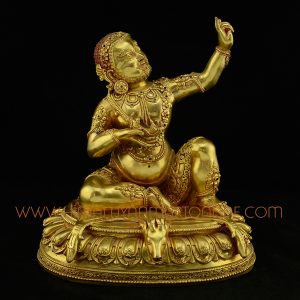
Leaving his monastery, he traveled throughout India as a wandering yogin, and stories abound of the many miraculous deeds he performed. He is known to have walked on water, restored dead pigeons to life, stopped the sun’s movement in the sky, and subjugated a tribe of flesh-eating ghouls. He also has a connection with the Hindu god Indra, whom he swore to the Buddha’s allegiance. At the end of his long life, he was welcomed with honor into the Paradise of the Dakinis.
GESTURES AND ATTRIBUTES
Virupa is depicted in his popular posture with his right hand and his gazes are directed towards the sun sitting upon a deerskin, the traditional meditation seat of a wandering yogin, and an ancient symbol of renunciation. His left hand is held aloft in the wrathful gesture known as the “posture of holding the sun”. This posture recalls Virupa’s miraculous act of stopping the sun in its path, where he held it motionless in the sky for several days. His right hand holds a skull cup or Kapala, signifying his attainment of the union of great bliss and emptiness, and his power over the duality of life and death.
- Visit Virupa Statues Collection
- Visit Virupa Thangka Painting Collection
