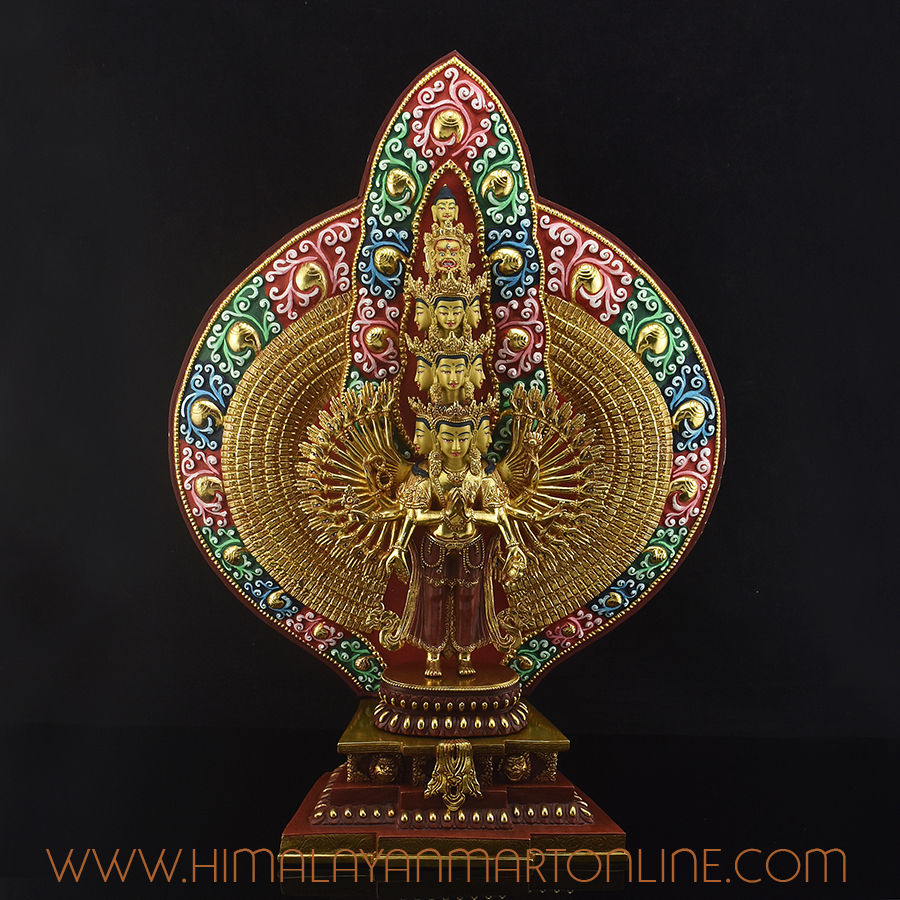
Thousand Armed Avalokiteshvara: Avalokiteshvara (Guan Yin in Chinese; Chenrezig in Tibetan; Kannon in Japanese) is the Bodhisattva of Compassion. Among the Bodhisattvas, it is Avalokeshvara who has the largest number of forms and is perhaps the most venerated and most popular Buddhist deity. His sex, originally masculine, is sometimes considered feminine in China and Japan, although this discrimination is unsupported by any canonical text and was often considered in China and Japan as the ‘mother of the human race’ and, in this respect, worshiped in the form of a woman.
Among the 108 forms of Lokiteshvara, Avalokeshvara is one who refuses to accept Nirvana since he considers such acceptance selfish in view of the ignorance of the great majority of the people who have not yet attained that stage. His sacrifice symbolizes infinite compassion (Karuna), sharing of mankind’s misery, willingness to help those in distress. Avalokeshvara holds in his hand the indestructible jewel. He is savior and protector from danger. So, his invocation (Mantra) “OM MANI PADME HUM” is found inscribed on rocks, loose stones, prayer wheels, etc.
Avalokiteshvara is known from very early in the development of the Mahayana doctrines and, until Buddhism disappeared from India, enjoyed great favor there. His cult passed from India to South-East Asia and Java, where it met with great success, and also in Nepal, Tibet (where he arrived with Buddhism and where King Srong – Tsong Gampo, 519-650, was considered to be his incarnation), and in China, from where he went on to Korea and Japan. All these countries imagined him in different forms according to their own temperaments and spirituality.
500Thousand Armed Avalokiteshvara
Gestures and Attributes of Thousand Armed Avalokiteshvara
It is said that Chenrezig once grew exhausted and discouraged from the overwhelming task of rescuing sentient beings. While struggling to comprehend the needs of so many, his head and body exploded into a thousand pieces. Buddha Amitabha came to Chenrezig’s aid and helped prepare the Bodhisattva for his monumental task. Amitabha endowed Chenrezig with eleven heads, with which to hear the cries of the suffering, and also with a thousand arms, with which to aid the suffering multitudes.
Chenrezig’s eleven faces are arranged in three tiers, topped by the wrathful face of Vajrapani, and, at the very top, the face of Buddha Amitabha. The skin of a deer is draped over Chenrezig’s left shoulder and heart, symbolizing his compassionate nature. His first two principal hands are pressed together at his heart in deference to his teacher, Amitabha; and his other principal hands hold a crystal rosary, a lotus blossom, an undrawn bow and arrow, an eight-spoked Dharma wheel, and a golden water pot. Each of Chenrezig’s one thousand hands has an eye in the center of its palm, symbolizing the union of the five method perfections (five fingers) with the sixth perfection of wisdom (eye).
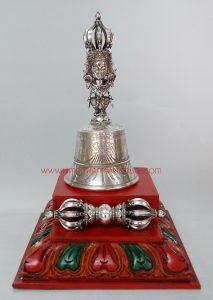
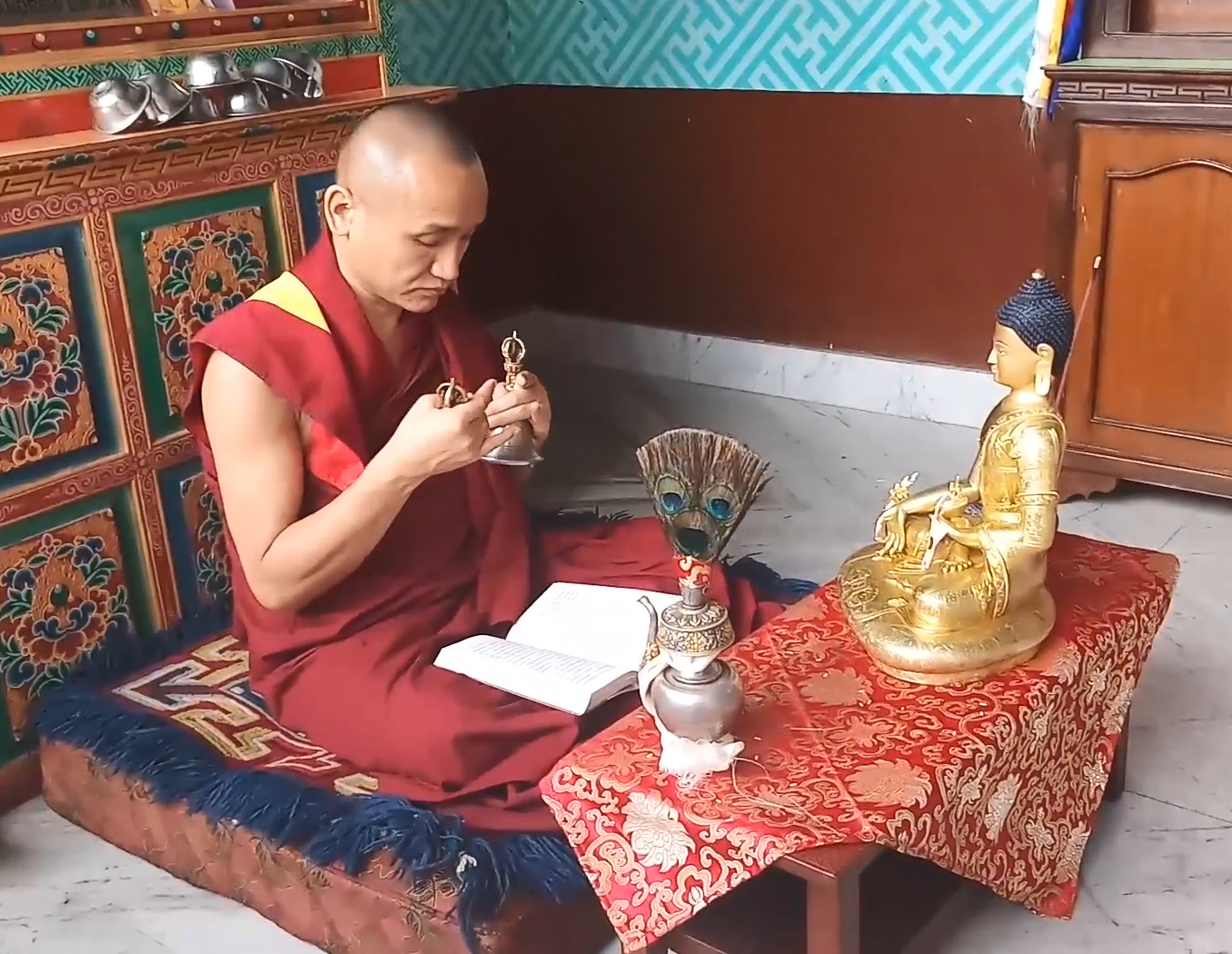
The Vajra and Bell are very important ritual implements in Tibetan Buddhism. The Vajra known as Dorje in Tibetan term and the Bell known as Drilbu in Tibetan term are mostly used as pair by every Buddhist monk almost in daily basis as ritual objects in tantric rituals and practice. Most of the Buddhist monks carry these two implements with them where ever they go because they need these items in their ritual performance. Though the Vajra (Tibetan: Dorje) symbolizes masculine inviolability and the Bell (Tibetan: Drilbu) symbolizes feminine wisdom are two different objects but mostly these are used as pair in the practice. These implements are attributes of many Buddhist deities and are held by deities like; Vajrapani, Chakrasamvara, Kalachakra, Vajradhara Buddha, Vajrasattva, Guru Padmasambhava, etc. as a part of their appearance which shows the importance of these two ritual items.
Vajra and Bell Set
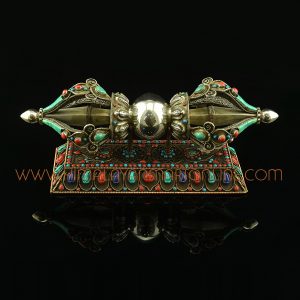
Vajra (Tibetan: Dorje)
The Vajra (Dorje) is one of the main ritual implements in Buddhism. The Vajra is an important ritual sacred tool in Vajrayana Buddhism. This Vajra can also found in Hinduism and Tantric practice where it symbolizes the male principle in religious practice. The Vajra – Indestructible Thunderbolt is believed as the destroyer of all kinds of ignorance. In Hindu mythology; The Vajra is symbol of Indra the Vedic god of war and king of Devas accordingly to Hindu mythology.
There are four types of Vajras; a. The nine prongs (pointed) Vajra which is known is Commitment Vajra, in nine prongs (pointed) Vajra; there are eight prongs plus the central hub, b. The five prongs (pointed) Vajra which is known as the Full Knowledge Vajra, c. The three prongs (pointed) Vajra which is used for exorcising inimical forces, and d. The open prongs (pointed) Vajra which is called the Wrathful Vajra.
Out of these four types of Vajras; the Nine pointed and the Five pointed Vajras are found used most commonly.
Vajra / Dorje
In Buddhism
The Vajra (Dorje) is a ritual implement which has very important role in Tibetan Buddhism. The use of Vajra in Buddhism is in all aspect of their religious, mythology, symbolism and philosophy. Many deities in Buddhism like; Vajrasattva, Vajradhara, Vajrapani, Chakrasamvara, Kalachakra, Guru Padmasambhava etc., hold Vajra as their attributes. The Vajra along with its counterpart Bell (Drilbu) is used by Buddhist monks in almost all their ritual performance.
In Hinduism
The Vajra also has its specific role in Hinduism. According to Hindu mythology; Indra the Vedic god of war and king of Devas; holds it as his weapon. It is a powerful weapon which has the combined feathers of all sword, mace and spear in it. As per Hindu mythology; it is believed that the Vajra is made out of thigh bones of sage Dadhichi who gave up his life willingly for a noble cause so that his spine could be used to build weapon and Indra used this weapon to kill Vritrasura who had conquered heaven and terrorized the gods. Due to this supreme sacrifice, sage Dadhichi became a legend. In another incident; Vitra, the serpent of drought had swallowed the cosmic water. Indra using his Vajra weapon split Vitra’s stomach to release the water inside the Vitra’s stomach.
In Tantric Buddhism
The Vajra is used widely in the rituals of the Tantra where it symbolizes male principle where as its counterpart Bell (Drilbu) symbolizes female principle representing compassion. The use of their interaction leads to enlightenment. According to Buddhist mythology; the Vajra destroys all kinds of ignorance, and is indestructible against any evil force. Various deities like; Vajrasattva, Vajradhara, Chakrasamvara, Kalachakra, Vajrapani, Guru Padmasambhava, etc., in Buddhism are depicted holding the Vajra individually or with its counterpart Bell together. Vajrasattva, Vajradhara and some other deities hold the Vajra in their right hand along with the Bell on their left hand and Vajrapani, Guru Padmasambhava and some other deities hold the Vajra on their right hand without its counterpart the Bell.
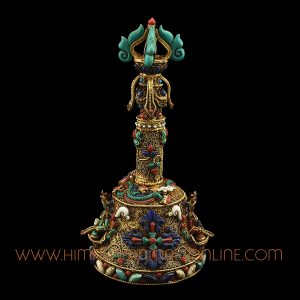
Bell (Tibetan: Drilbu)
Like Vajra (Dorje) the Bell (Drilbu) is also an important religious implement in Tibetan Buddhism. Like its counterpart Vajra; it plays important role in religious practice. While the Vajra symbolizes the male principle; the Bell symbolizes the female principle. The Bell can be seen held by many deities in Buddhism like; Vajrasattva, Vajradhara, Chakrasamvara, Kalachakra, etc. The Vajra is held by deities in right hand whereas the Bell is held in left hand. In ritual practice; the Vajra symbolizes the male principle and is held on right hand and the Bell symbolizes the female principle and is held in left hand in the practice.
Bell / Drilbu
The symbolism of the Vajra Bell Ritual Implement
Vajras are made of different prongs (points) some with five, some with nine, some with three and some with open prongs. These prongs or (points) symbolize the five wisdoms that are attained through beyond ordinary limits of five kleshas which are greed, anger, delusion, pride and envy. The hub between these signifies emptiness.
Vajra; it is a Sanskrit word and in Tibetan it is called Dorje; which is related to the word for diamond. The Buddhism has very important role of Vajra; which has been shown as attributes of different deities and it us used in ritual ceremonies. According to Hindu mythology; it is used as thunderbolt weapon carried by the Vedic god Indra. The Vajra has been used as important implement in Buddhist and Hindu religion however it the Vajra as an artifact appears throughout the cultures around the world like; the Zeus carries it as thunderbolt weapon as per ancient Greek mythology. As per the Greek mythology; Zeus the Sky god received it from Cyclopes; one eyed giant creature.
In all the religion; the Vajra has been used as a weapon which destroys both internal and external enemies. Like a diamond it symbolizes the indestructible and all penetrating mind of enlightenment.
It is believed that the bell sound calls to mind to purify all kinds of sins. The sound of the Bell is considered by Tibetan Buddhists as beautiful music. The bell is used as musical instrument together with other sacred instruments like Damaru, Tingsha, etc., in ritual ceremony as musical offerings to the Buddhas and other gods. This music is presented as one of eight offerings to the deity that is invoked during the ritual.
How are they used
The Vajra and Bell are often seen held in the hands of deities, and in ritual practice they are held in the hands of the monks during rituals performance, the Vajra in the right hand, the Bell in the left hand. They are moved as pair in prescribed manners in ritual performance. When the arms are crossed holding Vajra and Bell; it symbolizes that the two are united-representing enlightenment. The Vajra is used as weapon which destroys all the negativity and sins and purify minds. The Vajra is used in other religion as well such as; it is used as weapon by the Vedic god Indra as per Hindu mythology and by Zeus as per Greek mythology. The sound of the Bell is believed to purify the minds and is considered by Tibetan Buddhists as the most beautiful music. This music is presented as one of eight offerings to the deity that is invoked during the ritual.
Use of Vajra and Bell in Ritual Ceremony
Vajra and Bell are important ritual objects not only in Buddhism but in other religion as well such as Hindu, Greek, etc. In Buddhist religion; many deities carry Vajra and Bell as their prime attributes. The Vajra is found used in Hindu and other religion such as Greek religion from ancient time. The Vajra is considered as male principle in Buddhist religion which states masculine and bold and believed to destroy all the negativity whereas the Bell is considered as the female principle which has soft and southing sound and believed to purify the negativity in minds. The Vajra and Bell are important ritual objects which are widely used in ritual ceremony in Buddhist religion by the monks. There are many ritual objects like; Damaru, Offering Bowls, Bhumpa – The Ritual Vase, Kapala, etc. which all have significant role in Buddhist tradition.
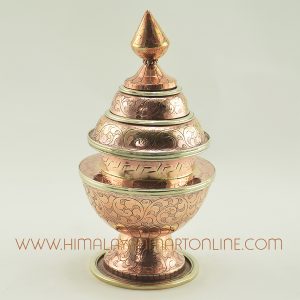
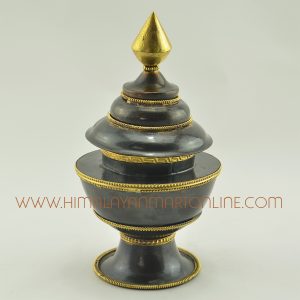
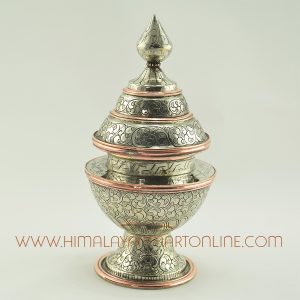
Neshi Dhupur: Neshi is also a Buddhist Ritual Object and is used to store offerings specially rice to the deities in a ritual ceremony. The Neshi is an important ritual object in the Buddhist community and Buddhist religion. The Neshi is store pot like object which is used to keep offerings in a ritual ceremony. Neshi may be found in copper, silver, brass or mixture of different metals.
Nheshi Dhupur: Nheshi is also a Buddhist Ritual Object and is used to store offerings specially rice to the deities in a ritual ceremony. The Nheshi is an important ritual object in the Buddhist community and Buddhist religion. The Nheshi is store pot like object which is used to keep offerings in a ritual ceremony. Nheshi may be found in copper, silver, brass or mixture of different metals.
Nesi Dhupur: Nesi is also a Buddhist Ritual Object and is used to store offerings specially rice to the deities in a ritual ceremony. The Nesi is an important ritual object in the Buddhist community and Buddhist religion. The Nesi is store pot like object which is used to keep offerings in a ritual ceremony. Nesi may be found in copper, silver, brass or mixture of different metals.
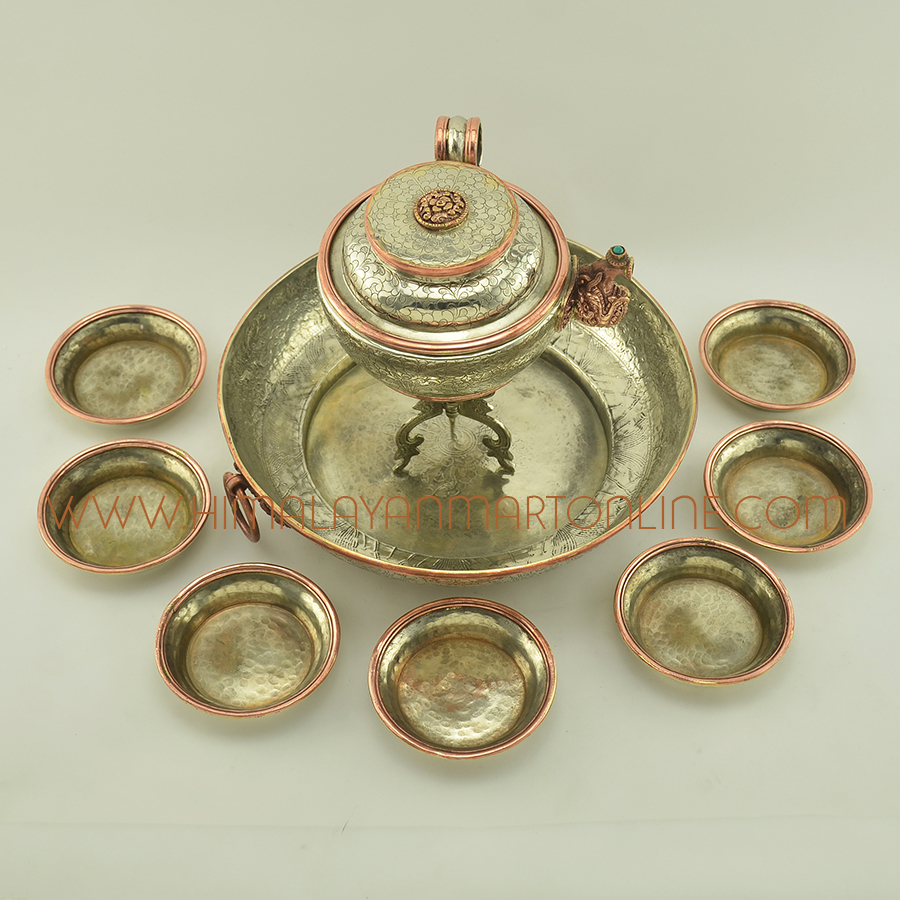
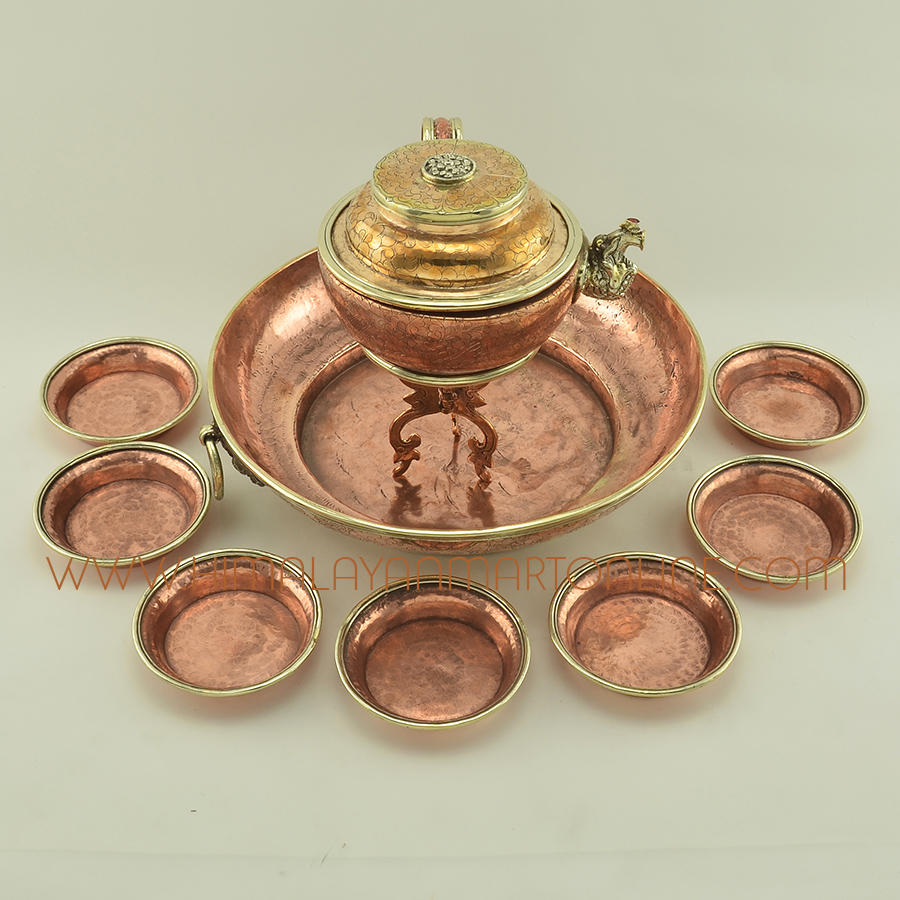
Jambala Water Offering Set: Jambala Water Offering (Chutor) Set which is also known as Water Torma Set is a whole set of pots which includes a water pot or kettle, a large plate type bowl where the offered water is stored after over filling from the Kettle, a tripod to place Kettle and 7 pieces of saucers or small plates. The Jambala Water Offering (Chutor) Set is used to perform water offering to the God of Wealth Dzambhala (Dzambhala).
Dzambala Water Offering Set: Dzambhala Water Offering (Chutor) Set which is also known as Water Torma Set is a whole set of pots which includes a water pot or kettle, a large plate type bowl where the offered water is stored after over filling from the Kettle, a tripod to place Kettle and 7 pieces of saucers or small plates. The Dzambhala Water Offering (Chutor) Set is used to perform water offering to the God of Wealth Dzambhala (Jambhala).
Red Tara is the manifestation of Tara expression of awareness of all phenomena. In Vajrayana Buddhism the practice of Red Tara is based on the ritual called the Mandala of wish-fulfilling essence that focuses on turning material desires into compassion and love. The ritual includes yoga, healing practices and teachings on the nature of mind. The Red Tara empowerment ritual was originated by Amitabha Buddha and passed to Avalokiteshvara, then to an emanation of Tara and the famous Indian master Nagarjuna that transmitted this teaching to Padmasambhava.
Red Tara – The Wish Fulfilling Tara
Guru Rinpoche left this knowledge to his consort Yeshe Tsogyal, and asked her to hide it as a treasure to be discovered at a later time, which it would produce the most benefit. The teaching was discovered by lama Apong Terton, who lived in last century. Before his death the lama transmitted the ritual to a monk that promised to reveal it to the reincarnation of Apong Terton, Sakya Trizin.
Gestures and Attributes
Red Tara is depicted in her peaceful manifestation. She is seated with the right leg slightly extended like the most common representation of Green Tara. The right hand is extended outward across the knee facing upward and holding a long-life vase (Kalasha) and the left hand is positioned in front of the heart holding the stem of a utpala flower with bow and arrow of skillful meaning wisdom on top of it.
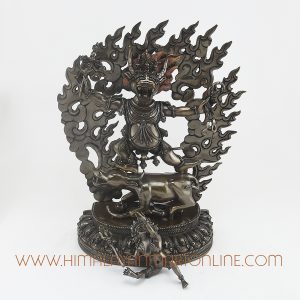
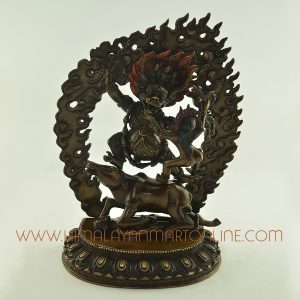
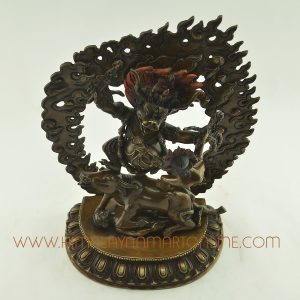
Yam Dharmaraj Buddhist Protector the Lord of Death, King of the Law; is the protector of the Vajrabhairava (Yamantaka) cycle of tantras.
Yam Dharmaraj Buddhist Protector
Gestures and Attributes
Yam Dharmaraj Buddhist Protector is depicted with one face and two hands in dark blue color and the head is that of a buffalo, three eyes, sharp horns entwined with flame, fierce and angry. Held upraised in the right hand is a bone stick composted of a fused spine and skull. In the left hand is a coiled lasso. Adorned with a crown of skulls and bone ornaments, he wears a necklace of fifty freshly served heads. Appearing extremely animate he stands with his right leg bent and the left extended on the back of a buffalo which is above a human body, sun disc and lotus seat. To the right is the consort Chamundi, blue with one face and two hands. A trident is held aloft in the right hand and a (Kapala) skull cup in the left hand. Both are adorned with wrathful attire, bone ornaments and various skins, completely surround by the swirling orange flames of pristine awareness.
Yama Dharmaraja Buddhist Protector the Lord of Death, King of the Law; is the protector of the Vajrabhairava (Yamantaka) cycle of tantras.
Yama Dharmaraja Buddhist Protector
Gestures and Attributes
Yama Dharmaraja Buddhist Protector is depicted with one face and two hands in dark blue color and the head is that of a buffalo, three eyes, sharp horns entwined with flame, fierce and angry. Held upraised in the right hand is a bone stick composted of a fused spine and skull. In the left hand is a coiled lasso. Adorned with a crown of skulls and bone ornaments, he wears a necklace of fifty freshly served heads. Appearing extremely animate he stands with his right leg bent and the left extended on the back of a buffalo which is above a human body, sun disc and lotus seat. To the right is the consort Chamundi, blue with one face and two hands. A trident is held aloft in the right hand and a (Kapala) skull cup in the left hand. Both are adorned with wrathful attire, bone ornaments and various skins, completely surround by the swirling orange flames of pristine awareness.
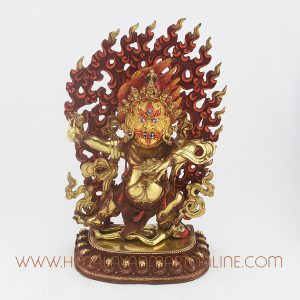
Yama Dharmaraja is the Inner Lord of Death, King of the Law. Dharmaraja is the special protector for the Vajrabhairava cycle of the Tantric practices and is especially associated with the Rwa Lotsawa Tradition.
Yama Dharmaraja Inner
Gestures and Attributes
Yama Dharmaraja is depicted in blue color with one face and two hands; his right hand holds a Kartika (curved knife) and the left hand holds Kapala (blood filled skull cup) to heart. Fearsome and wrath, having the appearance of Raksha demon, his dark yellow hair flows upward flame like, rising above a black half Vajra and the golden crown marked with five dry skulls. Wearing a green scarf and jewels, gold and bone ornaments, he is adorned with a necklace of severed heads and wears a tiger skin around the waist tied with a green sash. Standing with the left leg bent and the right leg extended above a brown corpse, sun disc and lotus blossom above a black triangle mandala filled with blood he dwells completely surrounded within the red flames of pristine awareness.
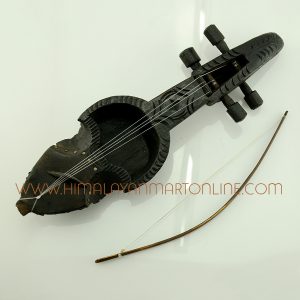
Sarangi is a Nepali folk musical instrument. It is a chordophone played by bowing. Traditionally in Nepal, the Sarangi was only played by people of Gandarbha or Gaine in local terms (both contested and interchangeable terms), who sing narrative tales and folk song, however; in present days, its popularity extends beyond the Gandarbha community and is widely used and played by other cast members as well. It has also garnered much interest in other music genres, such as Nepali rock and film music. While the Sarangi has become the quintessential Gandarbha instrument, while its counterpart, the arbajo, which is a plucked lute, has fallen into obscurity.
Construction
Traditional Nepali Sarangi is not standardized with regards to shape, construction materials, or scale or key. It is made up of a single piece of wood. Having a neck and hollowed-out double-chambered body, they are often made from woods of trees that are easily available, most often that of Khirra, Saaj, Lakuri, or aap. While the upper chamber is left open, the lower opening, upon which the bridge rests, is generally covered up with dried skin of sheep or goat. The neck is fretless, and the strings are tied upon and tuned with the tuning pegs. The size of Sarangi differs according to the players’ preference.
The Sarangi Nepali folk instrument consists of four strings. The original strings were made up of sheep intestine, similar to the use of catgut (made from the intestines of cattle) in many musical traditions around the world. The Gandarbha received intestines of sheep sacrificed during major festivals like Dashain, which they left in a pot for some days. Once the entrails was fully rotten, it was pulled out, leaving behind the fine nerves of the intestine in the pot. These were then woven to make strings. However, these days, badminton strings, nylon and steel strings have generally replaced gut strings. The bow was traditionally strung with horse tail-hair, but in the modern days, nylon bowstrings are common.
Tuning of the Instrument
The range of the Sarangi covers almost two octaves, and it is tuned in 5ths. From right to left, the four strings of Sarangi are tuned to lower fifth, root, root and fifth notes of a particular key. The middle 2 strings are used as drone. The instrument is tuned either by ear at the performer’s discretion, or tuned to keys of western music. This is mostly done in a setting where a standardized key is required to facilitate performing with musical instruments of other cultures, or in a recording studio. For example; if the middle tow strings are tuned at G note, both the first and fourth strings are corresponded to D.
Performance Techniques
There are different methods of producing notes on the Sarangi. Most players play the Sarangi by pressing the strings slightly with their fingers of the left hand and bowing the strings with right hand. However, Bharat Nepali and his students rub their hand fingernails to rub against the strings to create sound.
Also, traditionally, the Gandarbhas used to bow the root note continuously along with the notes of the song. As Sarangi is usually the only instrument used in their songs, except some Nepali percussion like Madal, the continuous sound of the root note (or drone from the 2 middle strings) provides the ambiance. Since now days the Sarangi is also played along with other instruments, performers do not bow the drone string continuously.
Unlike the traditional way of playing the Sarangi in a single key, modern players have started to use modal techniques to play the Sarangi in different keys. Along with the folk tunes, the Sarangi players also experimenting the use of this instrument in modern and western genres these days.