Manjushri & Green Tara Ghau Pendant

Ghau / Pendant / Prayer Box

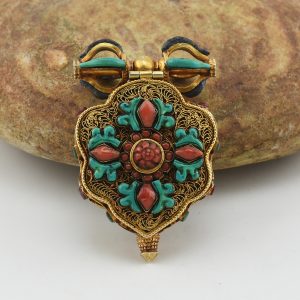
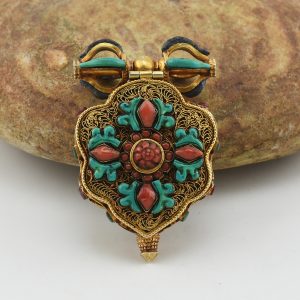
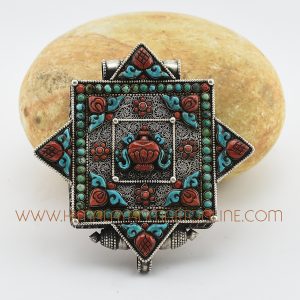
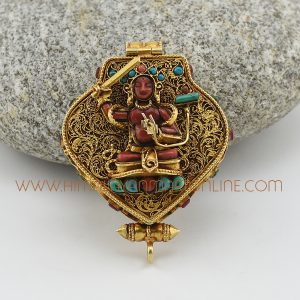
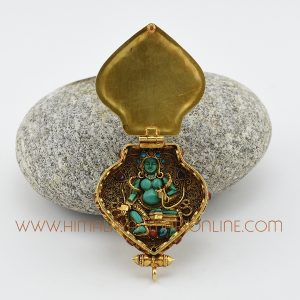
Manjushri & Green Tara Ghau Pendant: Ghau is a small prayer box worn as pendant by Buddhists as portable shrines where prayers and sacred relics are kept and used during their travel to hold their sacred deity inside. Now, Ghau or Prayer Box pendants are often used as jewelry or personal adornment. They are used to carry prayers or prayer concerns or photos, poems, small items, or memories. Ghau pendants can carry your prayers near to your heart throughout the day. They are jewelry that has a history. The Ghau opens to a concealed inner space, and is traditionally used by Tibetan Buddhists to hold a picture of their favorite deity or Lama, a folded-up scroll of sacred mantras, special herbs or sacred relics. The Ghau is used as an amulet to help the wearer to ward off negative energy and attract blessings. A Ghau is also used as a portable shrine and are worn on a cord around the neck and hung close to the heart.
Manjushri & Green Tara Ghau Pendant

These Ghaus are mostly made of silver like this Manjushri & Green Tara Ghau Pendant; however, the artisans also use copper, brass, gold and other metals. Ghau often have intricate designs of deity, auspicious symbols and mantras inscribed on their outer and inner surface Ghau is often decorated by precious or semi-precious gemstones which have various healing effects on the wearer. Turquoise, considered by many as a master healing stone, Lapis Lazuli and Coral are especially popular in Ghau or Prayer Box design for their beauty and healing properties. Other gemstones used by the craftsman include: amber, carnelian, amethyst, malachite, onyx and topaz.
Manjushri & Green Tara Ghau Pendant

About this Manjushri & Green Tara Ghau Pendant – Ritual Item

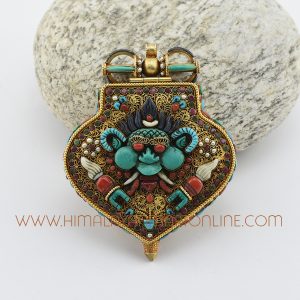
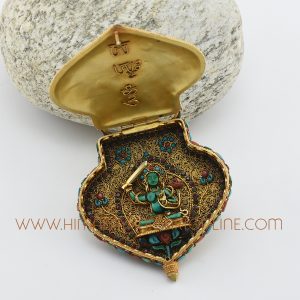
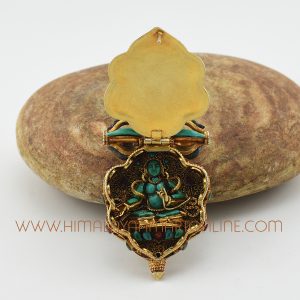
This wonderful Manjushri & Green Tara Ghau Pendant or Prayer Box is entirely a hand carved piece; made from Silver which has beautiful intricate filigree hand carvings known as siko carvings in local term and is submitted to a gold plating effect to yield a rich and sensuous finish and besides the decoration of Coral, Turquoise, Ruby and Emerald stones make this Manjushri & Green Tara Ghau Pendant or Prayer Box a stunning piece of art which is entirely a hand craft. This beautiful Manjushri & Green Tara Ghau Pendant or Prayer Box is hand made by the master artisans of Patan, which lies in the Himalayan Kingdom of Nepal; who have been in the business from generations.


Green Tara / Dolma Ghau Pendant

Ghau / Pendant / Prayer Box

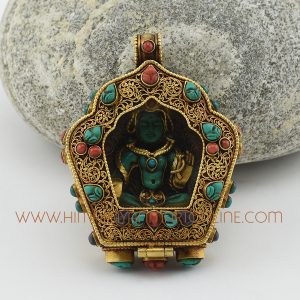
Green Tara / Dolma Ghau Pendant: Ghau is a small prayer box worn as pendant by Buddhists as portable shrines where prayers and sacred relics are kept and used during their travel to hold their sacred deity inside. Now, Ghau or Prayer Box pendants are often used as jewelry or personal adornment. They are used to carry prayers or prayer concerns or photos, poems, small items, or memories. Ghau pendants can carry your prayers near to your heart throughout the day. They are jewelry that has a history. The Ghau opens to a concealed inner space, and is traditionally used by Tibetan Buddhists to hold a picture of their favorite deity or Lama, a folded-up scroll of sacred mantras, special herbs or sacred relics. The Ghau is used as an amulet to help the wearer to ward off negative energy and attract blessings. A Ghau is also used as a portable shrine and are worn on a cord around the neck and hung close to the heart.

Green Tara / Dolma Ghau Pendant

These Ghaus are mostly made of silver like this Green Tara / Dolma Ghau Pendant; however, the artisans also use copper, brass, gold and other metals. Ghau often have intricate designs of deity, auspicious symbols and mantras inscribed on their outer and inner surface Ghau is often decorated by precious or semi-precious gemstones which have various healing effects on the wearer. Turquoise, considered by many as a master healing stone, Lapis Lazuli and Coral are especially popular in Ghau or Prayer Box design for their beauty and healing properties. Other gemstones used by the craftsman include: amber, carnelian, amethyst, malachite, onyx and topaz.


About this Green Tara / Dolma Ghau Pendant – Ritual Item

This beautiful Green Tara / Dolma Ghau Pendant or Prayer Box is entirely a hand carved piece; made from Silver which has fine intricate filigree hand carvings known as siko carvings in local term and is submitted to a gold plating effect to yield a rich and sensuous finish and besides the decoration of Turquoise, Coral and Lapis stones make this Green Tara / Dolma Ghau Pendant or Prayer Box an excellent piece of art which is entirely a hand craft. This beautiful Green Tara / Dolma Ghau Pendant or Prayer Box is hand made by the master artisans of Patan, which lies in the Himalayan Kingdom of Nepal; who have been in the business from generations.


Nagpash Yantra

Nagpash Yantra

Nagpash Yantra is an astrological situation which is fashioned when all of the planets are located in Rahu and Ketu. Rahu is considered as snake and Ketu is its tail. It is also known as Kaal Sarp Yoga which is made from two Sanskrit words; Kaal meaning death and Sarp meaning Serpent. It is energized by 1001 Nagpash Mantra. The one who takes start on this yoga undergo from varied troubles. The Nagpash Yoga is dreaded yoga that may trigger one’s life to be miserable. Folks with Nagpash Yoga have their life stuffed with struggle. An individual underneath the difficulty of this yoga brings a lifetime of ache and misfortune. It causes setbacks in life and generates obstacles in achievement of each work you encourage. Folks having Kaal Sarp Dosha shall carry our Puja on Naag-Panchami in addition to set up energized Nagpash Yantra of their home to guard themselves from the evil impact of this yoga. It reduces the in poor health results of the Kaal Sarp Yoga, which causes set backs in life and creates obstacles within the accomplishment of each work. The Kaal Sarp Yantra or Nagpash Yantra is a curse of snakes.

Nagpash Yantra
Nagpash Yantra

It is beneficial for relief from malefic effects of Rahu and Ketu and solves problems, happiness in life, enhance strength, builds confidence, speech power, progress in business, gain in wealth, prosperity, success in tasks, protection from evils, family security, removes obstacles from life and divine blessings. Worshiping the consecrated Nagpash Yantra reduces in the poor health results of the Nagpash Yoga.


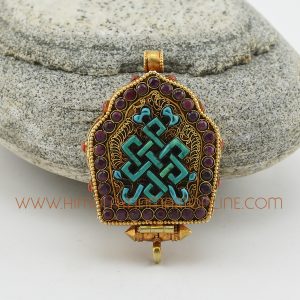
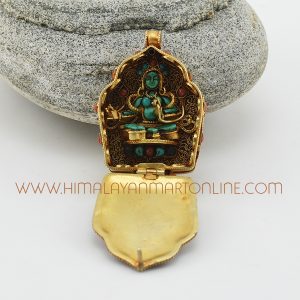
Nagpash Yantra & Green Tara Ghau Pendant

Ghau / Pendant / Prayer Box

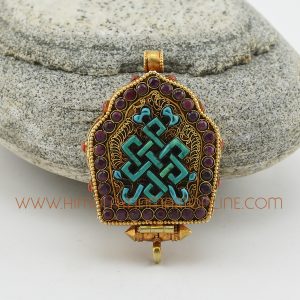
Nagpash Yantra & Green Tara Ghau Pendant: Ghau is a small prayer box worn as pendant by Buddhists as portable shrines where prayers and sacred relics are kept and used during their travel to hold their sacred deity inside. Now, Ghau or Prayer Box pendants are often used as jewelry or personal adornment. They are used to carry prayers or prayer concerns or photos, poems, small items, or memories. Ghau pendants can carry your prayers near to your heart throughout the day. They are jewelry that has a history. The Ghau opens to a concealed inner space, and is traditionally used by Tibetan Buddhists to hold a picture of their favorite deity or Lama, a folded-up scroll of sacred mantras, special herbs or sacred relics. The Ghau is used as an amulet to help the wearer to ward off negative energy and attract blessings. A Ghau is also used as a portable shrine and are worn on a cord around the neck and hung close to the heart.

Nagpash Yantra & Green Tara Ghau Pendant

These Ghaus are mostly made of silver like this Nagpash Yantra & Green Tara Ghau Pendant; however, the artisans also use copper, brass, gold and other metals. Ghau often have intricate designs of deity, auspicious symbols and mantras inscribed on their outer and inner surface Ghau is often decorated by precious or semi-precious gemstones which have various healing effects on the wearer. Turquoise, considered by many as a master healing stone, Lapis Lazuli and Coral are especially popular in Ghau or Prayer Box design for their beauty and healing properties. Other gemstones used by the craftsman include: amber, carnelian, amethyst, malachite, onyx and topaz.

Nagpash Yantra & Green Tara Ghau Pendant

About this Nagpash Yantra & Green Tara Ghau Pendant – Ritual item

This wonderful Nagpash Yantra & Green Tara Ghau Pendant or Prayer Box is entirely a hand carved piece; made from Silver which has beautiful intricate filigree hand carvings known as siko carvings in local term and is submitted to a gold plating effect to yield a rich and sensuous finish and besides the decoration of Turquoise, Coral and Ruby stones make this Nagpash Yantra & Green Tara Ghau Pendant or Prayer Box a stunning piece of art which is entirely a hand craft. This beautiful Nagpash Yantra & Green Tara Ghau Pendant or Prayer Box is hand made by the master artisans of Patan, which lies in the Himalayan Kingdom of Nepal; who have been in the business from generations.
 

Bishwa Bajra & Green Tara Ghau Pendant

GHAU / PENDANT / PRAYER BOX

Bishwa Bajra & Green Tara Ghau Pendant: Ghau is a small prayer box worn as pendant by Buddhists as portable shrines where prayers and sacred relics are kept and used during their travel to hold their sacred deity inside. Now, Ghau or Prayer Box pendants are often used as jewelry or personal adornment. They are used to carry prayers or prayer concerns or photos, poems, small items, or memories. Ghau pendants can carry your prayers near to your heart throughout the day. They are jewelry that has a history. The Ghau opens to a concealed inner space, and is traditionally used by Tibetan Buddhists to hold a picture of their favorite deity or Lama, a folded-up scroll of sacred mantras, special herbs or sacred relics. The Ghau is used as an amulet to help the wearer to ward off negative energy and attract blessings. A Ghau is also used as a portable shrine and are worn on a cord around the neck and hung close to the heart.

Bishwa Bajra & Green Tara Ghau Pendant

These Ghaus are mostly made of silver like this Bishwa Bajra & Green Tara Ghau Pendant; however, the artisans also use copper, brass, gold and other metals. Ghau often have intricate designs of deity, auspicious symbols and mantras inscribed on their outer and inner surface Ghau is often decorated by precious or semi-precious gemstones which have various healing effects on the wearer. Turquoise, considered by many as a master healing stone, Lapis Lazuli and Coral are especially popular in Ghau or Prayer Box design for their beauty and healing properties. Other gemstones used by the craftsman include: amber, carnelian, amethyst, malachite, onyx and topaz.

Bishwa Bajra & Green Tara Ghau Pendant

ABOUT THIS BISHWA BAJRA & GREEN TARA GHAU PENDANT – RITUAL ITEM

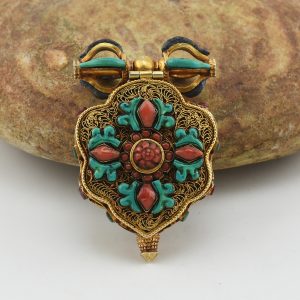
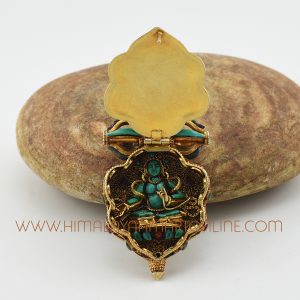
This beautiful Bishwa Bajra & Green Tara Ghau Pendant is entirely a hand carved piece; made from Silver which has fine intricate filigree hand carvings known as siko carvings in local term and is submitted to a gold plating effect to yield a rich and sensuous finish and besides the decoration of Turquoise, Coral, Ruby, Emerald and Lapis stones make this Bishwa Bajra & Green Tara Ghau Pendant an excellent piece of art which is entirely a hand craft. This beautiful Bishwa Bajra & Green Tara Ghau Pendant is hand made by the master artisans of Patan, which lies in the Himalayan Kingdom of Nepal; who have been in the business from generations.
 

Vishwa Vajra & Green Tara Ghau Pendant

GHAU / PENDANT / PRAYER BOX

Vishwa Vajra & Green Tara Ghau Pendant: Ghau is a small prayer box worn as pendant by Buddhists as portable shrines where prayers and sacred relics are kept and used during their travel to hold their sacred deity inside. Now, Ghau or Prayer Box pendants are often used as jewelry or personal adornment. They are used to carry prayers or prayer concerns or photos, poems, small items, or memories. Ghau pendants can carry your prayers near to your heart throughout the day. They are jewelry that has a history. The Ghau opens to a concealed inner space, and is traditionally used by Tibetan Buddhists to hold a picture of their favorite deity or Lama, a folded-up scroll of sacred mantras, special herbs or sacred relics. The Ghau is used as an amulet to help the wearer to ward off negative energy and attract blessings. A Ghau is also used as a portable shrine and are worn on a cord around the neck and hung close to the heart.

Vishwa Vajra & Green Tara Ghau Pendant
Vishwa Vajra Silver Ghau Pendant

These Ghaus are mostly made of silver like this Vishwa Vajra & Green Tara Ghau Pendant; however, the artisans also use copper, brass, gold and other metals. Ghau often have intricate designs of deity, auspicious symbols and mantras inscribed on their outer and inner surface Ghau is often decorated by precious or semi-precious gemstones which have various healing effects on the wearer. Turquoise, considered by many as a master healing stone, Lapis Lazuli and Coral are especially popular in Ghau or Prayer Box design for their beauty and healing properties. Other gemstones used by the craftsman include: amber, carnelian, amethyst, malachite, onyx and topaz.

Vishwa Vajra & Green Tara Ghau Pendant
Hand Made Vishwa Vajra & Green Tara Silver Ghau Pendant

ABOUT THIS VISHWA VAJRA & GREEN TARA GHAU PENDANT – RITUAL ITEM

This beautiful Vishwa Vajra & Green Tara Ghau Pendant is entirely a hand carved piece; made from Silver which has fine intricate filigree hand carvings known as siko carvings in local term and is submitted to a gold plating effect to yield a rich and sensuous finish and besides the decoration of Turquoise, Coral, Ruby, Emerald and Lapis stones make this Vishwa Vajra & Green Tara Ghau Pendant an excellent piece of art which is entirely a hand craft. This beautiful Vishwa Vajra & Green Tara Ghau Pendant is hand made by the master artisans of Patan, which lies in the Himalayan Kingdom of Nepal; who have been in the business from generations.
 

Kartika

Kartika – The Curved Knife or Chopper

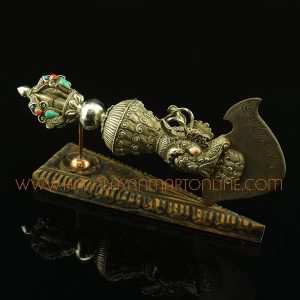
Kartika is a ceremonial Buddhist ritual tool shaped like a crescent knife or chopper, topped with a Vajra that acts as a handle to the blade. The Vajra-topped curved knife or flaying knife is also known as the ‘knife of the dakinis’. It symbolizes the severance of all material and worldly bonds, while the Vajra represents the destruction of ignorance, thus clearing the path to enlightenment. While the Kartika is used in several Buddhist ceremonies, usually in combination with the Kapala(skull-cup), it is particularly important in the Tibetan practice of Chod, a ritual involving a form of self-sacrifice, whereby the practitioner visualizes their own body as the offering at a form of tantric feast. The Kartika is also famously used in the Tibetan sky burial ritual, whereby the deceased are cut into small pieces and left for the vultures to consume on top of special gats or burial platforms. Interestingly, the Kartika is also utilized in the practice of Feng Shui.


The three main handheld attributes of the dakinis in general are the skull-cup (Kapala), the curved knife (Kartika) or the Damaru (Chod drum), and the Khatvanga. The skull-cup of blood which is held in the left hand of important dakinis, such as Vajrayogini, Vajravarahi, and Nairatma, symbolizes ‘method’ as the cultivation of great bliss; the curved knife held in the right hand symbolizes ‘wisdom’ as the severing of all conceptualizations; and the Khatvanga symbolizes the inseparable union of bliss and emptiness, as the consort (method) held in the dakini’s (wisdom) perpetual embrace (union), by the crook of her left arm.

The Kartika
Hand Made Silver The Kartika

The curved flaying-knife (The Kartika) of the dakini – which is either held aloft or extended in her right hand, or held above the skull at the level of her heart – is modeled on the Indian flaying-knife or ‘the knife of the butchers’, used for skinning animal hides. The scythe-shaped blade is made from iron honed to a sharp edge, and the gibbous crescent of its blade- which terminates in a sharp point or curved hook combines the flaying implements of a cutting-knife and scraping blade, and the piercing activity of a dagger or pulling-hook. The blade’s crescent is used for cutting through flesh and scraping it clean, separating the outer and inner as ‘appearance and emptiness’. The sharp hook or point of the blade is used for-the more delicate acts of flaying: the initial incising of the carcass, the pulling out of veins and tendons, and cutting around the orifices of the skin. Iconographically the sharp blade is depicted in the dark blue colour of iron; its upper edges are embellished with a thin leaf-shaped golden mount that emanates from the wide-open mouth of a golden makara. A central hub or shafted handle rises above the makara’s head, which is crowned by a golden half-vajra.


The dakinis perform the activity of circling the curved knife (Kartika) towards the ten directions, which symbolizes their destruction of all negative forces, as the wisdom consciousness that terrifies all maras or emotional defilements and severs all conceptualizations. The blade’s sharp edge, which divides into two everything it cuts, symbolizes the cutting through of the two ‘veils’ or obscurations: the veil of emotional defilements, which arises as the obscuration to liberation; and the veil of ignorance or conventional knowledge which arises as the obscuration to the knowledge of emptiness. The veil of emotivity arises both as the gross delusions of the five poisons of ignorance, desire, hatred, pride, and jealousy, and as the more subtle psychological delusions which form karmic seeds for their future continuity. The veil of ignorance arises as the dualistic appearance of ‘self and other’, as the individual’s inner consciousness (self) and the outer phenomenal world (other). As the knife’s blade severs all tangible and abstract conceptualizations, it also cuts through the six hindrances to meditative contemplation: pride, lack of belief, lack of devotion, distraction, inattention and boredom.


The Bishwa Bajra

The Bishwa Bajra

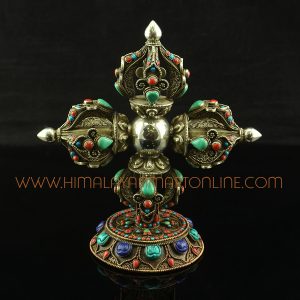
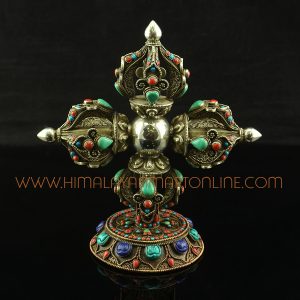
The Bishwa Bajra is created by two Bajra crossed together or four Bajra heads that sits at the cardinal points of a central hub. Bajra is a Sanskrit word that means both thunderbolt and diamond. As a ritual object in Buddhism, the Bajra symbolizes the indestructibility of a diamond and the irresistible force of the thunderbolt. The crossed, double or universal Bajra is thus called the Bishwa Bajra and represents the absolute stability of the physical world. It is also a powerful protective symbol that can not be destroyed but itself destroys all evil. It is associated with Amoghasiddhi, one of the five Dhyani Buddhas whom mudra is Granting Protection or Fearlessness (hand raised with outward facing palm) and whose consort is the Green Tara.

The Bishwa Bajra
The Bishwa Bajra

With its dual meaning of stability and protection from evil, deception and temptation, it is utilized extensively in Buddhism in its two dimensional and three-dimensional forms. It is often found stamped or applied to the base plate of statues that have been consecrated, and to canisters and containers that hold precious relics, important documents or prayers. It can be worn as pendant to provide spiritual protection. In visualization practices associated with the teaching and learning of Buddhist principles, the Bishwa Bajra may be imagined by the practitioner to assist with stabilizing the mind, creating a receptive state in which ignorance is dispelled and wisdom is encouraged, thereby increasing spiritual power.

The Bishwa Bajra
The Bishwa Bajra Set

The Bishwa Bajra is usually depicted in the five-colour scheme of the Five Buddha mandala with blue at its central hub, white in the east, yellow in the south, red in the west, and green in the north. The five directional colours symbolize the elements and qualities expressed in the symbolism of the Five Buddhas. The four sets of prongs of the Bishwa Bajra symbolize the four activities of Karmas of pacifying, enriching, magnetizing, and destroying, representing the Buddha’s activities in the four directions. The The Bishwa Bajra, or the sword, is the attribute of the green Buddha of the north, Amoghasiddhi, and represents his all-accomplishing wisdom as Lord of the Karma Family of activity.


The Vishwa Vajra

The Vishwa Vajra

The Vishwa Vajra is created by two Vajra crossed together or four Vajra heads that sits at the cardinal points of a central hub. Vajra is a Sanskrit word that means both thunderbolt and diamond. As a ritual object in Buddhism, the Vajra symbolizes the indestructibility of a diamond and the irresistible force of the thunderbolt. The crossed, double or universal Vajra is thus called the Vishwa Vajra and represents the absolute stability of the physical world. It is also a powerful protective symbol that can not be destroyed but itself destroys all evil. It is associated with Amoghasiddhi, one of the five Dhyani Buddhas whom mudra is Granting Protection or Fearlessness (hand raised with outward facing palm) and whose consort is the Green Tara.

The Vishwa Vajra
Vishwa Vajra Silver Ghau Pendant

With its dual meaning of stability and protection from evil, deception and temptation, it is utilized extensively in Buddhism in its two dimensional and three-dimensional forms. It is often found stamped or applied to the base plate of statues that have been consecrated, and to canisters and containers that hold precious relics, important documents or prayers. It can be worn as pendant to provide spiritual protection. In visualization practices associated with the teaching and learning of Buddhist principles, the Vishwa Vajra may be imagined by the practitioner to assist with stabilizing the mind, creating a receptive state in which ignorance is dispelled and wisdom is encouraged, thereby increasing spiritual power.

The Vishwa Vajra
Silver Vishwa Vajra Set

The Vishwa Vajra is usually depicted in the five-colour scheme of the Five Buddha mandala with blue at its central hub, white in the east, yellow in the south, red in the west, and green in the north. The five directional colours symbolize the elements and qualities expressed in the symbolism of the Five Buddhas. The four sets of prongs of the Vishwa Vajra symbolize the four activities of Karmas of pacifying, enriching, magnetizing, and destroying, representing the Buddha’s activities in the four directions. The Vishwa Vajra, or the sword, is the attribute of the green Buddha of the north, Amoghasiddhi, and represents his all-accomplishing wisdom as Lord of the Karma Family of activity.


Kalash Ghau Pendant

Ghau / Pendant / Prayer Box

Kalash Ghau Pendant: Ghau is a small prayer box worn as pendant by Buddhists as portable shrines where prayers and sacred relics are kept and used during their travel to hold their sacred deity inside. Now, Ghau or Prayer Box pendants are often used as jewelry or personal adornment. They are used to carry prayers or prayer concerns or photos, poems, small items, or memories. Ghau pendants can carry your prayers near to your heart throughout the day. They are jewelry that has a history. The Ghau opens to a concealed inner space, and is traditionally used by Tibetan Buddhists to hold a picture of their favorite deity or Lama, a folded-up scroll of sacred mantras, special herbs or sacred relics. The Ghau is used as an amulet to help the wearer to ward off negative energy and attract blessings. A Ghau is also used as a portable shrine and are worn on a cord around the neck and hung close to the heart.

Kalash Ghau Pendant
Kalash Silver Ghau Pendant Prayer Box

These Ghaus are mostly made of silver like this Kalash Ghau Pendant; however, the artisans also use copper, brass, gold and other metals. Ghau often have intricate designs of deity, auspicious symbols and mantras inscribed on their outer and inner surface Ghau is often decorated by precious or semi-precious gemstones which have various healing effects on the wearer. Turquoise, considered by many as a master healing stone, Lapis Lazuli and Coral are especially popular in Ghau or Prayer Box design for their beauty and healing properties. Other gemstones used by the craftsman include: amber, carnelian, amethyst, malachite, onyx and topaz.


About this Kalash Ghau Pendant – Ritual item

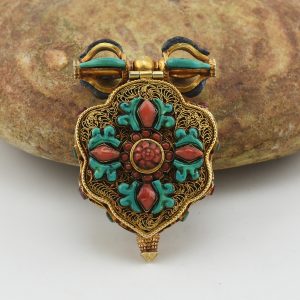
This excellent Kalash Ghau Pendant is entirely a hand carved piece; made from Silver which has fine intricate filigree hand carvings known as siko carvings in local term and the decoration of Coral and Turquoise stones; specially the Kalash design made from Coral and Turquoise Stones make this Kalash Ghau Pendant or Prayer Box a stunning piece of art which is entirely a hand craft. This beautiful Kalash Ghau Pendant is hand made by the master artisans of Patan, which lies in the Himalayan Kingdom of Nepal; who have been in the business from generations.


Cheppu Ghau / Pendant / Prayer Box

Ghau / Pendant / Prayer Box

Cheppu Ghau / Pendant / Prayer Box: Ghau is a small prayer box worn as pendant by Buddhists as portable shrines where prayers and sacred relics are kept and used during their travel to hold their sacred deity inside. Now, Ghau or Prayer Box pendants are often used as jewelry or personal adornment. They are used to carry prayers or prayer concerns or photos, poems, small items, or memories. Ghau pendants can carry your prayers near to your heart throughout the day. They are jewelry that has a history. The Ghau opens to a concealed inner space, and is traditionally used by Tibetan Buddhists to hold a picture of their favorite deity or Lama, a folded-up scroll of sacred mantras, special herbs or sacred relics. The Ghau is used as an amulet to help the wearer to ward off negative energy and attract blessings. A Ghau is also used as a portable shrine and are worn on a cord around the neck and hung close to the heart.

Cheppu Ghau / Pendant / Prayer Box
Cheppu Ghau Pendant Prayer Box

These Ghaus are mostly made of silver like Cheppu Ghau / Pendant / Prayer Box; however, the artisans also use copper, brass, gold and other metals. Ghau often have intricate designs of deity, auspicious symbols and mantras inscribed on their outer and inner surface Ghau is often decorated by precious or semi-precious gemstones which have various healing effects on the wearer. Turquoise, considered by many as a master healing stone, Lapis Lazuli and Coral are especially popular in Ghau or  Prayer Box design for their beauty and healing properties. Other gemstones used by the craftsman include: amber, carnelian, amethyst, malachite, onyx and topaz.

Cheppu Ghau / Pendant / Prayer Box
Cheppu & Manjushri Ghau Pendant Prayer Box

About this Cheppu Ghau / Pendant / Prayer Box – Ritual Item

This excellent Cheppu Ghau / Pendant / Prayer Box is entirely a hand carved piece; made from Silver which has fine intricate filigree hand carvings known as siko carvings in local term and is submitted to a gold plating effect to yield a rich and sensuous finish and besides the decoration of Coral, Turquoise, Conch Shell, Lapis, Ruby and Emerald stones make this Silver Ghau or Prayer Box a stunning piece of art which is entirely a hand craft. This beautiful Cheppu Ghau / Pendant / Prayer Box is hand made by the master artisans of Patan, which lies in the Himalayan Kingdom of Nepal; who have been in the business from generations.


Cheppu – The Mythical Creature

Cheppu – The Mythical Creature

Cheppu is one among the three brothers Garuda, Cheppu and Hiti Manga. It is told that once the mother of these brothers, requested her husband to give birth of such a son who would be the bravest, most truthful and entitled with all superior marks. Her husband told her to wait for a certain period. She being impatience to wait for a long period, looked the nest whether he was born or not. She found Cheppu in a prematured condition only with formation of head.

Cheppu Ghau Pendant Prayer Box

Cheppu is depicted in his wrathful appearance devouring showing only half of Cheppu’s body and devouring Naga(snake).


It is also told that Cheppu disappeared from the world as he did not want to see the kaliyuga, the great yuga, when the evil would completely triumphant over the good and the world would be destroyed by Vishnu in his incarnation as kalki, the destroyer. Knowing his bravery, truthfulness and entitled with all the superior marks Manjushree wanted to see him and requested him to show his full form. He appeared slowly amidst the cloud. Manjushree, as a veteran artist, immediately drew his form by his foot secretly without the knowledge of Cheppu. When Manjushree could finish to draw his head only he came to know Manjushree’s deception and immediately disappeared. Due to his bravery, truthfulness and all superior marks, he was given the place at the top of the main entrance of the shrines for the protection from all the dangers. Nagas(serpents) are the food of Cheppu.


Along the stories of Manjushree, comes an interesting and fascinating story attached to Cheppu – The Mythical Creature:

Long time ago, the Kathmandu Valley was only a huge lake inhabited by the countless number of aquatic animals. The majority of them were the Nagas (serpents). So, this valley was also known as Naga Daha, meaning the “Home of the Serpents’.


One day Manjushree Bodhisattva (a Buddhist god from China) came to visit this valley. He liked the valley. He liked the valley so much that he wanted to make a beautiful town out of it . With this intention he immediately cut through the southern hill of the valley with one stroke of this his legendary sword (Chandrahara) and drained off the water. This compelled all the inhabitants of the lake to leave, as they could not do anything against the almighty Manjushree. But a creature called Cheppu stayed put. When by his yogic power Manjushree sensed that there was someone still hidden somewhere under the remnant of the lake, he commanded the latter to leave the water instantly. He was terrified when he saw that he could not go against the power of Manjushree. So, he said he would leave the lake if Manjushree would promise not to look at his horrible feature when he moved out of the lake. According to the promise, Manjushree closed his eyes and Cheppu prepared to come out of the water. As the fear-stricken creature pushed half of his ugly body above the surface, Manjushree could not help but open eyes stealthily, out of curiosity. When Cheppu saw Manjushree open his eyes, he got so upset that he quickly dived back deep under the water to hide himself again. Manjushree, ashamed of breaking his promise, soon negotiated with Cheppu assuring him that he would never bother again to seen by anyone). He also promised that he would allow him to occupy a very significant place in the holy temples of Nepal (he was going to build up soon in the valley) and remain there half-hidden forever.


This story seems to explain a lot about our architectural tradition of showing only half of Cheppu’s body above the tympanums of the temple doorways. Whether this mythical story contains any grain of truth or not matters the least. What counts in the cultural value it reflects and the artistic fascination it leaves for one and all to understand and appreciate.


Subscribe To Our Newsletter