
The Bishwa Bajra
The Bishwa Bajra is created by two Bajra crossed together or four Bajra heads that sits at the cardinal points of a central hub. Bajra is a Sanskrit word that means both thunderbolt and diamond. As a ritual object in Buddhism, the Bajra symbolizes the indestructibility of a diamond and the irresistible force of the thunderbolt. The crossed, double or universal Bajra is thus called the Bishwa Bajra and represents the absolute stability of the physical world. It is also a powerful protective symbol that can not be destroyed but itself destroys all evil. It is associated with Amoghasiddhi, one of the five Dhyani Buddhas whom mudra is Granting Protection or Fearlessness (hand raised with outward facing palm) and whose consort is the Green Tara.

With its dual meaning of stability and protection from evil, deception and temptation, it is utilized extensively in Buddhism in its two dimensional and three-dimensional forms. It is often found stamped or applied to the base plate of statues that have been consecrated, and to canisters and containers that hold precious relics, important documents or prayers. It can be worn as pendant to provide spiritual protection. In visualization practices associated with the teaching and learning of Buddhist principles, the Bishwa Bajra may be imagined by the practitioner to assist with stabilizing the mind, creating a receptive state in which ignorance is dispelled and wisdom is encouraged, thereby increasing spiritual power.
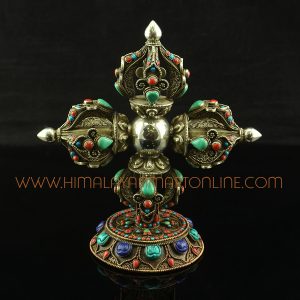
The Bishwa Bajra is usually depicted in the five-colour scheme of the Five Buddha mandala with blue at its central hub, white in the east, yellow in the south, red in the west, and green in the north. The five directional colours symbolize the elements and qualities expressed in the symbolism of the Five Buddhas. The four sets of prongs of the Bishwa Bajra symbolize the four activities of Karmas of pacifying, enriching, magnetizing, and destroying, representing the Buddha’s activities in the four directions. The The Bishwa Bajra, or the sword, is the attribute of the green Buddha of the north, Amoghasiddhi, and represents his all-accomplishing wisdom as Lord of the Karma Family of activity.
