
Endless Knot Symbol
In Buddhism, The Endless Knot (Sanskrit: Shrivatsa, Tibetan: Dpalbe’u) is a closed, graphic ornament composed of right-angled, intertwined lines. It overlaps without a beginning or an end, symbolizing the Buddha’s endless wisdom and compassion. Endless Knot Symbol indicates continuity as the underlying reality of existence.
Endless Knot Symbol is conjectured that it may have evolved from an ancient Naga (serpent) symbol with two stylized snakes. The latter image signifies the dramatic interplay and interaction of the opposing forces in the dualistic world of manifestation, leading to their union, and ultimately to harmony in the universe. This face is amply reflected in the symmetrical and regular form of the endless knot.
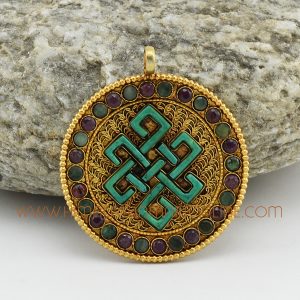
The intertwining of lines represents how all phenomena are conjoined and yoked together as a closed cycle of cause and effect. Thus, the whole composition is a pattern that is closed on in itself with no gapes, leading to a representational form of great simplicity and fully balanced harmony.
Since all phenomena are interrelated, the placing of the endless knot on a gift or greeting card is understood to establish an auspicious connection between the giver and the recipient. At the same time, the recipient is goaded to righteous karma, being reminded that future positive effects have their roots in the causes of the present.
This is because the knot represents a connection, a link with our fates, binding us to our karmic destiny. The Endless Knot Symbol is one of the eight auspicious symbols and is one of the most favorite symbols in Tibetan Buddhism, and often occurs on its own.
The auspicious drawing of Endless Knot symbolizes the mutual dependence of religious doctrine and secular affairs. Similarly, Endless Knot Symbol represents the union wisdom and method, the inseparability of emptiness and dependent arising at the time of path, and finally, at the time of enlightenment, the complete union of wisdom and great compassion.
