
Guru Rinpoche
Guru Rinpoche also Guru Rinpoche, the Precious Master — is revered throughout the Himalayan ranges as a Second Buddha. Invited from India in the eighth century to subjugate the forces inhibiting the spread of Shakyamuni’s teachings, Guru Rinpoche managed to transform hitherto hostile powers into guardians and protectors of the pure dharma and, in the process, left an indelible mark on the entire Himalayan region. In quite a literal sense, Guru Rinpoche’s mark is to be found throughout the Himalayan ranges in and around the many caves Guru Rinpoche used for meditation. At these sites one can still see handprints and footprints of the Precious Master impressed into solid rock, mute testimony to the extraordinary power this fully accomplished yogi and tantric magician exercised over the external and internal elements. Now, in the pure depth of the heavens, Vajrasattva, allowing the Metamorphic Body to be seen, seared upon an elephant, holding a golden vajra to his heart with his right hand, and with his left hand holding a silver bell at his side, crowned with the ornaments of the Five Transcendent Buddhas, his body covered with all the perfect ornaments, decorated with bones at the shoulders, at the wrists, and at the ankles, brilliant with the white glitter of crystal. Perfectly learned in the Mahayoga, Vajrasattva reveals as a dwelling the celestial palace of the three Baskets, reveals as gods and goddesses the whole internal essence, reveals as Mantra the entire murmur of the words, reveals as enchantments everything which is of body, speech, and mind. And Guru Rinpoche sets forth the Tantras of the Mahayoga, which are, according to the whole classification, five hundred thousand, and the whole of which forms the eighteen root Tantras.
Gestures and Attributes
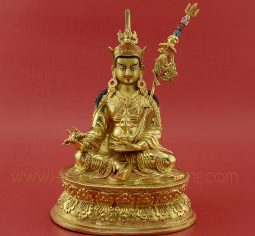
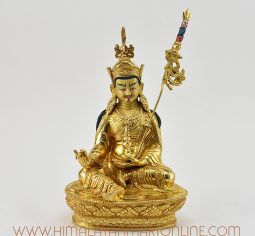
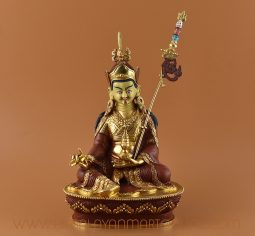
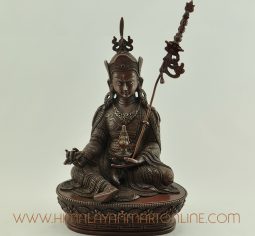
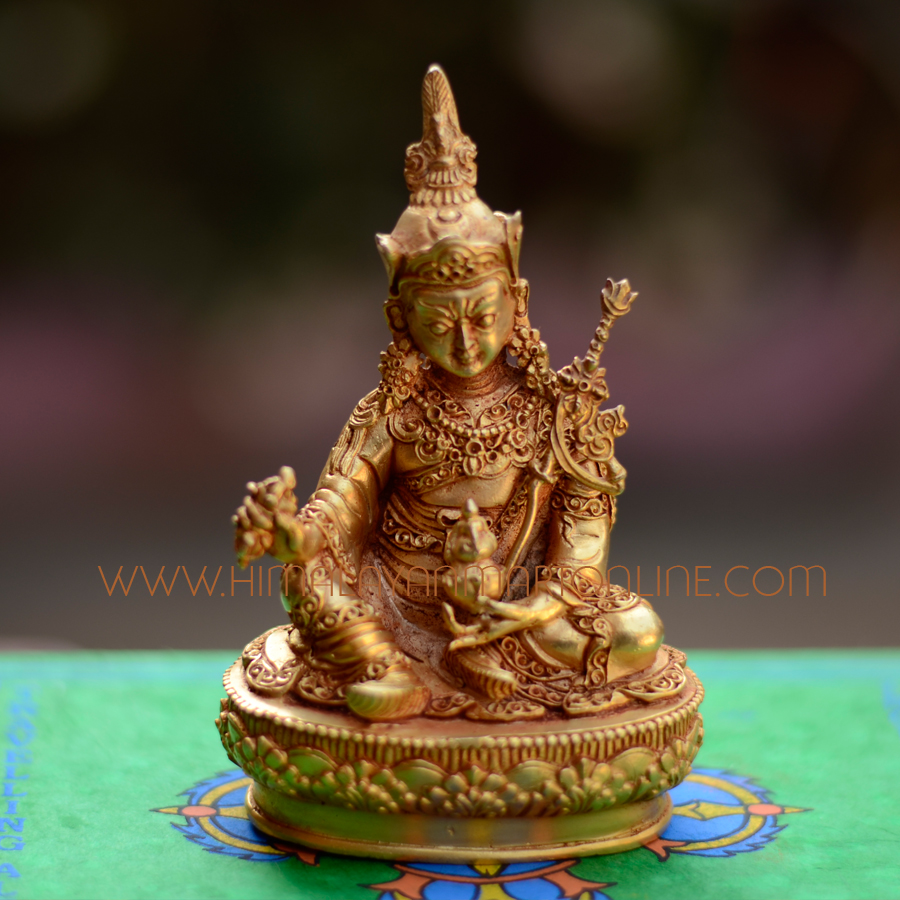
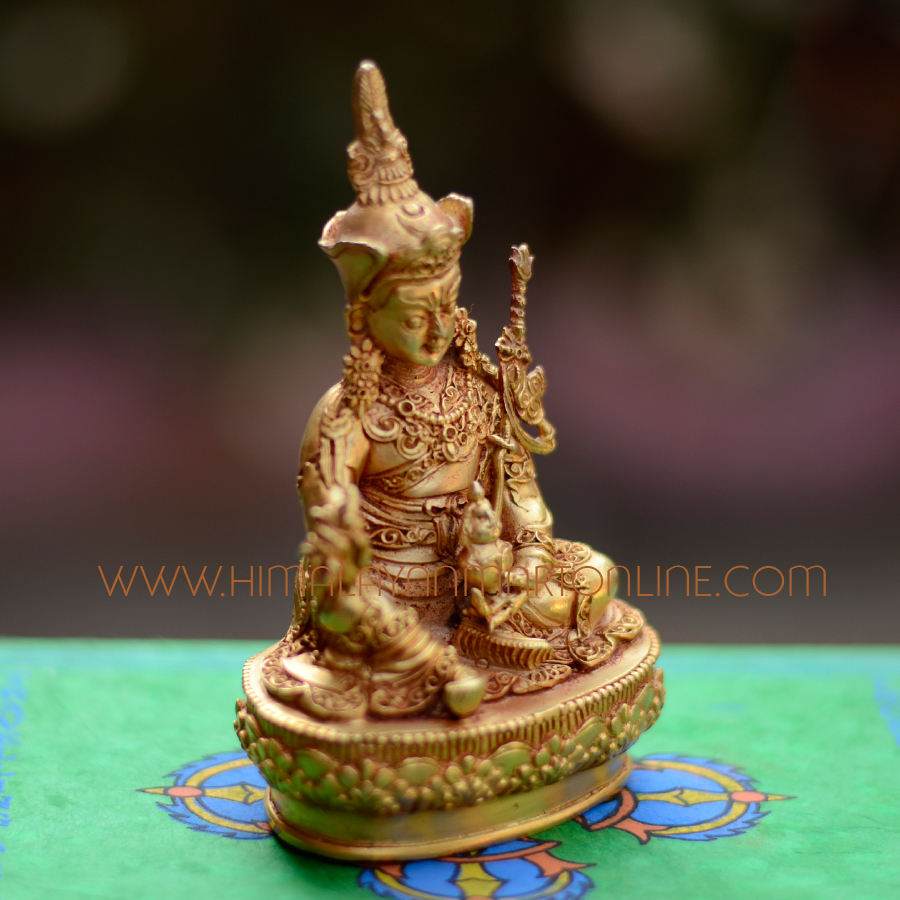
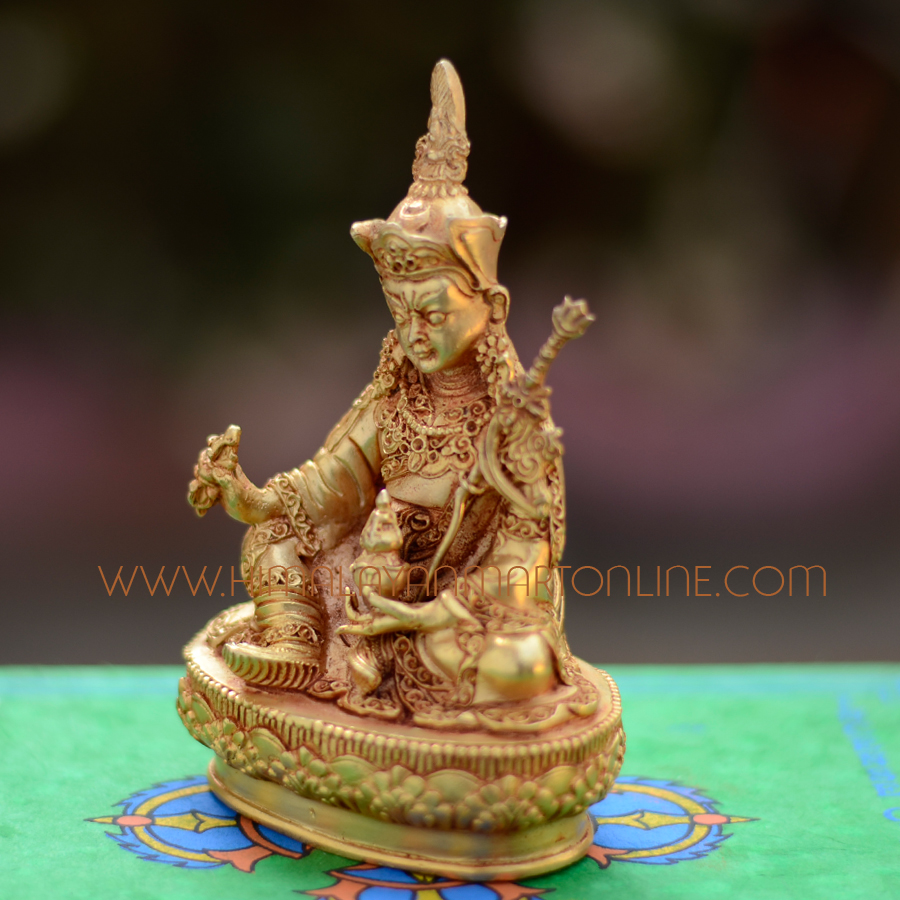
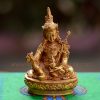
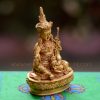
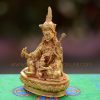
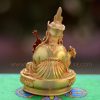
Here, Guru Padmasambhava can be seen in his most well known representation. His eyes are open in a piercing gaze; his face is wrathful and smiling, blazing magnificently with mysterious power. He cradles a khatvanga in his left arm, representing his consort Mandarava, who arouses realization of emptiness. His khatvanga is crowned with three severed heads and a trident, symbolizing Guru Padmasambhava’s liberation from the three kayas of desire, form and formlessness.
He wears a lotus hat ornamented with a sun and moon, representing skillful means and wisdom. His hat also has a vajra top, symbolizing his unshakable samadhi, and is crowned with a vulture feather, representing his realization of the highest view. In his right hand he holds a vajra, an implement used in Tantric ritual to symbolize the union of conventional and ultimate truth. His left hand rests in his lap in the gesture of meditation (Dhyana Mudra) and holds a skull cup containing the vase of immortality. The vase is filled with the nectar of deathless wisdom and is adorned with leaves of a sacred flowering tree. The vase further serves as a reminder of Guru Padmasambhava’s connection to Buddha Amitabha, as it is the special emblem of Amitayus (an aspect of Amitabha).
About this Sculpture
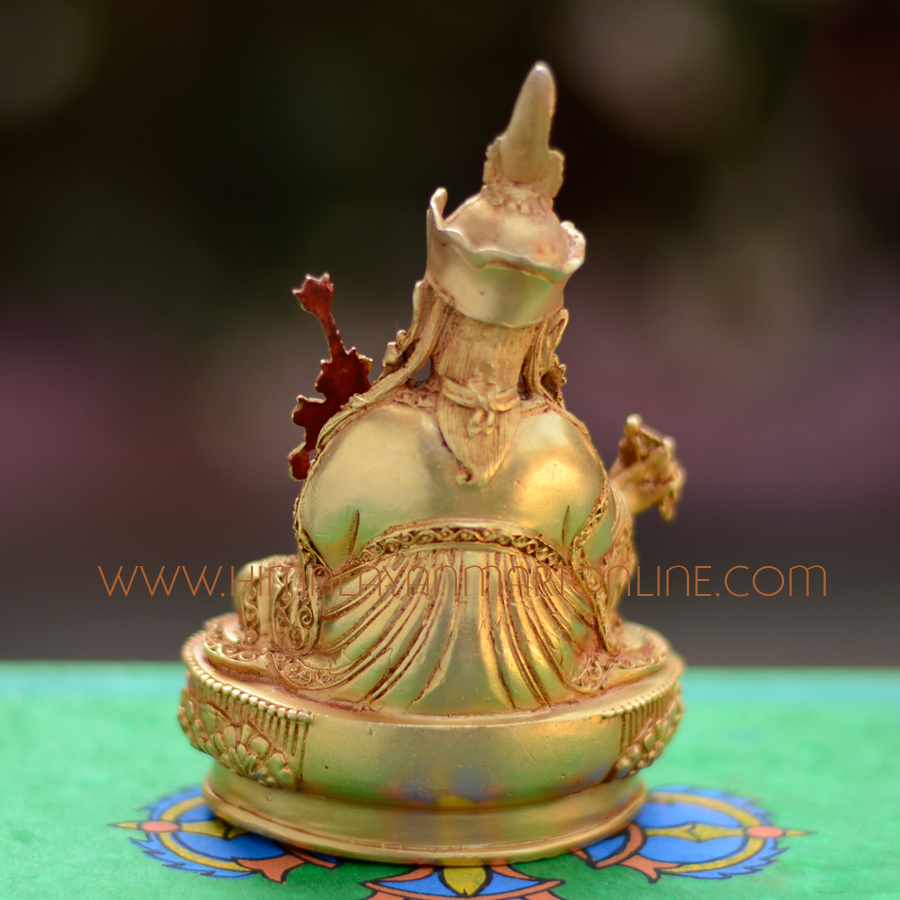
This statue is a beautiful representation of the beloved Guru Rinpoche. In this 4.5” Guru Rinpoche Sculpture, Guru Rinpoche embodies the ultimate attainment of the Vajrayana and the power, both temporal and spiritual, associated with this peerless attainment.
This Statue is machine made from copper-alloy and then electroplated with 24kt gold is made.