
Sarangi is a Nepali folk musical instrument. It is a chordophone played by bowing. Traditionally in Nepal, the Sarangi was only played by people of Gandarbha or Gaine in local terms (both contested and interchangeable terms), who sing narrative tales and folk song, however; in present days, its popularity extends beyond the Gandarbha community and is widely used and played by other cast members as well. It has also garnered much interest in other music genres, such as Nepali rock and film music. While the Sarangi has become the quintessential Gandarbha instrument, while its counterpart, the arbajo, which is a plucked lute, has fallen into obscurity.
Construction
Traditional Nepali Sarangi is not standardized with regards to shape, construction materials, or scale or key. It is made up of a single piece of wood. Having a neck and hollowed-out double-chambered body, they are often made from woods of trees that are easily available, most often that of Khirra, Saaj, Lakuri, or aap. While the upper chamber is left open, the lower opening, upon which the bridge rests, is generally covered up with dried skin of sheep or goat. The neck is fretless, and the strings are tied upon and tuned with the tuning pegs. The size of Sarangi differs according to the players’ preference.
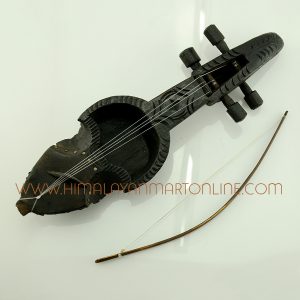
The Sarangi Nepali folk instrument consists of four strings. The original strings were made up of sheep intestine, similar to the use of catgut (made from the intestines of cattle) in many musical traditions around the world. The Gandarbha received intestines of sheep sacrificed during major festivals like Dashain, which they left in a pot for some days. Once the entrails was fully rotten, it was pulled out, leaving behind the fine nerves of the intestine in the pot. These were then woven to make strings. However, these days, badminton strings, nylon and steel strings have generally replaced gut strings. The bow was traditionally strung with horse tail-hair, but in the modern days, nylon bowstrings are common.
Tuning of the Instrument
The range of the Sarangi covers almost two octaves, and it is tuned in 5ths. From right to left, the four strings of Sarangi are tuned to lower fifth, root, root and fifth notes of a particular key. The middle 2 strings are used as drone. The instrument is tuned either by ear at the performer’s discretion, or tuned to keys of western music. This is mostly done in a setting where a standardized key is required to facilitate performing with musical instruments of other cultures, or in a recording studio. For example; if the middle tow strings are tuned at G note, both the first and fourth strings are corresponded to D.
Performance Techniques
There are different methods of producing notes on the Sarangi. Most players play the Sarangi by pressing the strings slightly with their fingers of the left hand and bowing the strings with right hand. However, Bharat Nepali and his students rub their hand fingernails to rub against the strings to create sound.
Also, traditionally, the Gandarbhas used to bow the root note continuously along with the notes of the song. As Sarangi is usually the only instrument used in their songs, except some Nepali percussion like Madal, the continuous sound of the root note (or drone from the 2 middle strings) provides the ambiance. Since now days the Sarangi is also played along with other instruments, performers do not bow the drone string continuously.
Unlike the traditional way of playing the Sarangi in a single key, modern players have started to use modal techniques to play the Sarangi in different keys. Along with the folk tunes, the Sarangi players also experimenting the use of this instrument in modern and western genres these days.
