
Kartika – The Curved Knife or Chopper
Kartika is a ceremonial Buddhist ritual tool shaped like a crescent knife or chopper, topped with a Vajra that acts as a handle to the blade. The Vajra-topped curved knife or flaying knife is also known as the ‘knife of the dakinis’. It symbolizes the severance of all material and worldly bonds, while the Vajra represents the destruction of ignorance, thus clearing the path to enlightenment. While the Kartika is used in several Buddhist ceremonies, usually in combination with the Kapala(skull-cup), it is particularly important in the Tibetan practice of Chod, a ritual involving a form of self-sacrifice, whereby the practitioner visualizes their own body as the offering at a form of tantric feast. The Kartika is also famously used in the Tibetan sky burial ritual, whereby the deceased are cut into small pieces and left for the vultures to consume on top of special gats or burial platforms. Interestingly, the Kartika is also utilized in the practice of Feng Shui.
The three main handheld attributes of the dakinis in general are the skull-cup (Kapala), the curved knife (Kartika) or the Damaru (Chod drum), and the Khatvanga. The skull-cup of blood which is held in the left hand of important dakinis, such as Vajrayogini, Vajravarahi, and Nairatma, symbolizes ‘method’ as the cultivation of great bliss; the curved knife held in the right hand symbolizes ‘wisdom’ as the severing of all conceptualizations; and the Khatvanga symbolizes the inseparable union of bliss and emptiness, as the consort (method) held in the dakini’s (wisdom) perpetual embrace (union), by the crook of her left arm.
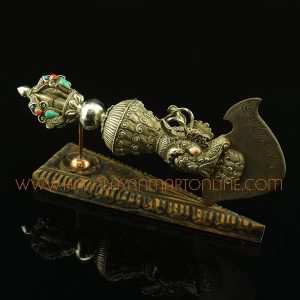
The curved flaying-knife (The Kartika) of the dakini – which is either held aloft or extended in her right hand, or held above the skull at the level of her heart – is modeled on the Indian flaying-knife or ‘the knife of the butchers’, used for skinning animal hides. The scythe-shaped blade is made from iron honed to a sharp edge, and the gibbous crescent of its blade- which terminates in a sharp point or curved hook combines the flaying implements of a cutting-knife and scraping blade, and the piercing activity of a dagger or pulling-hook. The blade’s crescent is used for cutting through flesh and scraping it clean, separating the outer and inner as ‘appearance and emptiness’. The sharp hook or point of the blade is used for-the more delicate acts of flaying: the initial incising of the carcass, the pulling out of veins and tendons, and cutting around the orifices of the skin. Iconographically the sharp blade is depicted in the dark blue colour of iron; its upper edges are embellished with a thin leaf-shaped golden mount that emanates from the wide-open mouth of a golden makara. A central hub or shafted handle rises above the makara’s head, which is crowned by a golden half-vajra.
The dakinis perform the activity of circling the curved knife (Kartika) towards the ten directions, which symbolizes their destruction of all negative forces, as the wisdom consciousness that terrifies all maras or emotional defilements and severs all conceptualizations. The blade’s sharp edge, which divides into two everything it cuts, symbolizes the cutting through of the two ‘veils’ or obscurations: the veil of emotional defilements, which arises as the obscuration to liberation; and the veil of ignorance or conventional knowledge which arises as the obscuration to the knowledge of emptiness. The veil of emotivity arises both as the gross delusions of the five poisons of ignorance, desire, hatred, pride, and jealousy, and as the more subtle psychological delusions which form karmic seeds for their future continuity. The veil of ignorance arises as the dualistic appearance of ‘self and other’, as the individual’s inner consciousness (self) and the outer phenomenal world (other). As the knife’s blade severs all tangible and abstract conceptualizations, it also cuts through the six hindrances to meditative contemplation: pride, lack of belief, lack of devotion, distraction, inattention and boredom.
